
That morning I found my mother’s letter where I had left the apartment keys with my own hands the evening before, and the very first sentence took my breath away.
“Son, do not be angry with us. We have returned home.”
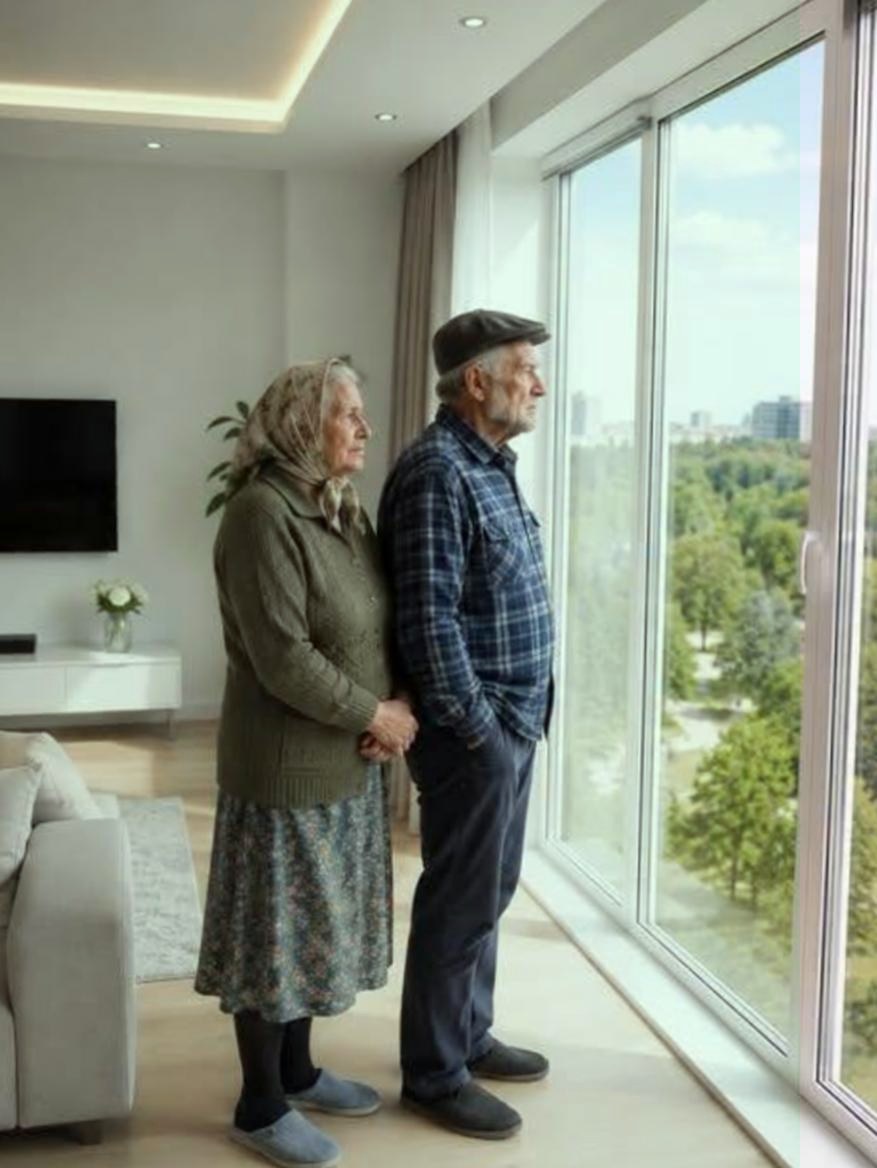
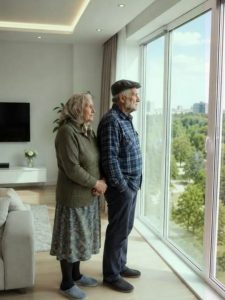
I stood in the hallway for a long time, holding the folded sheet of paper. The heated floor in the apartment was working quietly, while the green trees of the park could be seen from the window. Everything was exactly as I had promised my parents. Comfortable. Peaceful. Beautiful.
But there was no one there.
Mother’s knitted vest lay on the chair. Two cups stood on the kitchen table, and one of them still retained the smell of dried tea leaves. By the wall I found Father’s old wooden cane, whose silver handle had broken years ago. In his pocket I noticed an old pocket watch — beneath the cracked glass, its hand had stopped at four seventeen.
Father had inherited this watch from his grandfather. In childhood he told me that as long as it worked, the family also stood firmly.
And at that moment I thought for the first time that perhaps I had destroyed everything.
A month earlier I had arrived in the village in a new black car. The wheels slipped on the muddy road, the underside of the car struck the stones, but I was looking only toward my parents’ house. Father was digging the soil in the garden, while Mother was sorting onions under the old apple tree.
“Enough, Father,” I said and slammed the car door. “I bought an apartment in the city for you.”
Father placed his hands on his knees.
“For us?”
“Two bedrooms. First floor. Heated floors, a view of the park, a pharmacy and a clinic nearby. You will no longer have to carry firewood and bend your backs in the garden.”

Mother dried her hands on her apron.
“Our house?”
“It will remain. You will come in summer. But must you be buried in this land your whole life?”
Father lowered his head. That day I saw more fear than joy in his eyes, but I deceived myself and pretended not to notice.
After they moved to the city, I called every day. I taught them how to turn on the stove, how to make a video call, and where to take out the garbage. I gave Mother a new phone.
“You will take pictures of the park, Mother,” I told her with a laugh.
“The park will still be there, son?”
“It will.”
“Then why should I photograph it?”
I laughed. Now her voice came back to me and a heavy stone was placed in my heart.
That evening, when I found the letter, I looked at Father’s number on the phone. He did not answer. I called Mother too. Silence.
I ran to the lawyer Irakli. He took out the apartment documents, then looked at me strangely.
“Luka, you told me that you bought this apartment for your parents.”
“That is so.”
“Then why did they leave it?”
He carefully unfolded the letter. At the bottom was Mother’s handwriting, but there was only one sentence: “What you do not know separated us more than the city did.”
“What does this mean?” I asked.
Instead of answering, Irakli opened the desk drawer and took out a thin folder.
“Your partner Nika sent this to me yesterday. He told me to show it to you urgently.”
The address of our village house was written on the folder.

My hand reached toward it by itself, but Irakli gripped me by the wrist.
“Think first, Luka. When you open this, you may learn the reason your parents fled…”
Irakli’s fingers were on my wrist, but I still freed myself and opened the folder.
On the very first page lay a preliminary sale agreement for our village house and land. Nika’s company was listed as the buyer. My signature could be seen below.
The sheet fell from my hand.
“This is impossible,” I whispered.
“The signature is yours.”
“I was signing only loan documents. Nika told me this was collateral, not a sale.”
Irakli leaned back in the armchair.
“It says here that the registration must be completed tomorrow morning.”
The ticking of the wall clock could be heard in the room. It was four seventeen. The same time at which Father’s watch had stopped.
“Did my parents see this?” I asked.
“Probably. Otherwise their letter would make no sense.”
I arrived in the village that same evening. I found the yard dark. The gate was open, and the chickens were making noise in the coop. No one was visible in the house, but the ash in the kitchen stove was still warm.
Most of the clothes remained in Mother’s wardrobe. Father’s boots were also in their place. They had taken only a little food, an icon, and a framed photograph of me from childhood.
A small pocket watch lay on the table.

Father never forgot it.
Beside it I found a second letter.
“Luka, if you have come this far, listen to your father before you believe Nika.”
Below it lay a small old radio recorder. In childhood Father used it to record village stories. I pressed the button with my finger.
First there was a rustling sound. Then Mother’s frightened voice.
“Tell him that this land is no longer for sale.”
Father answered:
“I told him, but he says that Luka signed.”
“Luka did not know.”
“Perhaps he knew and did not tell us?”
These words struck me in the chest.
Then Nika’s voice sounded. Calm, confident, like the one he had in my office.
“If we move the old people to the city, no one will stand in our way. Selling the house will save Luka’s business. Then he himself will thank us.”
Mother exhaled loudly.
“You are deceiving our son.”
“Your son is interested only in the result, Mrs. Elene. He has never understood the value of the village house.”
The recorder fell silent.
I sat down on the chair and covered my face with my hands. I believed that I was creating a better life for my parents, but not once had I asked whether they wanted the life I had imagined.
That night I went to the neighbor Tamar. She opened the door only halfway.
“Your parents left in the morning,” she told me.

“Where?”
“To the old mill. Your father said that a bus leaves from there.”
“Why did you not call me?”
Tamar narrowed her eyes.
“You should have asked yourself, son. Money sometimes removes a person’s ears so completely that he can no longer hear even his own mother’s voice.”
I went to the mill. At the empty stop I found Mother’s small cloth bag. Inside there was only a boiled egg and a photograph from my childhood.
The phone rang. It was Nika.
“Luka, where are you?” he asked me.
“At your deal.”
He was silent for several seconds.
“Do not complicate things. Tomorrow’s signature is only a technical procedure.”
“The sale of my parents’ house is a technical procedure?”
“With your signature, it has already been sold.”
At that moment the headlights of a bus appeared at the end of the road. Irakli stopped behind me, holding a new document.
“Luka, I found another document in your name,” he told me. “But when you read this, Nika will no longer be able to say that everything happened of your own will…”
Irakli spread the document across the car hood. The wind fluttered the pages, and I held them with both hands.
It was a power of attorney that I had never given Nika. The signature was mine, but the date was the day when I had been lying in the hospital after a serious operation.
“I did not sign this,” I said.
“I know,” Irakli replied. “I also have the doctor’s record. That day you were barely coming out of anesthesia.”

We found Mother and Father behind the old mill, in a small shed. A thin shawl was wrapped around Mother’s shoulders, while Father sat on a wooden box and turned the cracked watch in his hands.
When Mother saw me, she lowered her eyes.
“We did not run away from you, Luka.”
“I know, Mother. You ran away from my lie.”
Father slowly stood up.
“You did not deceive us. You yourself were deceived.”
“But I gave your house to them.”
“You lost not our house, but our voice,” Mother told me. “Before taking us to the city, you did not ask even once whether we wanted to leave.”
I could not utter a word.
Irakli placed the recorder on the table, and Nika’s voice sounded again. This time we listened to the last part of the recording.
“Luka only needs to think that he is helping his parents. The city apartment is bait for him. As soon as the village house passes into our hands, the bank will no longer be able to take anything from us.”
Mother’s face turned white. Father struck the table with his hand.
“Bastard!”
I closed my eyes. To Nika, our house had been only part of a deal, and my parents an obstacle.
“Why did you not tell me immediately?” I asked.
“Because you were happy,” Mother said. “When you came for the first time, your eyes were shining. We did not dare take that joy away from you at once.”
Irakli raised the document.
“Now the choice is simple. This power of attorney is forged, the recording exists, and we have the doctor’s certificate. Tomorrow morning we will stop the registration.”

The phone rang again.
This time it was an unknown number.
“Mr. Luka?” asked a woman’s stern voice. “I am calling from the bank’s security department. A request to seize your company has been submitted. Nika presented documents according to which you had to cover the entire debt.”
Father looked toward me.
“He will put everything on you.”
“I know.”
The woman continued:
“But we also received an audio recording and medical documents. Please appear in the morning together with a lawyer.”
The call ended.
I looked at Mother.
“Shall we return home?”
She looked at me for a long time, then nodded.
“Only if this time you do not decide where we should live.”
That night we slept in the village house. In the morning, before the sun rose, a black car stopped in the yard. Nika got out, followed by two unfamiliar men.
He had a new folder in his hand.
“Luka, before you call the police, know that your parents still do not own this house,” he said and opened the folder. “I have a document that will change everything…”
ნიკამ ბოლო საბუთი გახსნა და პირველად გაჩუმდა…
მე მეგონა, რომ ყველაზე მძიმე უკვე გავიგე. მაგრამ ნამდვილმა ფინალმა დამანახა, ვის ვკარგავდი სინამდვილეში.
„სოფლის სახლი უბრალოდ ძველი სახლია.“
ოთახში პირველად შემრცხვა საკუთარი თავის.
👇 ისტორიის ფინალი უკვე გახსნილია
Related posts:
 I took my mother from the house, but when my brother opened her room with a duplicate key, the color drained from his face
 Before our fifth anniversary, I overheard my husband’s secret conversation and his laughter suddenly stopped
 Part 4 — I Bought My Parents a New Apartment in the City, but While Reading Their Letter the Lawyer Suddenly Could Not Hide His Pallor
 I was bathing Dante’s mother at home when Luka’s unexpected question silenced the entire room
 For three years he told me that he would never walk again, but when his laughter returned home, it froze my husband in place
 My Former Billionaire Husband Left Me Because of the Children, but He Saw the Twins in a Restaurant and Lost the Color in His Face





