
Two men stood behind Nika, but this time his voice was no longer so calm.
I stood at the door. Mother stood to my left, while Father turned the cracked watch in his hands.
“I do not advise you to come inside,” I told Nika.
“This is my business.”
“No. This is my family’s business.”
He raised the folder.
“It says here that you yourself gave me the right to sell the land.”
Irakli stepped forward.
“And here it says that this document was drawn up on the day Luka was in the hospital.”
The color changed in Nika’s face.
“The doctor’s certificate proves nothing.”
“The audio recording proves it,” I said.
“The recording may have been edited.”
Irakli turned on the phone. The village yard suddenly filled with Nika’s own voice.
“If we move the old people to the city, no one will stand in our way.”
Nika shook his head.
“That is taken out of context.”
“Which context do you want?” I asked. “Shall we also play the part where you say that my parents are bait?”
For the first time he said nothing.
The police came in ten minutes. Nika tried to call the bank, then his lawyer, then the two men, but every conversation ended the same way.
“We are not getting involved in this matter.”
“This is your contract.”
“Now it is already a criminal case.”
Nika stood in the middle of the yard and seemed to understand for the first time that the people who had stood beside him for years no longer wanted to save him.
I was not as angry with him as I had thought I would be. Anger was replaced by exhaustion. I realized that all this time I had taken his decisions for my own wishes.

We went to the bank that same day. The senior lawyer placed the documents on the table.
“Mr. Luka, we are ending our cooperation with your company,” he told me.
“You have the right to do that.”
“But we will not impose the personal debt on you. The papers presented by Nika are suspicious, and we will hand them over to the investigation.”
For the first time I breathed out.
“Thank you.”
“No thanks are necessary. Just do not sign what you will not read.”
In the evening I went to Nika’s office. With police permission, I had to take the recordings that remained there. His room had always been large and noisy, but now only the hum of the air conditioner could be heard.
A photograph of me lay on the desk — the two of us, in childhood, at the village gate. Nika often saw the photograph, but he had never asked who the people standing beside me were.
I found a recorded conversation on the computer. The complete recording of that same meeting.
I turned it on.
I heard my own voice.
“I will move my parents to the city. They will be better there. The village house is just an old house, after all.”
Then Nika’s voice:
“That is exactly how you should think. Emotions interfere in business.”
I listened to my words from the outside and could no longer recognize myself.
“The village house is just an old house.”
I remembered Father’s words: in the morning the smell of bread rose there, Mother walked there barefoot, and there I had fallen from a bicycle for the first time.
It had not been an old house.
It had been my family’s memory.

As I was leaving the office, Nika called me.
“Luka, we can still reach an agreement.”
“There is nothing left for us to agree on.”
“You will lose everything too.”
“Perhaps. But this time I will at least not lose what is mine.”
“Your parents will not appreciate this.”
“They have never demanded my appreciation.”
I ended the call.
That same week the sale deal was canceled. An investigation began against Nika for a forged power of attorney, document forgery, and attempted fraud. I did not get involved in the court details more than was necessary.
Nika’s lawyer asked to meet me.
“If you change your statement, the case may end lightly,” he told me.
“I told only the truth.”
“Nika says that you were his partner.”
“I was. That is why I know how he deceived me.”
“Do you look at him with hatred?”
“No. I simply no longer intend to answer in his place.”
Several days later I entered my parents’ city apartment. Everything was almost the same as I had found it, but now the silence met me differently.
In the bedroom, Mother’s wardrobe had been left half open. A pair of wool socks lay on its shelf. I found Mother’s new phone in the kitchen drawer. A picture of the park was saved on the screen.

She had taken a picture after all.
Probably because she wanted to show me that she was trying.
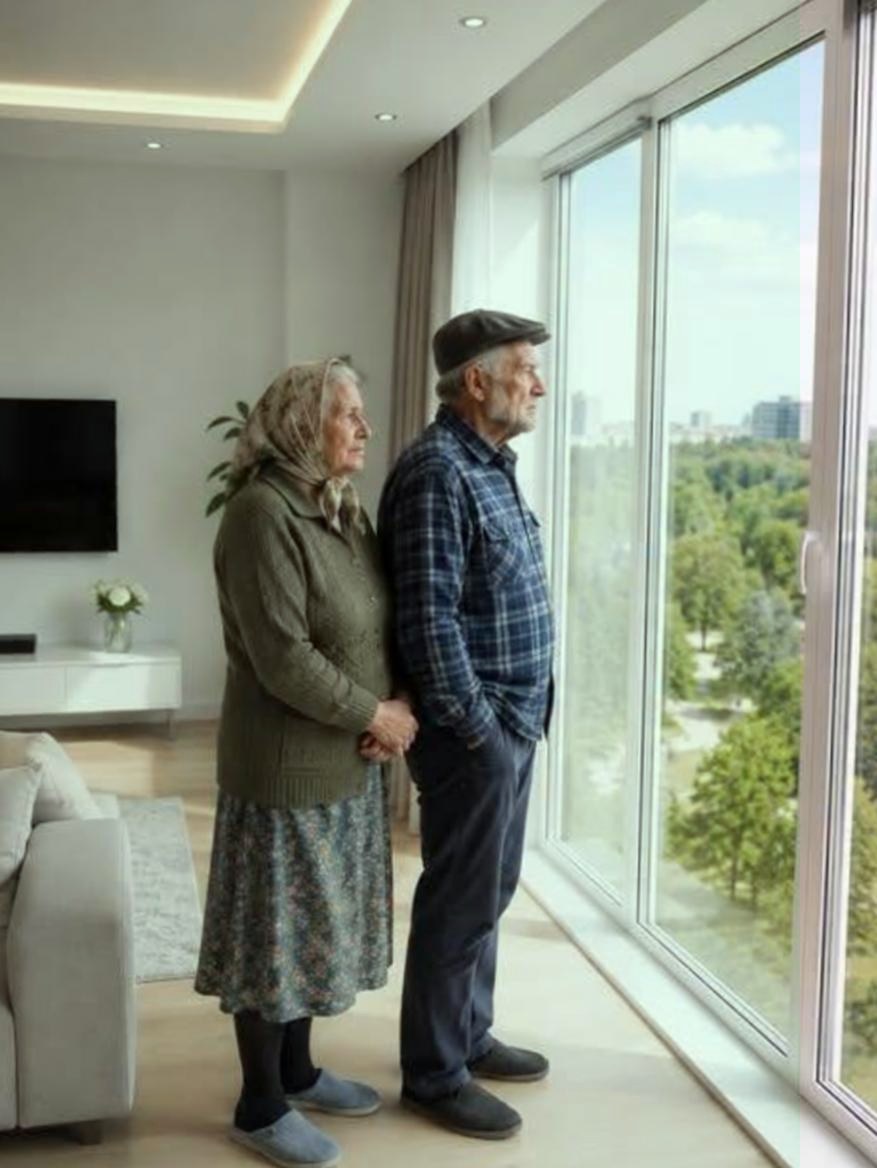
Father’s armchair stood by the window. A small scratch could be seen on its arm, which had appeared when it was moved from the village house. The floor was warm, but the room seemed cold to me.
I placed the cracked watch on the table.
Four seventeen.
That night I returned to the village and told my parents that they could leave the apartment whenever they wanted. If they wished, they could sell it. If not, they could stay there.
Father looked at me for a long time.
“What are you offering us now?”
“A choice.”
Mother wiped her eyes.
“That is the most valuable thing you have given us so far.”
Three weeks later the city apartment was rented out. I put the money into repairing the village house. Not luxuriously. Just a new roof, a handle in the bathroom, a safe stove in the kitchen, and a low bench in the yard so Father would not have to stand for a long time.
I had to sell part of the business. I sold the car too. I bought an old truck that no longer got stuck on the village roads.
At the first snow, Mother went out into the yard and left white tracks with her shoes.
“Snow fell differently in the city,” she said.
“How?”
“We watched it from the window. Here you hear it under your feet.”

Father stood by the fence and was arranging firewood. When I helped him, he waved his hand.
“I can still do it.”
“I know, Father.”
“But you can stand beside me.”
“That I can already do.”
Several months later I opened a small enterprise in the village. I employed local people and gradually learned that success was not only the number on an account. Sometimes success is also when Mother calls you from the kitchen, Father answers you from the yard, and you know that both of them are there.
One evening my little daughter, Nino, drew our house on paper. Four people stood beside the house, and a large sun was drawn above it.
“Why are there four of us?” I asked.
“You, me, Grandma, and Grandpa.”
“Where is the dog?”
“We do not have one yet.”
“The car?”
“We do not need that either.”
Mother attached the drawing to the refrigerator. She used as a magnet the small metal shovel that I had once found while working in my garden.
That evening I received a letter from Nika. It was not from prison. The trial had not yet ended, but he had sent it through his lawyer.
“Luka, we built many things together. You can come at least once. Let us explain everything.”
I read the letter several times.
Then I asked Mother:
“Should I send a reply?”


She put sugar in her tea and slowly turned the spoon.
“If you have something to say, tell him. If only guilt is pulling you, do not go.”
I wrote a short reply.
“I will not come anymore. Tell the truth in court and take responsibility for your own life yourself.”
I sent the letter by mail.
That same night Father gave me his cracked watch.
“Come, let us repair it.”
“I do not want to, Father.”
“Why?”
“Because I should remember the day when I first realized how many things I had failed to understand.”
Father placed the watch in my palm.
“Then keep it. But remember, when a watch stops, time still moves.”
Now that watch lies on my work desk. It is still stopped at four seventeen. I see it every day, and it no longer hurts.
Beyond the window our yard can be seen. Mother sits on a bench under the apple tree. Father slowly walks toward the barn. Nino leaves tracks in the snow.
And I place my hand on the watch and, for the first time in my life, no longer try to turn time back.
The house is still waiting for us.
Missed the beginning?
Related posts:
 I Bought My Parents a New Apartment in the City, but While Reading Their Letter the Lawyer Suddenly Could Not Hide His Pallor
 My Husband Threw Me, Eight Months Pregnant, into a Boiling Pot, but When I Looked at the Old Clock, His Mother’s Smile Froze
 I took my mother from the house, but when my brother opened her room with a duplicate key, the color drained from his face
 My Mother Spilled My Daughter’s Soup on the Floor and Threw Us Out of the House, But Dad’s Face Suddenly Changed
 After My Husband’s and Daughter’s Funeral, My Mother Asked Me for the Insurance Money, but the Bag on My Table Suddenly Erased Her Smile
 My Father Was Fed by a Poor Woman at Night, but When I Followed Her Trail, a Stranger’s Face Suddenly Turned Pale