
There was one hour left until eight in the morning at the old harbor.
Helena immediately told me not to go alone.
“It could be a trap.”
“I know.”
“Then why are you going?”
I stood by the window. Night still hung over the sky of Raleigh, and the wet asphalt of the street reflected the light of the headlights.
“Because someone knows what we do not know.”
Helena sighed.
“I will have a police officer accompany you.”
“Okay.”
This time accepting help no longer seemed like weakness.
At the old harbor, fog was rising from the river. Five minutes before eight, a gray-haired woman came out of a wooden warehouse. She was holding a small metal box in her hands.
“Chase Mercer?”
“Yes.”
“I am Elaine Foster. I worked at the same law firm as your father for eighteen years.”
“Did you send me the message?”
“Yes. And you should have had this from the day you turned twenty-one.”
She held out the box to me.
There were fine scratches on the lid, as if for years someone had forgotten to open it, but had not dared to throw it away.
Inside lay an old will, a land ownership certificate, and an envelope.
“Your grandfather, Arthur Mercer, left this house and the land around it in your name,” Elaine said. “But there was one condition in the will. The property was to be transferred to you on your thirtieth birthday.”
“Then why was it not transferred to me?”
Elaine lowered her eyes.
“Your father told me that you had refused. I did not believe him, but he showed me your signature on the document.”
She took a sheet of paper from the envelope.
The signature was false again.
This time, in the lower corner of the document, was the number of my childhood soccer card—a detail I had never used publicly. Silas could only have known it from old documents he had seen in the family drawer.

“Father hid the property in order to take out a loan for Silas,” I said.
“Worse,” Elaine replied. “Part of the land is now valued as an expensive shopping center site. Silas’s company was planning to sell it to investors. Your house was the guarantee for the deal.”
Everything became clear in one moment.
Their words that evening—“we do not need you anymore”—actually meant: we do not need your signature anymore while your property is still with us.
The police officer was standing by the car. Helena photographed the documents, then called my father, mother, and Silas.
“The deal is suspended,” she told them. “All your transfers and bank documents have been handed over to the investigative team.”
Silas began to shout.
“Chase planned all of this! He wants to destroy us!”
Helena replied calmly:
“You recorded yourselves planning to deceive him.”
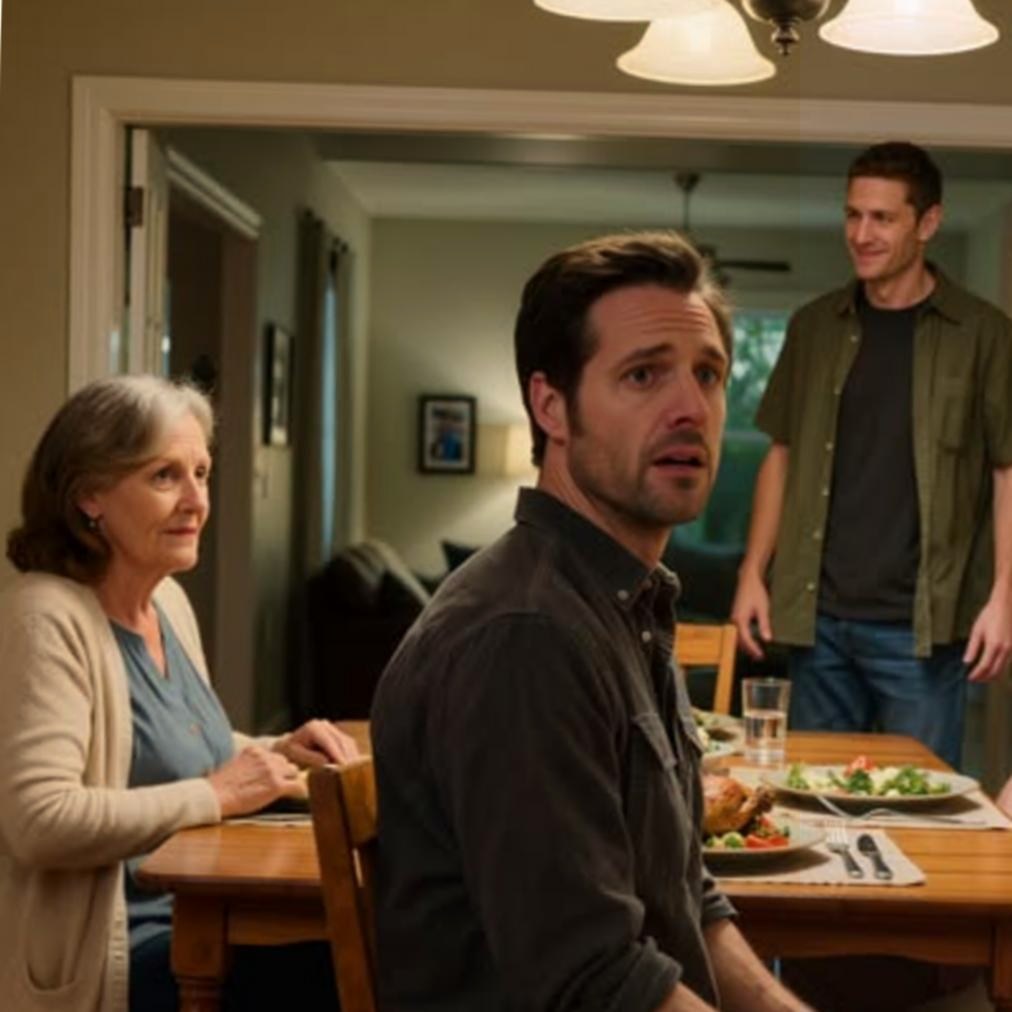
That same day we met at the family house. A laptop stood on the living-room table. My father sat in an armchair, my mother stood by the window, and Silas walked between the door and the hallway.
Helena played the audio recording.
My father’s voice sounded:
“Chase will not understand anything.”
Then Silas’s voice:
“As long as we get him to sign, everything will be mine afterward.”

Silas shook his head.
“It was not like that.”
“You said it yourself,” I replied.
“I was speaking because I was nervous.”
“When nervous, a person does not invent their own plan. They expose themselves.”
My father struck the table with his hand.
“You are my son!”
“And that is exactly why I believed you for so many years.”
My mother told me through tears:
“We did not want to hurt you.”
“Harm does not always begin with intention. Sometimes it begins with a person being certain that you will endure everything.”
The police did not arrest Silas at the scene. He and my father were ordered to appear in court, their bank account was frozen, and the transfer documents were declared invalid. My mother had not initially participated, but the investigation established that she had deceived the signature witness. A case was opened against her as well.
Helena asked me:
“Do you want us to file the maximum claim against them?”
I looked at the yard through the window. The same small copper bird still hung there, waiting for my finger during the heavy family conversations of my childhood.
“I want the truth to be recorded,” I told her. “Let us leave the rest to the law.”
Several weeks later, the lawyer hired by Silas refused to take the case.
“The client hid financial documents,” he said. “I can no longer represent him in such a case.”
Silas called me that same evening.
“Chase, everything can be fixed.”
“No, Silas.”
“Mother is sick. Father cannot bear it.”
“I am sorry.”
“You always helped us, didn’t you?”

The words were like an old door. A door I had automatically tried to open for years.
But this time I did not look for the key.
“Helping and deceiving yourself are not the same thing,” I told him. “Now you must answer for what you did.”
Three months later, the house in Cary officially passed into my name. I did not sell it.
I arranged a small home office in the room on the left. On the wall I hung a new calendar, on which there were no family tasks. In the morning I walked to work, and in the evening I stayed for soccer practice, even when I was tired.
On the first snowy morning, my niece, Lily, came into the yard. Her mother, Silas’s former wife, stood a little farther away and looked at the house awkwardly.
Lily handed me a sheet of paper.
“Uncle Chase, I drew this for you.”
There was a house on the paper, a large tree beside it, and a small man under the tree. The man was holding a key in his hand.
“This is you,” Lily told me. “Now you live in your house.”
Something caught in my throat.
“Yes, little one. I live here now.”
“Will Grandma and Grandpa come back?”
I looked at the snow through the window.
“Maybe they will see you someday. But this house must be safe now.”
Lily nodded, as if that answer was enough for her.

Several days later I found a letter from Silas in the mailbox. I recognized his handwriting on the dark blue envelope.
“Give me one more chance. I will explain everything.”
I held the letter in my hand for a long time.
Then I folded it and put it in the trash bin.
I felt neither anger nor victory.
Only peace.
I hung on the kitchen wall the small copper bird I had taken from my parents’ house. As a child, I tapped it with my finger when others made decisions about my life instead of me.
Now I no longer tapped the bird.
Snow was falling quietly by the window. No one in the house asked me to transfer money, sign, drive, or make one more sacrifice.
For the first time in my life, the silence truly belonged to me.
And the small copper bird no longer waited for me on the wall.
Missed the beginning?
Related posts:
 My family told me they no longer needed me, but after my calm reply, the wine glass slipped from Silas’s hand
 My Father Was Fed by a Poor Woman at Night, but When I Followed Her Trail, a Stranger’s Face Suddenly Turned Pale
 My daughter-in-law rented my mother’s lake house for a party, but after my calm response my husband stopped speaking
 In my eighth month of pregnancy, my husband locked me out of the hospital, but after a single phone call, the smile vanished from his mistress’s face.
 A Flat Tire Stopped Me at a Desert Diner, but When the Waitress Heard My Name, the Color Drained from Her Face
 She returned to my workshop after eighteen years and changed everything with one phrase — the woman standing at the door suddenly turned pale