
The captain told the one hundred forty-seven of us that we were dying, and I unfastened my seat belt and stood up.
“The airplane no longer responds to control. Prepare for impact,” Captain Thomas Reed’s trembling voice rang through the cabin.
It was Friday, midday. The sky above Las Vegas looked so clear, as if the world did not want to spoil anything for us. Flight 2891 had taken off forty-one minutes earlier and was flying toward Seattle. The children were sleeping, films were playing on the screens, and the flight attendants were collecting trash.
I was sitting in the fourteenth row, in seat fourteen C, and looking at the clouds through the window. On my knees lay a small, copper-colored badge — the emblem of an old air base that I had carried in my pocket for years. I was running my fingers along its serrated edge when the airplane suddenly tilted to the right.
At first nobody was frightened. They thought it was light turbulence.
Then the glasses fell onto the floor in the cabin.
“Mom, why are we tilting?” some little boy shouted.
“Everything will be all right,” his mother answered, but her own voice was trembling too.
Up front, in the cockpit, First Officer Jennifer Parker was staring at the instruments. I later learned that first the pressure in the hydraulic system had dropped. Losing one system was dangerous, but manageable. Then the second indicator also fell to zero.
The third did too.
The captain pulled the controls toward himself.
The airplane did not respond.

He tried to tilt left, then right. Nothing. The airplane was slowly but unstoppably descending toward the right side. Fifteen degrees became twenty. Thirty became thirty-seven.
Screaming broke out in the cabin.
“Lower me!” an old man shouted.
“Call my son!” someone was holding a phone against their face.
But inside myself I heard only one phrase: complete hydraulic failure.
I had already heard those words. Thirty-two years ago.
“Emergency, emergency, Flight 2891, all three systems have failed, the airplane is uncontrollable,” the captain was speaking on the radio.
Then he addressed us.
“Ladies and gentlemen, I am Captain Reed. I can no longer control the airplane. We are going to crash. Please prepare for impact and tell your loved ones that you love them.”
His last words fell especially heavily.
“Tell my wife that I love her,” he added on the radio.
At that moment I opened my eyes.
I was a fifty-eight-year-old woman, in worn jeans, work boots, and a simple black T-shirt. I had burn scars on my hands. No one would have thought that I had ever been able to save an airplane.
But thirty-two years earlier I had been known as Lieutenant Colonel Sarah Mitchell, the chief test pilot at Edwards Air Base.
My nickname was Phoenix.

In one hundred forty-seven test flights I had brought malfunctioning airplanes down to the ground. Once I had controlled a fighter using the thrust of its engines with zero hydraulics.
Then came the “Ghost” crash.
The engineers knew that its system was dangerous, but they did not want to lose a huge military contract. They did not tell me the whole truth. The airplane crashed, two people died, and I was blamed.
They took away my medals. They canceled my pension. They erased my career.
My daughter Emily did not speak to me for fifteen years.
Two months ago she sent me a wedding invitation. She had found the old test reports and finally understood that I had been telling the truth. I spent almost all my savings on the cheapest ticket.
The fourteenth row. Fourteen C.
Now the airplane was tilted forty-two degrees.
I unfastened my belt.
“Ma’am, sit down!” the flight attendant Linda Carter blocked my way forward.
“I am a test pilot,” I told her quietly. “I know how to control an airplane without hydraulics.”
“I cannot let you into the cockpit!”
“If you do not let me in now, getting there soon will no longer matter.”
Linda looked at my burned hands. Then through the airplane window she saw the horizon turn over.
Her face lost its color.
“If you are wrong, we will all die,” she whispered.
“If I am not wrong, we may survive.”
She gave way to me.

I reached the cockpit door. My fingers closed around the handle. From inside, the captain was shouting, while Jennifer kept repeating something.
I lowered the handle and opened the door.
The captain turned around. An old radio microphone was trembling in his hand. I took one step and said:
“Captain, take your hand off the controls. I know what we need to do…”
At first the captain thought I had lost my mind.
“Get out of the cockpit!” he shouted at me. “This is not a military airplane!”
“That is exactly why you must listen to me. The controls no longer work. We have to turn it using the power of the engines.”
Jennifer looked at my hands. She recognized the scars immediately, although she could not remember the name.
“Ma’am, who are you?”
“A person who has already gone through this.”
The airplane tilted even farther. The captain struck the console with his hand.
“If you know, then tell me what to do!”
“Reduce the left engine slightly. Increase the right one. Slowly. If you act sharply, we will lose the wing.”
He watched me for several seconds, then signaled to Jennifer. The levers moved.
The airplane stopped turning, but it was rapidly losing altitude.
“The airport will not make it in time,” Jennifer said, leaning toward the radio.
“Find a wide, straight surface,” I told her. “A highway, the surface of a lake, anything.”
The captain looked at the monitor.
“There is an old military airfield ahead. Abandoned.”
“Then that is where we are going.”

Suddenly a red warning lit up on the rear screen of the cockpit. Jennifer looked at it and her face changed.
“Sarah… this is not a malfunction.”
“What do you mean?”
She placed her finger on the screen.
“Someone has remotely activated the flight-assistance system. And now someone is trying to make us turn right again…”
The captain switched on the voice coming from the radio. An unfamiliar man said calmly:
“Tell Phoenix that this time she can no longer escape…”
Such silence fell in the cockpit that even amid the roar of the engines I heard my own heartbeat.
“He knows my nickname,” I said.
Captain Reed looked toward me.
“Who are you?”
Jennifer removed her hand from the screen.
“I have already seen this name in the old Air Force archives. Lieutenant Colonel Sarah Mitchell. Phoenix.”
“That woman died thirty-two years ago, together with her career,” the captain said.
“Not the woman. The career was killed. I survived.”
The voice came from the radio again.
“Sarah, you were always too proud. Do you still think you can save people?”
The captain switched off the radio.
“Do you know him?”
“No. But I know whom he serves.”

The old copper badge lay in my bag. On its back was a small scratch that only I knew about. Thirty-two years ago, a few minutes before the “Ghost” flight, engineer David Hales had placed this badge on the table and told me that the system was not safe.
I entered his words into the official record then.
Later that record disappeared.
“Captain, reduce the left engine,” I said. “Jennifer, find the cable of the auxiliary system. Do not switch off the main power, only the remote-control channel.”
“What if we are wrong?”
“Then at least we will decide how we fall.”
Jennifer opened the panel. The smell of burned plastic stood inside.
“There is an additional transmitter here,” she shouted. “This is not a factory part!”
Captain Reed barely kept the course.
“Sarah, seven minutes to the airfield.”
“Seven minutes is enough.”
Jennifer pulled out a small black device. An unknown number was flashing on the screen.
“There is a file here,” she said. “Directly in your name.”
“Open it.”
An old recording began on the screen. I heard David Hales’s voice, hoarse and frightened:
“If Sarah Mitchell ever hears this recording, let her know that the crash was not her fault. The system error was deliberately concealed. The order came from Colonel Richard Vale.”
Captain Reed opened his mouth.
“Richard Vale? He is now the chairman of the largest aviation company.”
In the recording Hales said one more thing: the remote-control device had not been destroyed then. It had been transferred into the systems of new airplanes.

Jennifer looked at the screen.
“This device is now trying to bring the airplane into military airspace. Missiles will destroy us there.”
Suddenly the cockpit telephone rang.
One word appeared on the screen: Emily.
My breath froze in my throat.
“Do not answer,” the captain said.
But the call moved to the second line. This time a woman’s voice sounded on the radio.
“Mom, I am at the airport. Vale’s people have occupied our wedding hall. They told me that if we do not let the airplane be destroyed, I and all the guests will die…”
მისი საკუთარი ხმა მთელ სალონში გაისმა…
მე მეგონა, ყველაზე რთული თვითმფრინავის დასმა იქნებოდა. მაგრამ ნამდვილი ბრძოლა მიწაზე დაიწყო. ამ ფინალში ყველაფერი სხვა მნიშვნელობას მიიღებს.
„პირველად დაინახა, რომ გაქცევა აღარ შეეძლო.“
მის სახეზე ღიმილი გაქრა.
👇 ისტორიის ფინალი უკვე გახსნილია
Related posts:
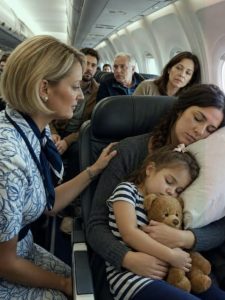 On the night flight, the captain asked for help, but when the woman from seat 8A stepped into the cockpit, his face suddenly turned pale
 Part 4 — The Pilot Announced That We Were Dying, but When I Went Toward the Cockpit, the Flight Attendant’s Face Suddenly Turned Pale
 At eight thousand meters, the commander asked for a combat pilot, and when I stood up, everyone on board fell silent
 Part 4 — On the night flight, the captain asked for help, but when the woman from seat 8A stepped into the cockpit, his face suddenly turned pale
 My Father Dropped My Military Medal into Mashed Potatoes, but the General Who Came to the House Suddenly Turned Pale
 A Flat Tire Stopped Me at a Desert Diner, but When the Waitress Heard My Name, the Color Drained from Her Face