
I rushed to the window, but Levan grabbed my hand.
“Do not go out there.”
The black car stood motionless below. Its windshield reflected no light. My father, meanwhile, was alone in the yard beside the car.
Levan took out his phone and called the security service.
“Lock all entrances. Notify the police too. Immediately.”
Evelyn leaned against the wall.
“Victor would not do this.”
“He has already done it,” I said.
“You know nothing.”
“Then tell me, why should my father die?”
Evelyn lowered her head.
“I no longer trusted him.”
“No,” I answered. “You only trusted his money.”
The sound of tires came from outside. The black car drove away and disappeared beyond the yard gate. A few minutes later my father rushed into the house. His face had a color as if he had spent the entire night underground.
“There was no one in the car,” he said. “But I found this on the driver’s seat.”
He showed me a small wooden box.
The same box that Elena had been holding in the camera recording.
My mother’s initials were carved into the lid of the box. When I was a child, I often opened it and kept my mother’s old letters inside. Years ago Elena had told me that the box was lost.
Now it was lying here again.
Inside were a memory card, several receipts, and a handwritten sheet of paper.

Levan read the paper.
“If you are seeing this, Victor already knows that I discovered the truth.”
My father clutched the back of a chair.
“Elena knew?”
“Everything,” Levan answered. “And apparently she saved a copy in advance.”
The police arrived ten minutes later. They put handcuffs on Evelyn. She first clung to my father.
“Robert, tell them that I did not know what Victor was doing.”
My father did not move.
“You knew that Nina had to be blamed.”
“I only wanted her to leave the house!”
“And you threw my sister down the stairs?”
Evelyn began to cry.
I no longer felt her pain. Nor did I feel victory. I felt only exhaustion that had sunk into my bones.
The next morning we went to the police station. On the table in the room lay my phone, photographs of the broken glass, and the card taken from the wooden box.
Victor came at noon. He was wearing an expensive suit and behaved as if everything were merely a legal misunderstanding.
“Nina, this can be resolved peacefully,” he told me.
“Did you order my murder?”
A muscle moved on his face.
“You should use such words carefully.”

Levan played the audio recording.
Victor’s own voice sounded:
“Now get rid of the girl too.”
Victor froze.
His lawyer cleared his throat.
“Mr. Morel, from this moment on, I no longer represent you.”
“What?”
“I did not know that you were involved in the matter.”
For the first time Victor lost the confidence with which he had deceived everyone for years.
“This recording means nothing.”
“The camera recording too?” I asked.
Levan placed the tablet in front of him.
On the screen, Evelyn’s hand could be seen pushing Elena down the stairs. Then Victor appeared. He went to the stairs, took the documents from Elena’s bag, and called someone on the phone.
Victor looked at the screen.
“This is impossible.”
“No,” I said. “The only impossible thing was that we would believe you for much longer.”
That same evening Elena was transferred from the clinic. Her leg was broken, and she had a serious shoulder injury, but her mind was clear. When I entered her room, a small pot of lavender stood by the window.

“I knew you would find me,” she told me.
“Why didn’t you tell me anything?”
“Victor controlled everyone. Your father too. I thought I would protect him first, and then reveal everything.”
“He almost made us lose each other.”
Elena squeezed my hand.
“But he did not manage to make us lose each other.”
The trial lasted for months. Evelyn confessed to the crime when the evidence was connected. Victor was charged with fraud, falsifying evidence, and organizing the attack. The case concerning Elena and my attack was also combined against Evelyn.
My father came to every hearing.
Once, during a recess, he heard his own voice. Levan played the recording from that night again.
“Enough, Nina.”
His old voice sounded in the room.
My father sat on a chair and listened to himself—the man who had not seen his bloodied daughter, but had immediately believed his wife’s tears.
“Did I say that?” he asked quietly.
“Yes,” I answered.
He lowered his head.
“At that moment I should have begun protecting you.”
“At that moment I wanted only one thing. For you to listen first.”
“Will you forgive me?”
I was silent for a long time.
“Forgiveness is possible, Dad. But trust does not return on the same day.”


When I returned home, my room was empty. I had taken everything from the closet, leaving only one thing behind: the dark green robe in whose inside pocket I had hidden my phone.
A small bloodstain was still visible near the sleeve.
I tried washing it several times, but it did not come out completely.
I hung the robe on a chair. For the first time it was no longer an object of fear. It was proof that I had saved myself that night.
Three months later I moved into a small apartment in a seaside city. In the mornings I worked in a café, and in the evenings I organized documents in an archive. My neighbor’s daughter, Salome, often came to me and drew with colored pencils.
One morning she left me a picture. On it was a small house with open windows. Two women stood by the door, and above them was the sun.
“Who are these?” I asked.
“You and Aunt Elena,” she answered. “No one frightens you here.”
That day I smiled for the first time without having to force myself.
I met my father once a week. He moved into a new house with Elena. He sold the old mansion. He said that too many lies had accumulated within those walls.

Victor sent me a letter once. He wrote that Evelyn had planned everything, while he had helped only for the money. At the end of the letter he asked me to soften my testimony in court.
I carried the paper to the window and put it in the trash bin.
I did not reply.
Several weeks later I received a message from Evelyn.
“You are still my family. Come see me.”
I stared at the screen for a long time.
Then I deleted it.
Not because I hated her.
Because saving her was no longer my responsibility.
On the first winter morning, snow came to the city. I attached Salome’s drawing to the refrigerator. Elena called me and said that she had begun walking without help. And for the first time my father asked where I wanted to go in the summer—not because he was planning my life, but because he was interested in my wish.
In the evening I took the old dark green robe out of the closet. I put my hand into the pocket. There was no phone there anymore, no bloody handkerchief, no trembling.
I found only the key to the small wooden box, which Elena had given me that day.
I stood by the window and looked at the snow.
My father texted me: “Are you home?”
I answered: “Now I am.”
I hung the robe on the chair.
This time fear was no longer in the pocket.
Missed the beginning?
Related posts:
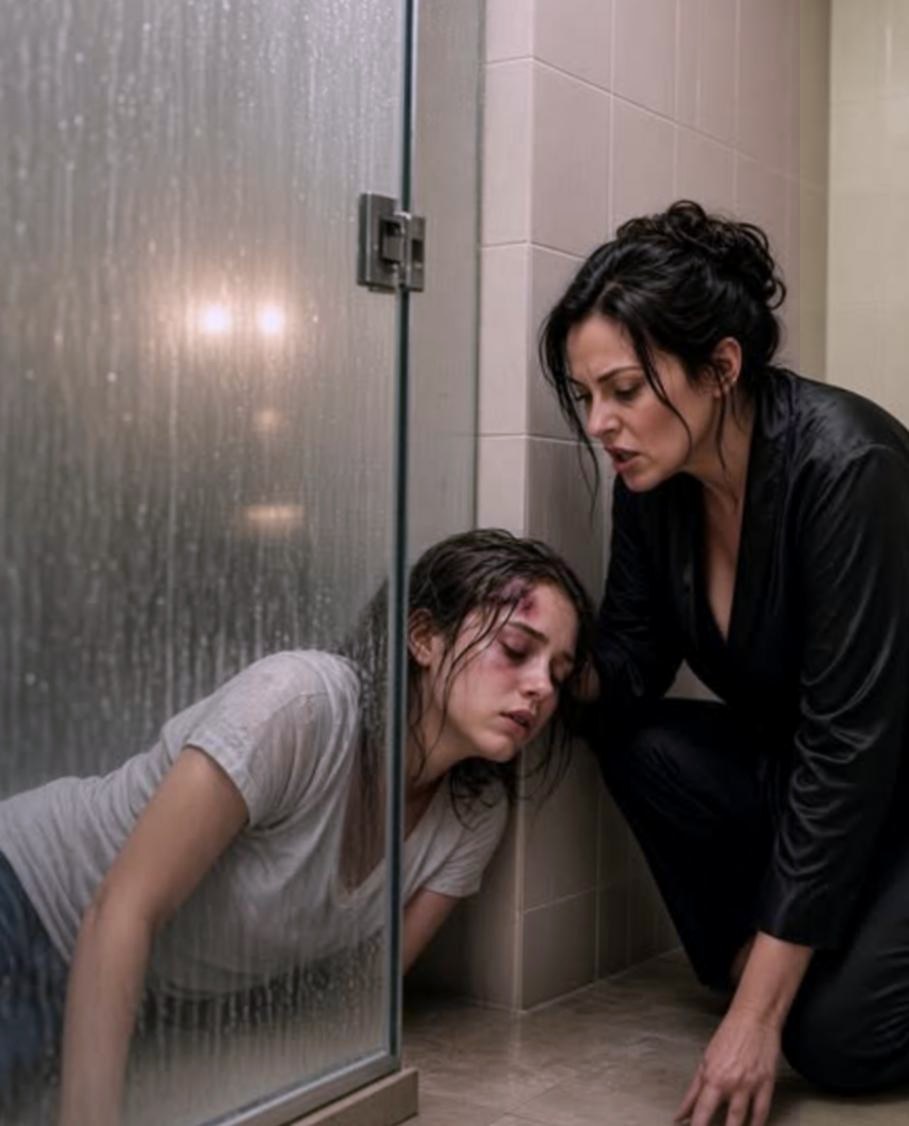
 My stepmother slammed me into the bathroom glass door, but when my father believed that I was to blame, fear suddenly appeared on her face
 They locked a pregnant woman in a wooden box, while her husband loudly began planning the funeral and one woman suddenly could not hide her paling
 The New Boss Made Me Hide My Daughter’s Existence at Work, but Her Face Suddenly Turned Pale During the Meeting with the School Principal
 My husband humiliated me in front of everyone on his birthday, but the moment I took the microphone, his smile disappeared
 My Father Was Fed by a Poor Woman at Night, but When I Followed Her Trail, a Stranger’s Face Suddenly Turned Pale
 My son wore a red dress to the graduation ceremony and laughter broke out in the hall until an unknown woman turned pale