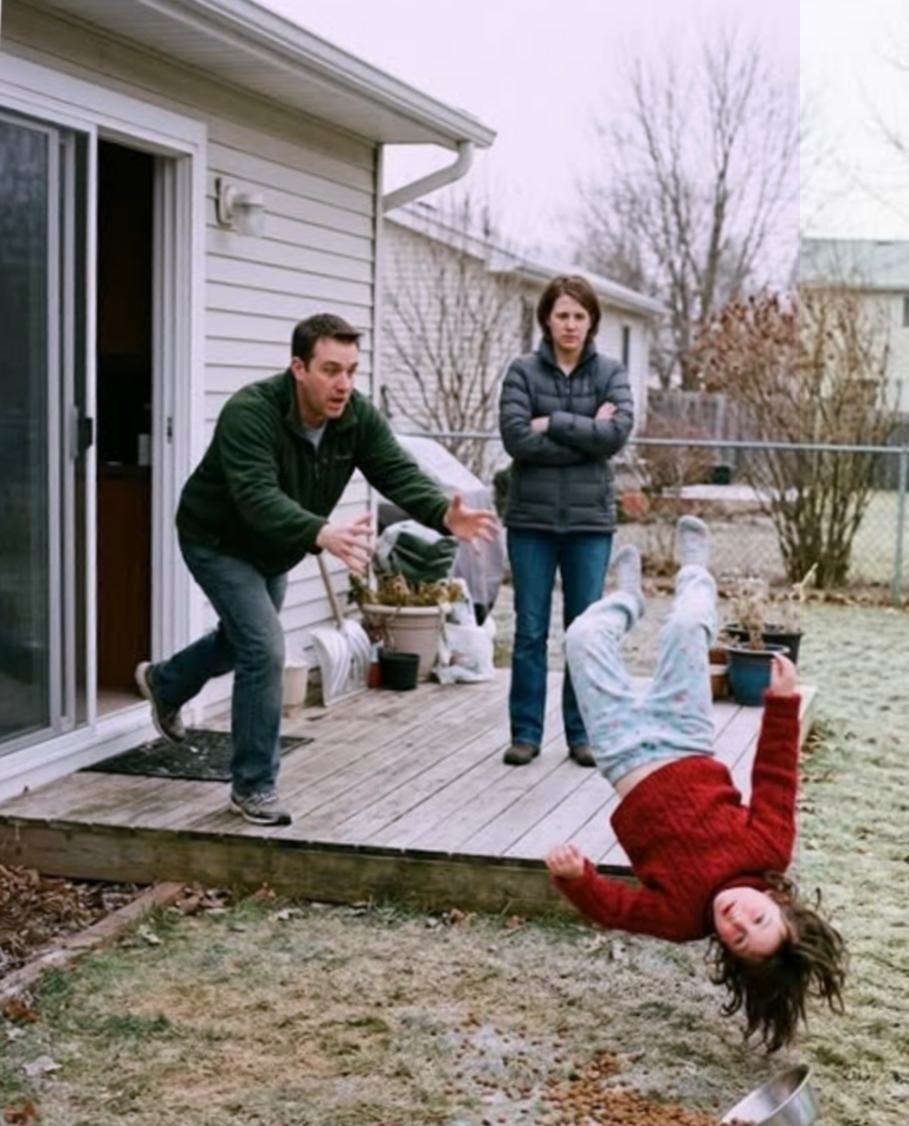

The window lock moved once again.
The officer immediately locked the door.
“Everyone step back.”
They pushed Elene’s bed against the wall. I stood in front of her, even though my knees were buckling.
The footsteps in the corridor stopped.
Nino whispered:
“It is Dato.”
“How do you know?”
“Because he always comes this way. First he does not knock on the door.”
The doctor on duty called security. In a few seconds noise came from outside, then someone struck the door hard with his hand.
“Nino! Bring the child out to me!”
Elene pulled the blanket over her head.
“Dad, do not let him take me away.”
“No one will take you away.”
The police officer shouted on the other side of the door:
“Police. Lie down on the floor and put your hands on the wall.”
Silence came in response.
Then the sound of escape.
Dato did not come in through the window. He tried to escape by the side staircase, but hospital security stopped him at the lower exit. I breathed out only when I heard the metallic sound of handcuffs in the corridor.

Nino sat on a chair and twisted her fingers as if her lies were hiding in each joint.
“Luka, it was not supposed to end like this,” she told me.
“How was it supposed to end?”
“You would get angry, leave the house, and I would keep Elene. Dato would take her for several weeks. Then everything would calm down.”
“And my child’s three broken ribs?”
She lowered her eyes.
“It was only punishment.”
At that very moment the officer asked me for my phone. The audio had been saved separately in the neighbor’s video. He played the recording.
Nino’s voice sounded through the room.
“If Luka returns, tell him that the child fell. If he does not believe it, tell him that he is imagining everything. Men always believe it when a woman cries.”
Nino froze.
It was the first time she heard her own voice from outside.
“Turn it off,” she said.
“It is your voice,” I answered.
“I was angry.”
“No. You made a decision.”
Something collapsed in her eyes. But I no longer felt victory. Only exhaustion and that strange pain that comes when you realize that you hardly knew at all the person with whom you had lived for years.

That night Nino was arrested for causing serious physical harm to a child and attempting abduction. Dato was arrested too. The court gave me temporary custody of Elene, while the social service investigation took evidence from every room of Nino’s apartment.
But the hardest moment came when I returned home to take away our things.
Elene’s room was empty. On the shelf lay only one drawing: four figures had been drawn, but the mother’s face had been erased. On the floor lay her coral-colored glove.
The little copper bell no longer jingled.
I picked it up in my hand and could not let it go for a long time.
Three weeks later Elene’s ribs were healing better. Every evening after the hospital we returned to the new apartment, where old trees could be seen from the kitchen window and the door lock closed only once.
On the first night Elene asked me:
“Mother cannot come in here?”
“No.”
“What if she says that she has changed?”
“Change is not proved with words.”
“Then with what?”
“With not hurting anyone anymore.”
She thought for a long time.
“You have changed too, Dad.”
Those words turned out to be more painful than any accusation.

“I know.”
“What would you have done before, when you were afraid?”
I went to the window. Light snow was beginning outside in the street.
“I would say that everything would be resolved.”
“What will you say now?”
“I will tell you the truth, even if it is dangerous.”
Months passed.
I changed jobs and began working in a small workshop located near home. In the mornings I took Elene to school, and in the evenings we prepared soup together. She still checked the plate several times before eating, but little by little her hands stopped trembling.
A new drawing appeared in her room. This time there were no longer four figures. She drew only two of us—me and herself. Above us she drew a large yellow sun.
One evening Nino’s lawyer called me.
“She wants to speak with you,” he told me. “She says she is beginning treatment and wants to apologize to Elene.”
I stood by the window. In my hand I held the little copper bell, which I had removed from the glove and was now keeping on the shelf.
“There will be no conversation with Elene,” I said.
“Perhaps you should listen at least once.”
“I listened for a very long time. I simply did not believe the right words.”
“She says that the family can still reunite.”
I closed my eyes.
“A family is where a child does not need protection from their own parent.”
The next day Nino’s letter arrived. It was short. She wrote that everything had become my fault because I came home late that evening. At the end she added: “Elene is still my child.”

I folded the letter and did not answer.
I had already given the answer.
On the first snowy morning of winter, before going to school, Elene put on the coral-colored glove. It was a new glove; from the old one I kept only the little copper bell. It now hung on her bag.
When the door opened, the bell rang lightly.
Elene looked at me.
“Dad, I will pour the soup this evening.”
“Are you sure?”
“If I spill it, we will clean the floor.”
We smiled.
It was an ordinary sentence, but for me my whole life changed.
We went out into the street. Snow was quietly falling on the roofs. I did not look back.
I heard only the sound of the bell.
This time it no longer sounded like fear.
Missed the beginning?
Related posts:
 My daughter-in-law emptied our yard in front of the guests, but her hands trembled when she heard one decision of mine
 My husband gave flowers to his former lover, and I left the hall — behind the cameras, his smile disappeared
 I Overheard My Husband’s Secret Conversation at the Airport, but When He Mentioned Losing My House, His Companion Suddenly Turned Pale
 Before our fifth anniversary, I overheard my husband’s secret conversation and his laughter suddenly stopped
 I Found My Feverish Son in the Yard After Returning Home, but When I Confronted My Wife, the Smile Disappeared from Her Face
 I was having lunch with my wife when the sheriff poured a cold cocktail over my head and suddenly stopped laughing when he saw my composure