
For several seconds after Maia’s words, no one moved.
The monitor continued ticking.
For the first time, my father looked not at me, but at the police officer.
“This is impossible,” he said.
The police officer took the phone from Maia and looked at the screen.
“The time of the transfer?”
“Three twenty-two at night,” Maia answered.
“Elene was in the hospital then,” I said.
“And you confirm this?” the police officer asked, looking at Andria.
My father fell silent.
His lawyer arrived ten minutes later. He was a small, bald man holding a leather bag. He read the documents, listened to a copy of the recording, and finally sat down beside my father.
“Your defense in this case is impossible,” he told him.
“You are my lawyer!”
“That is exactly why I am telling you. You are suspected not only of misappropriating the fund’s money, but also of destroying evidence and physical violence.”
Natela struck the table with her hand.
“She is our child! You cannot turn a family argument into a crime!”
Maia answered calmly:
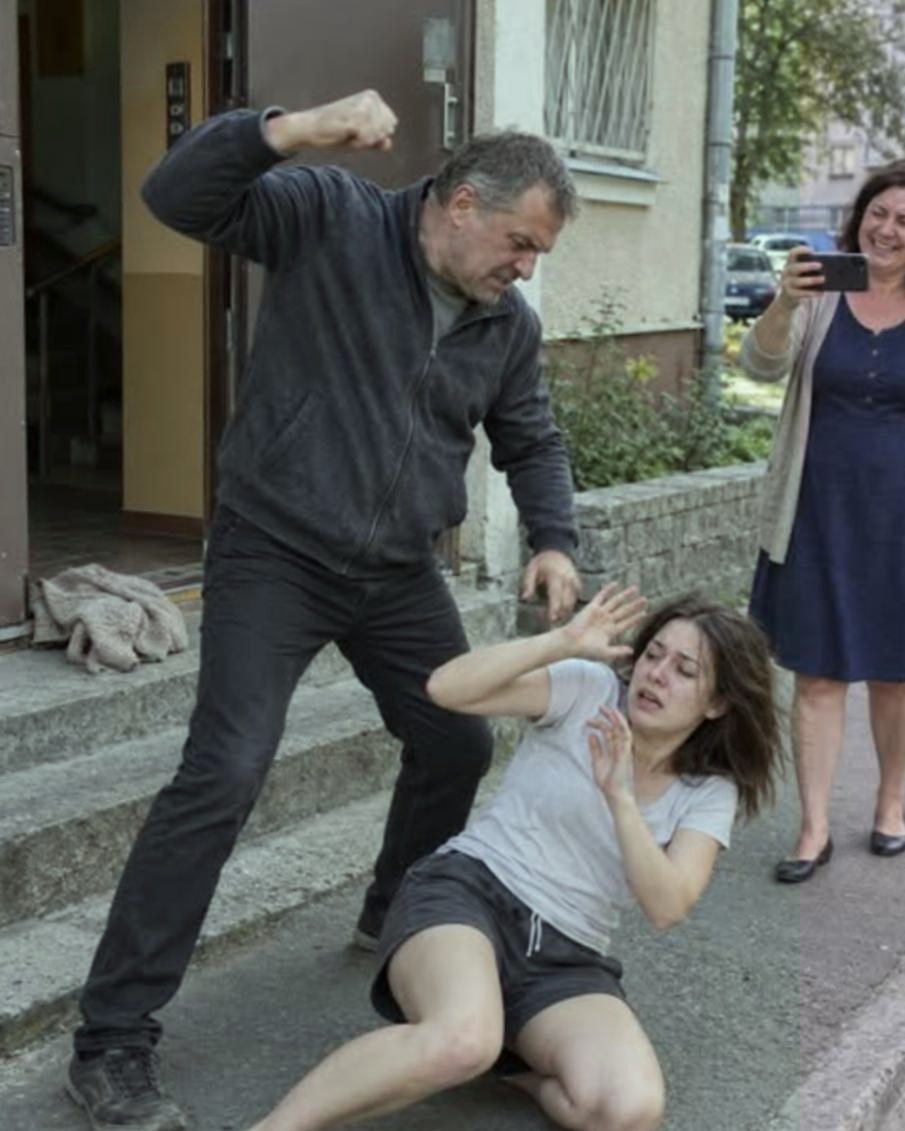
“A family argument is not kidnapping, beating a person, and leaving her in the street.”

My father came to my bed. I immediately recognized the strong smell of his cologne. Earlier, that smell had meant the childhood home to me. Now it made me nauseous.
“Elene, tell them that this was a mistake,” he told me.
“Which part?”
“Everything.”
“Your fists? Mother’s laughter? Forging my signature?”
He raised his hand, but this time the police officer stepped between us.
“Step back.”
That same morning both parents were taken to the station. They were still trying to maintain their own version. They said that I had provoked them, that the recording had been cut, and that the fund actually belonged to them.
But Maia had prepared everything in advance.
The medical report stated the nature of my injuries. Nikoloz confirmed that he had found me in the street. The supermarket cameras showed my father’s car stopping at the rear entrance at two forty-one at night. Another camera showed how they took me out of the car.
And a video was found on my mother’s phone.
It had not been completely deleted.
In the video I was lying on the floor, while my mother pointed the camera toward me.
“Smile, Elene,” Natela was saying. “Now let everyone see what you are like.”

The trial took place several months later. I entered the courtroom slowly, without a cane. It still hurt to breathe in the cold, but the steps were mine.
My father did not raise his head.
And Natela was asking with her eyes that I be her child again.
The judge finally confirmed that the fund’s money had been transferred illegally. The property was seized, and the parents were sentenced for violence and fraud. Part of the money was returned to me, but I could not perceive that money as a victory.
The real victory was that for the first time no one was asking me to carry their lie.
After the trial Maia asked me:
“Do you want to sell everything and leave here?”
“No,” I told her. “I want to decide myself where I will live.”
Three weeks later I rented a small apartment near the river. A tram line was visible from the window. In the morning, the smell of the neighbor woman’s coffee came in, and in the evenings the street lamps painted golden stripes on the floor.
I started a new job at a charitable foundation. There I helped people so that their documents would not disappear into someone else’s hands.
In the very first week a little girl asked me:
“Were you afraid too?”
“Yes,” I answered.
“Then how did you dare?”
“It is possible to move forward even together with fear.”
She sat down close to me and drew a house on a sheet of paper. The house had windows, and on the door there was a large lock.
“This is yours,” she told me.
“Why does it have a lock?”
“So bad people cannot come in.”

Several months later the first snow came. In the morning I opened the window and saw white silence in the street. The kettle quietly boiled in the kitchen, while on the table I kept the same copper-colored folder that had brought me out of the destructive lie of my family.
Letters came from my parents.
The first time, my father wrote that he had done everything with regret.
The second time—it was that Mother was ill.
On the third one there was only one sentence: “If you say in court that you changed your mind, everything will change.”
I forwarded the letter to Maia.
“Do you want an answer?” she asked me.
“No.”
“Are you sure?”
I went to the window. Snow was falling silently on the balcony railing.
“I already gave the answer when I told the truth.”
That evening my mother called me. For a long time she said nothing. I heard only her heavy breathing.
“Elene,” she said at last. “Could you come at least once?”
“No.”
“I am your mother.”
“I know.”
“Then why are you leaving me?”
I closed my eyes and saw that night again: the floor, the sound of the broken clock, the laughter that hurt me the most.
“I did not leave you,” I told her. “You left me when I asked for help and you turned on the camera.”

My mother began to cry.
And I ended the call.
Then I returned to the kitchen. I closed the folder, turned the lock, and placed it on the shelf.
Earlier it had been evidence for me.
Now it had become the boundary of my life.
Outside, the snow began falling even more heavily. The little girl’s drawing hung on the refrigerator, and a new lock gleamed on the door.
For the first time I was no longer afraid to open the door.
Because this time the key was in my hand.
Missed the beginning?
Related posts:
 My ex-wife came to our eldest daughter’s wedding in an expensive dress, but when the box was opened, her smile disappeared
 My Father Threw Me Out of the House Half-Naked, While My Mother Filmed Everything — But the Smile Disappeared from Both Their Faces at the Sight of the Lawyer
 I Returned Home Unexpectedly on New Year’s Eve and Found My Wife with a Fever and My Baby in the Cold — My Mother Lost Color
 Part 4 — My ex-wife came to our eldest daughter’s wedding in an expensive dress, but when the box was opened, her smile disappeared
 Part 4 — I Returned Home Unexpectedly on New Year’s Eve and Found My Wife with a Fever and My Baby in the Cold — My Mother Lost Color
 My Father Was Fed by a Poor Woman at Night, but When I Followed Her Trail, a Stranger’s Face Suddenly Turned Pale





