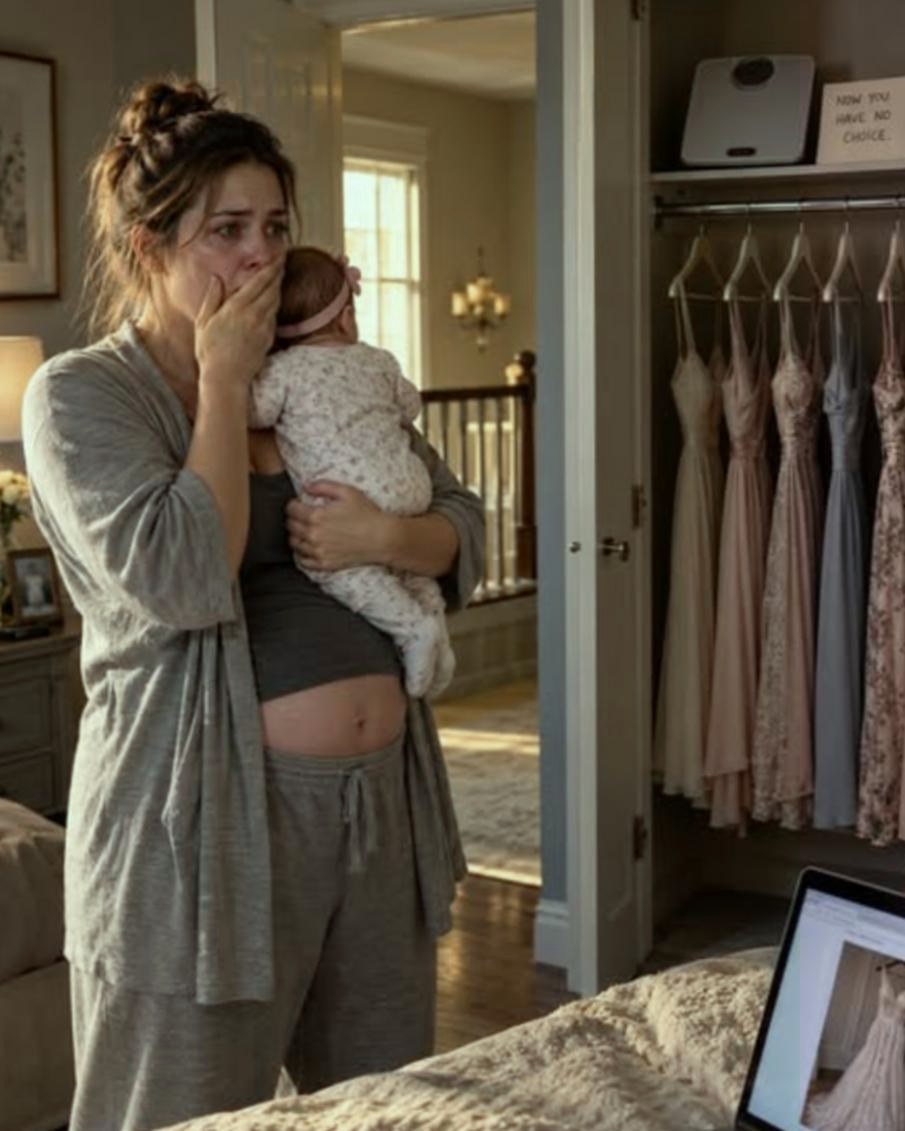

On Monday, at four eighteen, seven weeks after surgery, I opened the wardrobe and saw that my husband had left only nine dresses there—all six sizes too small for me.
On the shelf where the nursing bras had been, there was a bathroom scale. Beside it was a short note: “Now you have no choice.”
For several seconds I leaned against the doorframe, holding my daughter, Ivy, by the shoulder with my other hand. The child had fallen asleep in the car on the way back from the pediatrician. She was healthy, gaining weight, and making a small squeaking sound in her sleep, as if somewhere an old door screen were opening.
The doctor told me that I was doing well too. The wound was healing. My blood pressure had returned to normal. That morning I had even managed to take a shower. Then Ivy spilled milk in the yard, and I went upstairs to change my clothes.
I had nothing left to change into.
The soft black pants, high-waisted leggings, loose shirts, three bras, two cardigans, a raincoat, and the wide shoes I still needed because of the swelling in my feet were gone. The faded green robe my mother had given me had disappeared too.
I began taking photographs. First I photographed the wardrobe, then the scale and the note. That was when Paul called.
“See what I did?” he asked without a greeting.
“Where are my clothes?”
“At the women’s assistance center. At least they will appreciate them there.”
“You gave away my things without asking me?”
“I removed your excuses.”


I looked at the note.
“Recovery clothes are not an excuse.”
“Jenna, you have been hiding in elastic pants for almost two months.”
“I had abdominal surgery seven weeks ago.”
“The doctor gave you permission to walk. Walking is exercise. Exercise changes the body.”
I recognized in his voice that calm, professional patience with which he humiliated clients, as if he were reading them a bill.
“Bring everything back.”
“It is already too late.”
I opened the banking application. My access to the joint card was restricted. It said that clothing and personal-care expenses were disabled.
“You locked my card?”
“I am only controlling unnecessary expenses. I will not finance giving up on yourself.”
I looked at those dresses. I could barely get into two of them. Suddenly I noticed his old phone on the dresser. He said he used it to control the cameras and speakers. A red light was blinking in the upper corner of the screen.
“Are you receiving?”
The line went silent.
“Jenna, don’t turn this into something disgusting.”
“You already did.”
I placed the phone face down and hung up.

Twenty-six minutes later Rosa arrived. She was holding two canvas bags. She had held my hand during childbirth when Paul left the operating-room corridor to answer an emergency call.
“This is not motivation,” she said when she saw the wardrobe. “This is financial control, simply arranged according to colors.”
The bags contained soft pants, nursing shirts, and a blue wrap dress.
“Let’s write everything down,” she told me. “Prices, receipts, missing things. Let’s not tell Paul anything.”
We began searching old receipts in the emails. We listed forty-three items. Then I discovered an empty wedding-dress box on the top shelf of the guest room.
“Maybe he took it along with the clothes,” I said, although I no longer believed even my own voice.
Rosa began searching using a wedding photograph. In the third result my dress appeared. In the photograph I recognized my mother-in-law’s dining-room wall and a brass lamp.
“Lace wedding dress. Worn once. The owner no longer needs it. Price—three thousand two hundred dollars.”
The seller was listed as Marlene V.
I enlarged the photograph. A small zipper was visible in the inner seam of the garment bag. A cream-colored envelope showed from a half-open pocket. In the corner was a fragment of a blue notarial seal.
Rosa placed her hand on my shoulder.
“Jenna, this is no longer just a dress.”
I already knew. My mother-in-law was selling my wedding dress—and inside it was something hidden that Paul had been searching for all these years…

Rosa did not call Marlene.
“If she finds out that we found it, both the dress and the envelope will disappear,” she told me.
She registered under another name and arranged a meeting. The reply came four minutes later: tomorrow, at ten in the morning, for serious buyers.
That night Paul brought only his own salad and a protein drink for me.
“You are ruining everything with this dress,” he said.
“Ivy’s doctor said she is gaining well. She weighs nine pounds and three ounces.”
“Good.”
He did not even look at the baby. He watched my clothes for a long time.
“Did you go into the guest room?”
“Why are you asking me?”
He did not answer. Twice he asked whether I had called the center. He did not mention the wedding dress even once.
In the morning I went with Rosa to the Laurel Lane boutique. I had the receipt, the storage certificate, the wedding photographs, and the number indicated on the box with me.
The shop owner, Grace Kim, compared the documents with the dress, locked the door, and called a lawyer.
“I will not sell disputed property,” she said. “But we need to know whom it belongs to.”
Marlene’s contract said that she had consigned the dress the previous morning at eleven thirty-six. But Paul had told me that the things had already been given away.
Grace brought the box. My mother’s handwriting was still visible on the underside.
I opened the small zipper inside the dress. On the envelope it said: “Jenna Harper—private.”
Inside was a contract, with both signatures and a notary’s seal. My mother’s letter was there too: “Keep the document with the dress from which your new life began. Trust love, but also the complete files.”

At that moment Paul called me.
“Where are you?”
“Why?”
“Marlene told me that a problem had arisen concerning the dress. Did you open the envelope?”
“Why are you interested?”
After a long silence he said quietly:
“The contract you found is not the contract my lawyer has…”
“Then tell me which contract your lawyer has,” I said, and Rosa turned on recording on her phone.
The air in Laurel Lane’s closed boutique was heavy. Raindrops fell against the window, while my mother’s letter, the dress box, and a twelve-page document lay on the table.
“Jenna, come home,” Paul said. “This is a family matter.”
“Is it a family matter that your mother sold my dress?”
“Marlene only carried out my instruction.”
Grace exhaled sharply.
“Then I advise you to stop the conversation. You are now admitting to interference with property.”
The line went dead.
I picked up the document. My maiden name was written on the first page. My and Paul’s initials appeared on every page. The last sheet bore both signatures and the notarial notation.
Grace connected her own lawyer, Helen Barrett, by video call. As soon as her face appeared on the screen, it seemed as if time had turned back.
“Your mother left this copy with me,” Helen said. “She told me to give it to you after her death only if you ever felt that Paul wanted access to your property.”
“Why didn’t you tell me before?”
“That was her written instruction. She knew that during love, a warning often seems like an insult to a person.”

Helen enlarged the document on the screen.
“The seventh clause is clear. The Columbus house, your forty percent in the Belvedere bridal workshop, and all future growth of this property remain solely your property. Your husband has no right to sell, mortgage, or manage them without your consent.”
I called Paul.
“You knew about this?”
“No, that is an old version.”
“Your initials are on every page.”
“The copy in my lawyer’s possession says the seventh clause differently.”
Rosa stood pale.
“So someone changed the contract?”
Helen nodded.
“Someone used an altered copy. This is already a matter of forgery and fraud.”
My knees gave way. For eight years I had thought that Mother was excessively cautious. Now I understood that she had seen the danger I was hiding under the name of love.
“Paul, why did you sell the dress?”
For the first time his voice broke.
“I needed money.”
“For what?”
The silence was heavier than the answer.
At that very moment Helen’s phone rang. She listened, her expression changed, and she looked toward me.
“Jenna, the bank called me. Paul has already begun taking out a loan against your house. He was supposed to submit the documents tomorrow…”
But Helen did not finish the next sentence. An unknown number lit up on her screen and a message appeared: “If you want to find out where the rest of your things went, do not come alone…”
მისი საკუთარი ხმა პირველად მის წინააღმდეგ გაისმა…
ფინალში ყველაფერი თავდაყირა დგება. ყველაზე მტკივნეული მტკიცებულება იქ აღმოჩნდა, სადაც სიყვარულის დასაწყისი ინახებოდა.
„მას არჩევანი არ ექნება.“
პოლმა პირველად ვეღარ გაიღიმა.
👇 ისტორიის ფინალი უკვე გახსნილია
Related posts:
 Part 4 — The Husband Took Away the Clothes of His Mother Seven Weeks After Surgery, but at the Sight of the Wardrobe His Calm Voice Suddenly Disappeared
 A Flat Tire Stopped Me at a Desert Diner, but When the Waitress Heard My Name, the Color Drained from Her Face
 I Refused Every Marriage for Three Years, but One Cup of Water Broke My Silence and Laureano’s Smile Vanished
 I took my mother from the house, but when my brother opened her room with a duplicate key, the color drained from his face
 After My Husband’s and Daughter’s Funeral, My Mother Asked Me for the Insurance Money, but the Bag on My Table Suddenly Erased Her Smile
 I always protested leaving three children for free, but after my calm answer Sloan’s smile suddenly disappeared