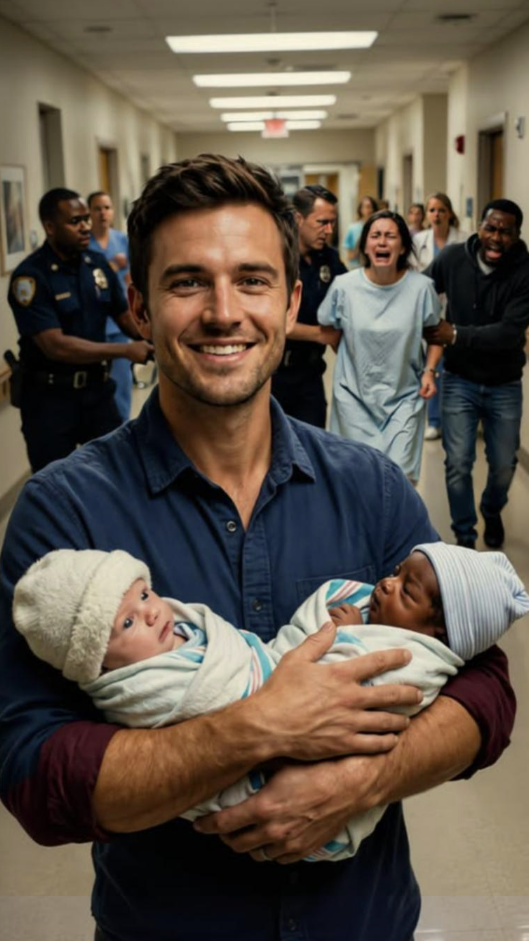


Part 4
That person was not alone in the security footage.
Nika laid the file in front of me and switched on the video on the screen.
At two eleven in the morning in the hospital’s subterranean archive, Eleonora stood alongside a man. That man was the clinic administrator, Gela Meladze.
He held the child’s medical folder in his hands.
— “This is our final chance,” Eleonora was saying. “These papers must no longer exist by morning.”
— “You have already lost everything,” Gela replied. “The recording exists.”
— “A recording exists only if someone finds it.”
On the screen, Gela unclasped the folder. He pulled out several sheets of paper, but right then, the hallway lights flickered on, and both of them looked toward the camera.
The video paused.
I stared at the screen, my hands turning cold.
— “Did this happen yesterday?” I asked.
— “Last night,” Nika told me. “The police are already on their way.”
Eleonora sat on a chair, all her strength drained away. She no longer resembled the woman who had been threatening everyone just a few hours prior.
Her lawyer stepped into the room, his phone held to his ear.
— “Mrs. Eleonora, I can no longer represent you in this matter.”
— “What do you mean, you can no longer represent me?”
— “The source of the funds received from you is suspicious, and I was unaware of the recording. Find another defense attorney from here on.”
— “You told me you would handle everything!”
— “You told me this was merely a family dispute. This is now a criminal matter.”
Eleonora threw her phone against the wall. Plastic fragments scattered across the floor.
For the first time, I heard her voice as if it belonged to a complete stranger. On the recording, she was saying calmly, almost bored: “You have to leave at least one child behind.”
Nika played the audio once more.
Eleonora’s words echoed through the room again.
“The second baby is a mistake.”
“Our family name cannot endure this.”
“Davit should be left only with the one who suits his name.”
Eleonora stared at the speaker, slowly realizing she could not run from these words. This was not someone else’s account. This was her own voice—her breathing, her pauses, her cruelty.
Ana stood beside me, weeping.
— “I wanted what was good for you too,” Eleonora whimpered.
— “No, Mother,” Ana replied. “You wanted my choices, my family, and my children. You never did anything good for me.”
The police arrived shortly after. They seized Eleonora’s recordings, forged consent forms, and financial transfer documents. Gela was detained that same night for attempting to remove materials from the archive.
Salome’s test results brought us hope the following day.
She proved to be a compatible donor for the baby.
The transplant lasted five hours. I sat in the hospital hallway, holding Ana’s copper bracelet, which she had removed prior to the surgery. The tiny clay bird cooled against my palm.
When the surgeon emerged, he uttered just a single sentence:
— “The transplant went well.”
Ana leaned against the wall and wept. I closed my eyes. For the first time that day, I was able to breathe.
We met Salome later.
She stood under a pear tree in the hospital courtyard, holding an umbrella with both hands, even though the rain had stopped.
— “I won’t take anything from you,” she told us. “I only want him to know, when he grows up, that his existence was not a mistake.”
Ana walked up to her.
— “He wasn’t a mistake even when I knew nothing,” she said. “And now he isn’t at all.”
Salome nodded, and they shook hands.
Months later, the court ruled that Eleonora had used donor biological material without our consent, forged medical documents, and exerted unlawful pressure on my family. She was spared prison time due to her age and medical condition, her sentence being commuted to home arrest; however, she forfeited her foundation, a portion of her assets, and all rights to approach the children.
I did not attend her sentencing.
I stood outside the courthouse, reflecting on how many years we had lost to the fear of a person who called herself the savior of the family.
Ana stood beside me.
— “What do we do now?” she asked me.
— “For the first time, let’s live the way we want to.”
Six weeks later, we left our apartment and moved to a small coastal town. There, we rented a house whose kitchen window overlooked fishing boats in the morning.
I began a new job in hospital administration. Every morning at seven, I walked to work, drank coffee from a paper cup, and double-checked documents.
Ana stayed home with the children, but twice a week, she read fairy tales to children at the nearby library.
Our dark-skinned son gradually recovered. We placed Salome’s photograph by his bed, though we did not rush to explain anything to him just yet. When the time came, we would not hide the truth.
His fair-skinned brother went to his bed every evening and straightened his blanket.
— “I’m here,” he would tell him.
He did not yet understand how immense that promise was.
Three months later, the first snow fell.
The boys drew two houses, a bright sun, and four figures near the window. There was a fifth figure as well—a woman with an umbrella, standing a little further away.
— “Who is this?” I asked.
Our dark-skinned son looked over at me.
— “She’s with us too. She’s just standing outside.”
I stared at the drawing for a long time.
That same evening, a letter arrived from Eleonora. The envelope was white, stamped with the old family seal in the corner.
“Davit, I made a mistake. Ana and the children miss us. Let’s start everything over.”
I sat at the table for a long time.
Ana was washing dishes in the kitchen. The sound of running water echoed peacefully.
— “Did you open it?” she asked me.
— “I read it.”
— “What will you reply?”
I folded the letter in half.
— “Nothing that will shatter our peace again.”
The next day, I sent just one brief reply:
“We are well. Please leave it this way.”
Nothing arrived after that.
Months passed.
One morning, as I was putting hats on the children, I noticed that Ana’s copper bracelet was back on her wrist. The tiny clay bird had a crack across one wing, but it hadn’t broken.
— “Why weren’t you wearing this?” I asked.
— “I was afraid everything would vanish again,” she answered. “Now I know that what we endured hasn’t vanished—it simply no longer controls us.”
Snow was falling outside. The children waited by the door, their laughter filling the entire house.
Ana touched her bracelet, then wrapped her arms around both of our sons.
I looked at the tiny clay bird, which was no longer trembling.
Our family began with a lie, but the truth saved us.
Missed the beginning?
Related posts:
 Grandma accused me of swapping the newborns, but the second genetic test result wiped the smile off her face in an instant.
 When my husband’s family broke my leg and my husband told me to submit, the smile vanished from his face three days later.
 My husband asked me to donate an organ to his ex-mistress, but the doctor turned pale after my calm response.
 After the accident on the coastal road, the police officer called my words a lie, but then suddenly turned pale.
 Part 4 — Every morning, I used to buy sixty kilograms of meat for the old man, but when the gate was opened, the policeman turned pale.
 My parents wanted to throw my belongings out into the yard and keep my child, but the smile vanished from my father’s face the moment I gave my answer.