
Part 4
…But security didn’t need to answer after all.
Heavy footsteps echoed up from the basement.
Father immediately stepped in front of me.
— “Clarissa, fall back.”
— “Who just entered?”
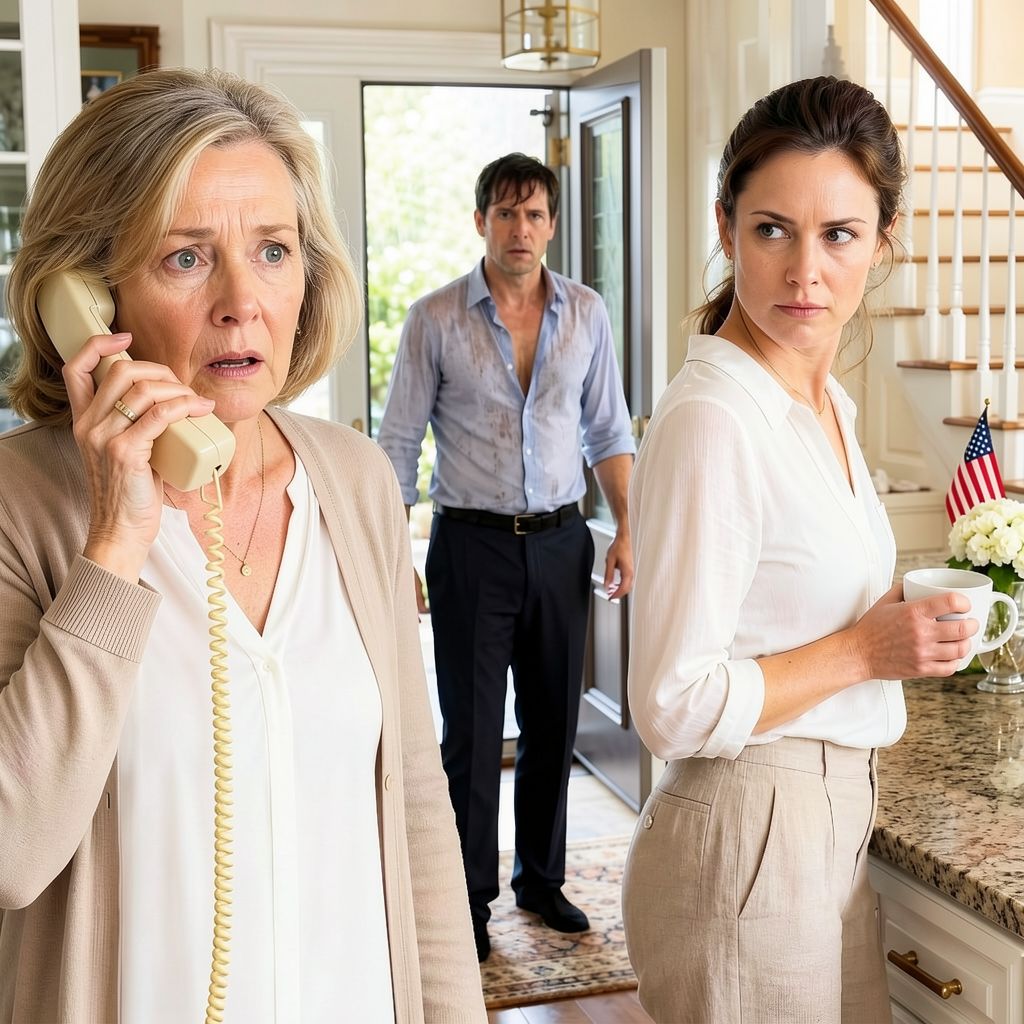
Helene held the phone to her ear.
— “Security is on their way. They’ll be here in five minutes.”
— “Five minutes is too long,” I said.
The door handle moved.
Martha stepped out from the kitchen holding a large wooden spoon in her hand. Her face was pale, but her voice didn’t tremble.
— “I’ve worked in this house for three years,” she said. “Whoever it is, they won’t lay a hand on my lady.”
The door opened.
Julian stood there.
His suit was no longer immaculate. His tie was undone, his hair disheveled, and a small cut marked his cheek. No one was visible behind him.
— “Clarissa, let me speak to you alone.”
— “No.”
— “You don’t know what’s happening.”
— “I know you were stealing money using my name.”
His eyes shifted to Father.
— “Is he back? He didn’t check on you once in three years, and now he’s playing the hero?”
Father replied calmly:
— “I gave her the freedom to choose. You, on the other hand, never left her a choice.”
Julian pulled a phone from his pocket.
— “If I don’t leave this room, the police will come in the morning and arrest you. Every document bears your signature.”
— “I’ve already seen the recording,” I told him.
His fingers froze.
— “Which recording?”
— “The one where you tell Chloe that you were my husband, so no one would ever suspect you.”
Julian’s face fell.
Helene switched on a small speaker. His own voice filled the room:
“I’m her husband. Nobody will suspect a thing.”
Then the second voice:
“If Clarissa turns against us, we’ll convince her that she doesn’t want to go to prison.”
Julian stood motionless.
He was hearing his own words from the outside for the very first time. That was the moment he realized he could no longer alter them, could no longer blame my emotions, and could no longer convince me that he had done everything for love.
— “Clarissa, that’s taken out of context,” he said.
— “No. The complete recording exists.”
— “I was trying to protect you.”
— “Then why were you using my name?”
He had no answer to offer.
— “Why did you open accounts in my name?”
— “For business.”
— “Why did you threaten me with prison?”
His mouth opened, but no sound came out.
Right then, the sound of cars echoed from outside. Security officers and law enforcement personnel entered the house. Julian looked at them, then back at me.
— “Please, tell them this is a misunderstanding.”
— “This misunderstanding lasted three years.”
— “We’re husband and wife.”
— “Which is precisely why I trusted you.”
He took a step forward, but Father raised his hand.
— “Don’t come any closer to her.”
Julian lowered his eyes for the very first time.
The officers cuffed his hands. He no longer offered any resistance. Chloe was taken into custody at the hotel at that same moment while trying to exit through the back door. Her diamond necklace fell to the floor, clattering against the stones several times.
That sound stayed with me for a long time.
The next morning, the board of directors forced Julian’s resignation from his company. The banks froze all accounts. Auditors confirmed that funds had been disappearing for years. Every document signed in my name was declared fraudulent.
Yet the heaviest moment didn’t occur in a courtroom.
It happened in our former home.
Law enforcement officers told me I needed to retrieve my belongings from the bedroom. I stepped into the room and saw a half-empty closet. Julian had already thrown away or removed most of my things.
Only a single item remained in front of the mirror.
The dark blue dress.
It hung over the back of a chair. The frayed thread near the sleeve was still visible. Julian had likely thought it was trash and not worth taking.
I reached into the pocket of the dress and found a small piece of paper. It was the old letter Father had sent me three years ago:
“When you realize that asking for help is not a weakness, call me.”
I pressed the letter to my heart.
Father stood by the doorway.
— “Are you ready?”
— “Not yet.”
— “How much time do you need?”
— “As much time as it takes to reclaim myself.”
He nodded.
— “Then I’ll wait for you.”
A few weeks later, the city felt different.
I moved in with Father, but I couldn’t stay in his large house for long. Arthur rented a small apartment for me near the lake, where a white mist rested over the surface of the water in the mornings. For the first time in my life, no one dictated what my home or my life ought to look like.
I began working at my father’s foundation, helping women who were emerging from financially or emotionally abusive marriages.
On my first day, a young woman asked me:
— “Is it really possible to start over?”
I set a pencil down in front of her.
— “Not starting over. Rather, continuing as yourself.”
She looked at me for a long time, then smiled for the first time.
Father called often—sometimes just to ask if I had eaten, other times falling silent on the line as if slowly reclaiming the three lost years.
One evening, my little niece, Nini, placed a drawing on my table. In the drawing stood a woman in a blue dress next to a tall man, with a bright yellow sun overhead.
— “That’s you,” Nini told me. “And that’s Grandpa. You’re not scared anymore.”
— “How do you know?”
— “Because there’s a sun here.”
The first snow fell in November. I set my cup on the window sill, grabbed my work bag, and stepped outside. I was no longer waiting for anyone to call, to judge me, or to approve of my clothing.
That was when a text message arrived from Julian:
“Clarissa, I’ve lost everything. Chloe abandoned me. Your father is controlling you. We can still talk. Come back to me.”
I read the message several times.
Then I typed a reply:
“I’m not abandoning you. I’m simply no longer saving you.”
And I sent it.
No reply ever came.
A few months later, the court sentenced both Julian and Chloe. They were forced to return the stolen funds, barred permanently from corporate management, and held accountable for forgery. I sat calmly in the courtroom.
Their punishment was not my revenge.
It was simply the consequence of their own choices.
And for the first time, I was no longer trying to rescue anyone from the results of their own actions.
That same evening, after returning home, I opened my closet. I still kept the dark blue dress. It was no longer the garment Julian used to humiliate me. It had become proof that even at my lowest point, I could stand on my own feet.
I tucked Father’s letter into the pocket of the dress and hung it back on the rack.
Outside the window, snow fell silently. The kettle whistled in the kitchen. The phone was quiet.
Father texted me: “Are you home?”
I smiled and replied: “Yes.”
Then I stepped over to the window.
The dark blue dress hung peacefully against the backdrop of the falling snow.
That night, I realized for the very first time that returning home doesn’t mean knocking on someone else’s door.
Home is where you no longer have to shrink yourself.
Missed the beginning?
Related posts:
 My husband left me with his mistress at a charity gala and mocked my dress, but a call from my father instantly wiped the smile off his face.
 My father grabbed my wrist in front of eighty guests and called me a deserter, but the face of an unknown officer suddenly turned pale.
 Liguei trinta vezes para avisar que minha sogra estava morrendo, mas quando meu marido atendeu, a risada ao fundo fez seu sorriso desaparecer
I brought my daughter to the Cole mansion for one dinner, but when Julian saw her sleeve, his polite smile vanished
Liguei trinta vezes para avisar que minha sogra estava morrendo, mas quando meu marido atendeu, a risada ao fundo fez seu sorriso desaparecer
I brought my daughter to the Cole mansion for one dinner, but when Julian saw her sleeve, his polite smile vanished
 My father kicked me out of the house at the Thanksgiving dinner, but when I placed the car keys on the table, the smile vanished from his face.
 I heard my daughter-in-law showering upstairs while my son said she had flown away, and the woman who entered my kitchen suddenly stopped smiling