
“A storage locker at the railway station,” Raymond said.
His words thundered through the room like a heavy stone.
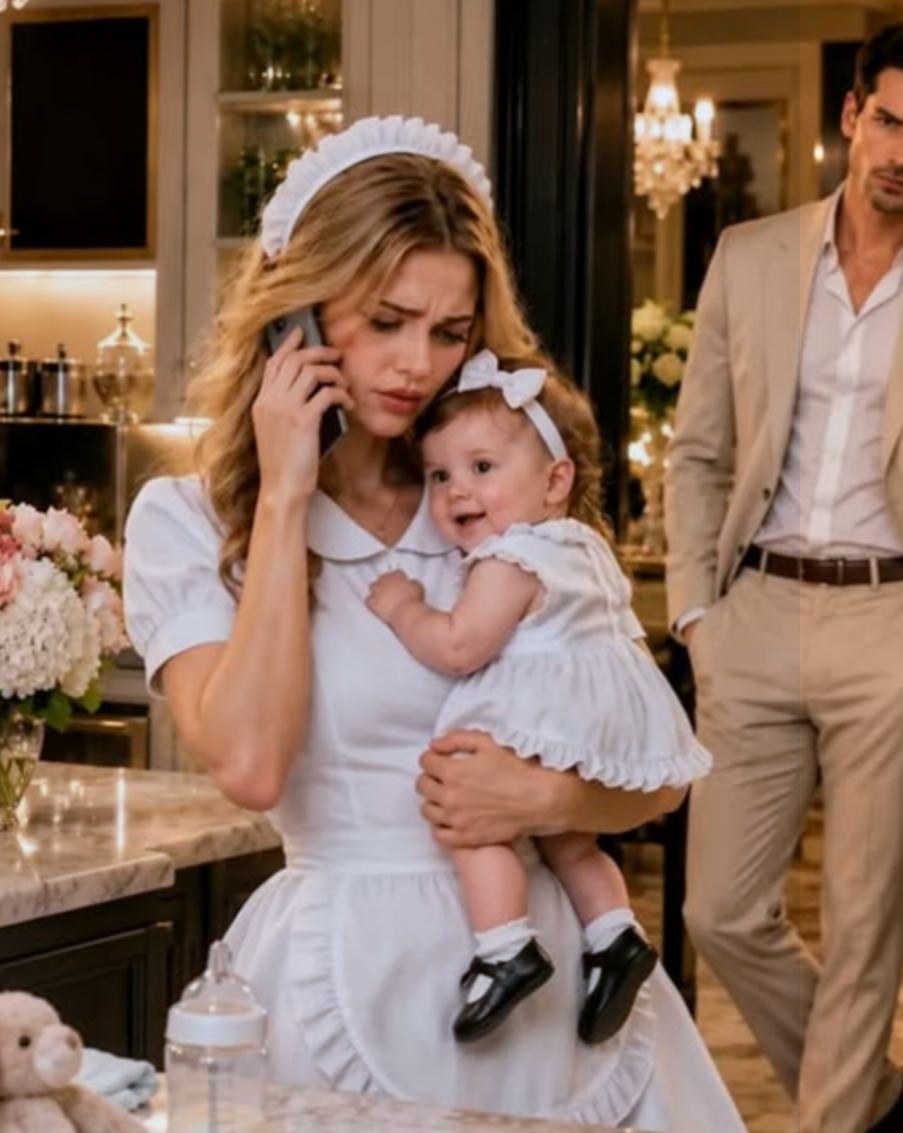
Marisa immediately understood that this was not an ordinary key. It had hung around her neck for four years, and she had thought it was only her husband’s last possession.
“Nathan told me never to take it off,” she said. “He told me not to open it until Owen’s birthday.”
“Owen is only eleven months old,” I said.
“Then he already knew that he might not make it this far.”
My father took out his phone.
“Raymond, we are stopping all this right now.”
“You can no longer stop it.”
“You are my family’s lawyer.”
“I was, Thomas. From this moment, I am no longer.”
Raymond put his phone on the table. The screen showed several missed calls, bank messages, and a document sent from the lawyers’ office.
“I have already sent the court your grandfather’s will, Nathan’s birth record, and the examination of the forged renunciation,” he said.
My father moved toward him.
“You will regret this.”
“I have regretted it for four years.”
The police did not come that night. They did not arrest my father immediately either. Life does not correct injustice so quickly.
But he lost control for the first time.
His phone was constantly switched on. The bank, the company board, journalists, and his own lawyers called him. On every call he repeated the same thing:
“This is a family misunderstanding.”
The next day his chief lawyer, Helen Moore, came to the office. Marisa, Raymond, and I were sitting there. Nathan’s documents lay on the table.
“I can defend you,” Helen told my father, “but I can no longer defend a lie.”
“What do you mean?”
“The court already knows that four years ago you signed a forged document.”
“I did not sign it.”
Helen opened the folder.
“Then listen to yourself.”
She turned on the recording.
My father’s old voice sounded through the room.
“Nathan Keane will receive nothing from this family. If necessary, we will make the signature too.”

Then my voice sounded, young and confused.
“Who are you talking about?”
The recording ended there.
My father sank into the chair. For the first time I saw on his face not anger, but a man frightened by his own words.
“This was obtained illegally,” he whispered.
“No,” Raymond said. “This is a recording from my office. I kept it for four years.”
“Why didn’t you publish it?”
“Because I thought a son should not have to stand against his father.”
Helen closed the folder.
“I no longer represent your interests.”
My father looked at her.
“Then who will defend me?”
No one answered.
That same evening we went to the station. It was a cold February night. The smell of iron stood on the platform, while raindrops rattled on the roof like coins.
We found the storage locker in the old part of the station. The number one hundred sixteen was written on it.
Marisa took out the copper key. It was still warm from her hand.
“What if there is nothing here?” she asked.
“Even then we will know that we tried to the end.”
The door opened.
Inside lay a small wooden box, an old camera, several photographs, and a letter written for a child.
Marisa opened the letter.
“My Owen, if you are reading this, it means I did not manage to tell you who your father was. Remember: our name is not what others will call us. Our name is what we have not lost before the truth.”
Marisa cried silently. I stood by the window and watched the train pass into the darkness.
The box also contained Nathan’s notarized statement. It said that all the unreturned share belonged to Marisa and Owen, while I, as the acting head of the family, had the duty to protect this property for them.
That night I began what my father had avoided for years.
Within several months the court restored the trust. The examination proved the forgery of the signature. The company board removed my father from leadership. He was not sentenced to prison because he began cooperating with the investigation, but he lost the property, power, and control over the family name.
I did not celebrate his punishment.
I simply stopped trying to save him for the first time.

My father came to my new house after all. It was already May. I had moved to a small town several hours from Boston. There I converted an old warehouse into a construction training center and taught young workers the trade for free.
Marisa headed the administration. Owen ran through the corridors every day, with a wooden toy truck in his hand.
My father stood at the door.
“I only want five minutes,” he said.
“Say it.”
“Can we start over?”
Behind him, the spring wind moved the trees.
“No,” I answered.
He lowered his head.
“Just like that?”
“No. It took me four years to understand: forgiveness does not mean giving you permission to control my life again.”
He took a small envelope from his pocket. This time it was not old. Inside was the only photograph in which my father and I stood in my grandfather’s workshop as children.
“Let this remain with you.”
I took the photograph, but I did not open the door wider.
“Goodbye, Father.”
“Adrian…”
“Be well.”
I closed the door.
Several weeks later Owen said my name for the first time. Not completely, only “Adri.” Marisa smiled from the kitchen.
“He chose you,” she told me.
“Children choose everyone who prepares their milk.”
“No. They choose the one who leaves and still comes back.”
That evening Owen drew a house on a sheet of paper. There was a large sun above the house. Beside it were three figures: Marisa, me, and Owen himself. A fourth figure stood in the corner, small and drawn with a black pencil.
“Who is this?” I asked.
“Father,” he said.
Marisa fell silent.
I looked at the picture for a long time. I did not teach the child who was bad. Nor did I teach him whom he should hate. I simply told him:
“Sometimes a person stands far away, but their love can still find us.”
In the summer the court issued its final decision. Owen was officially declared Nathan Keane’s heir. An account was opened for Marisa, and Nathan’s share was transferred into a protected fund until Owen became an adult.
Twenty-eight dollars never became a problem again.
But Marisa did not buy the most expensive thing with the first money she received. She opened a small children’s food pantry in our center. On the door she wrote: “No one should have to choose between food and a child’s breathing.”
And I still kept that copper key at home. It no longer hung around Marisa’s neck. Now it lay on a small wooden shelf beside Owen’s drawing.
One morning, months later, my father sent me a final message.
“If you ever need me, I am here.”
I looked at the screen. Earlier I would have called immediately after such a sentence. I would have asked whether he was all right. I would have tried again to carry for him the burden he had chosen himself.
This time I sent only one reply:
“Now I am well. Please let that be enough.”
I turned off the phone.
The first snow was falling outside. Owen stood by the window and drew a small circle on the glass with his palm. Marisa was pouring coffee. The kitchen smelled of bread and warm milk.
I took the copper key and placed it in Owen’s hand.
“This once belonged to your father,” I told him.
He raised the key toward the sun. Light flashed on its surface.
At that moment I understood that Nathan had finally managed to open the door.
It was simply that there was no money behind that door.
There was a home.
Missed the beginning?
Related posts:
 The Widow Working in My House Needed Twenty-Eight Dollars, but the Family Lawyer Turned Pale at the Sight of an Old Letter
 My housekeeper’s daughter rolled up her sleeve at dinner, and when I saw her birthmark, my cousin stopped smiling
 I Caught My Fiancée in the Maid’s Room, but When Something Fell from the Pillow, She Stopped Smiling for the First Time
 After my warning at the billionaire’s negotiation, the lawyer ordered the guards to remove me, but his smile suddenly disappeared
 Mi hijo me advirtió que no tocara el té durante la cena, y cuando miré a mi esposo, dejó de sonreír
 Ich stellte mich mit einer Rührschüssel auf dem Kopf vor den schweigenden Millionär – und plötzlich verschwand sein Lächeln