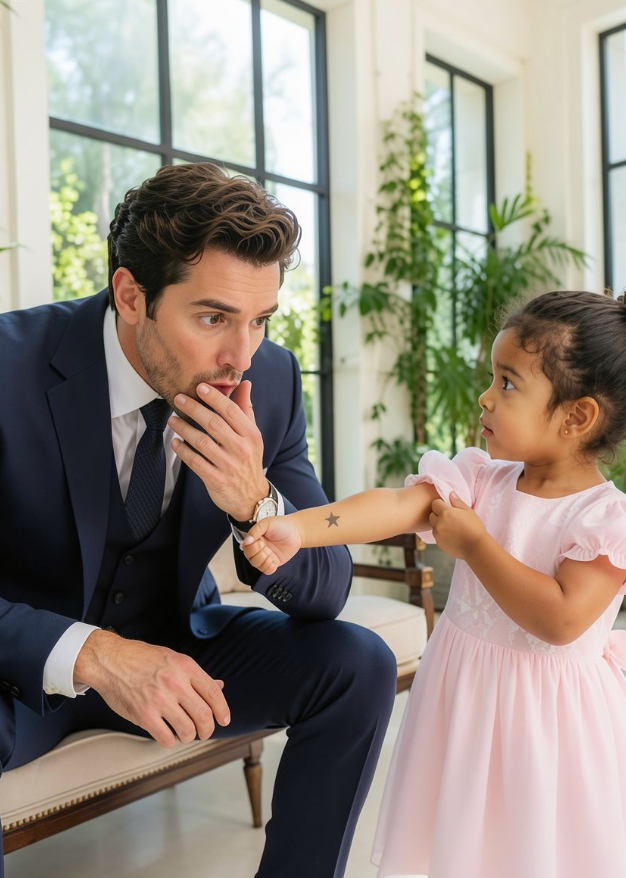
The fork slipped from my hand when my housekeeper’s three-year-old daughter lifted her sleeve and revealed the birthmark I had spent years trying to forget.
It landed against the porcelain plate with a sharp crack. Around the dining table, nobody moved at first. Richard was halfway through explaining a merger. My aunt was reaching for the wine. Marisa Álvarez stood behind the child’s chair with one hand on a silver serving tray, her face already tightening with embarrassment.
Sofia did not notice any of it. She was trying to reach a folded napkin while her feet swung above the floor.
“Mr. Cole?” Marisa asked quietly. “Are you all right?”
I couldn’t answer. My eyes were fixed on the small crescent-shaped mark on Sofia’s left forearm. Pale brown. Tilted slightly sideways. Exactly the same size and shape as the mark on my mother’s arm.
I had traced that mark with my thumb a thousand times when I was a boy. I remembered the warmth of her skin, the perfume she wore in winter, and the way she used to say, “Some families carry their stories where everyone can see them.”
My mother had been dead for eleven years.
“Julian,” Richard said, his voice suddenly too careful, “you’re staring.”
The room seemed to tilt. Sofia tugged her sleeve down and looked at me with enormous dark eyes.
“Did I do something wrong?” she asked.
“No,” I said. My voice sounded distant. “No, sweetheart. You didn’t do anything.”
Marisa stepped closer. “We should leave. I’m sorry she was at the table. The sitter canceled, and I had nowhere else to take her.”
“Don’t go,” I said.
She froze.
Richard leaned back in his chair, the gold watch on his wrist catching the chandelier light. “It’s a family dinner, Julian.”
I looked at him. “Then perhaps she belongs at it.”
His smile disappeared for half a second. It was the first honest expression I had seen on his face all evening.
Six weeks earlier, Marisa had arrived at Cole House with one suitcase, a child’s car seat, and a recommendation from a neighborhood employment program. The job came with a small apartment above the garage, which meant she could keep Sofia close instead of sending her across town on two buses every morning.
She worked silently and efficiently. She polished rooms no one entered, organized cupboards larger than her old apartment, and never complained about the mansion’s endless corridors. Sofia, however, treated the estate as her personal kingdom. She collected smooth stones near the garden steps and attached a tiny yellow lighthouse charm to the zipper of her lunch bag.
The first day she met me, she held out a gray stone.
“This one shines when it’s cold,” she announced.
I crouched beside her. “That sounds scientifically unlikely.”
She narrowed her eyes. “You can still believe it.”
I did.
After that, I found reasons to pass through the kitchen when she was drawing. I answered her questions about dogs, clouds, and why adults looked tired even after sleeping. Marisa watched me cautiously, as if kindness from a Cole always came with a bill attached.
That night, while she arranged the dessert plates, I asked, “What happened at the coast before everything changed?”
Her hands stopped over the silverware.
“Why are you asking me that?”
“Because you looked like you recognized the question.”
Marisa’s eyes flicked toward Richard. He had gone completely still.
Then Sofia’s lighthouse charm struck the table edge with a tiny metallic click, and Richard rose so quickly his chair scraped the floor.
“Enough,” he said. “Julian, come with me. Now.”
I didn’t move.
Richard’s jaw tightened. “If you want answers, ask Marisa what she was doing three years ago. Ask her why she disappeared. Ask her why she never told you about the child.”
Marisa went white.
Sofia looked between us. “Mommy?”
I heard my own heartbeat. Three years. The mark. The coast. The photograph locked in my desk.
“What child?” I whispered.
Richard turned toward the hallway. “You should see what I found.”
At the end of the corridor, he reached for a leather folder on the console table. His fingers closed around its edge, and the brass clasp began to open…
PART 2
His fingers closed around its edge, and the brass clasp began to open…
“Richard, put it down,” I said.
He glanced over his shoulder. “You wanted answers.”
Marisa moved in front of Sofia. The little yellow lighthouse charm swung from the child’s lunch bag, tapping against her knee.
“Julian,” Marisa whispered, “don’t let him show you anything until I explain.”
“Explain what?”
Richard opened the folder.
Inside were photographs, bank receipts, and a single cream-colored envelope with my name written across it. The handwriting belonged to Marisa. I knew that immediately, because I had once seen the same careful loops on a coffee receipt she left beside my car.
She saw me recognize it and closed her eyes.
“You wrote to me,” I said.
“I wrote three letters.”
“Why didn’t I receive them?”
Richard gave a soft laugh. “Because she never sent them.”
Marisa turned on him. “You told me Julian wanted nothing to do with me.”
“I told you what he said.”
“That isn’t true!”
The hallway clock struck nine. Each chime rolled through the marble like a warning.
I picked up the envelope, but Richard’s hand came down over it.
“Not here,” he said. “Not in front of the staff.”
“She is not staff,” I replied, looking at Marisa. “She is the mother of a child who may be mine.”
Sofia’s small fingers curled around Marisa’s dress.
Richard’s expression hardened. “You have no idea what you’re saying.”
“I know exactly what I’m saying.”
“No, you know what you want to believe because you saw a birthmark.”
That stopped me. He was right about one thing. A mark was not proof. It was only a door, and behind that door waited three years of questions I had never known to ask.
At ten thirty, I drove Marisa and Sofia to a private medical clinic downtown. Rain ticked against the windshield. Sofia slept in the back seat with one hand wrapped around the lighthouse charm, while Marisa sat rigidly beside me.
“You should have told me,” I said.
“I tried.”
“Then try now.”
She stared at the wet city lights. “We met at Harbor Point. You were twenty-nine. Your father had sent you there to inspect the old hotel before selling it. You stayed three weeks.”
“I remember.”
“I remember every day.”
My hands tightened around the steering wheel.
“You said your family controlled everything,” she continued. “You said Richard handled your father’s business affairs. You said you were going to leave after the inspection.”
“I was.”
“You left sooner than you planned. Your father collapsed. Richard came to my apartment two days later.”
The rain grew heavier.
“What did he want?”
Marisa looked at me then. “He wanted me to understand that a woman like me could not build a life with a man like you.”
At the clinic, a nurse collected our samples while Sofia colored a picture of a crooked yellow lighthouse. The paper smelled faintly of crayons and disinfectant. I sat beside Marisa beneath fluorescent lights, feeling my entire past rearrange itself.
When the nurse returned, she did not speak to either of us. She handed me a sealed report and said, “The physician would like to discuss the result privately.”
Before I could stand, my phone rang.
The screen showed an unknown number.
I answered. No one spoke for three seconds.
Then a man said, “Mr. Cole, if you open that report, your daughter will not be the only person whose life changes tonight.”
The line went dead.
Marisa gripped my sleeve. “Who was that?”
I looked at the sealed report in my hand. Behind the clinic window, lightning turned the city white.
“I don’t know,” I said.
But on the back of the envelope, beneath the laboratory seal, someone had written four words in black ink: Your mother knew everything…
PART 3
Your mother knew everything…
I turned the envelope over twice, as if the words might disappear from the paper.
Marisa stood beside me, one hand pressed to her mouth. Behind us, Sofia was still coloring, her yellow lighthouse leaning dangerously to one side.
“Open it,” Marisa said.
The physician, Dr. Patel, closed the examination-room door. “Before you read the report, I need to confirm that both samples were collected under proper identification.”
“Were they?” I asked.
“Yes. The result is conclusive.”
My throat tightened. “Say it plainly.”
Dr. Patel lowered her eyes to the report.
“Julian Cole, the probability that you are Sofia Álvarez’s biological father is greater than ninety-nine point nine percent.”
The words did not sound real. They moved through the room slowly, one after another, until they reached the place inside me that had been empty for three years.
My daughter.
Marisa began to cry without making a sound.
I looked through the glass panel at Sofia. She held up her drawing and smiled when she saw me.
“Daddy, look!”
The word struck harder than the report.
I opened the cream-colored envelope from Richard with shaking fingers. Inside was a letter dated three years earlier. Marisa had written that she was pregnant, that she loved me, and that she would wait at Harbor Point until Friday evening.
There was also a photocopy of a delivery confirmation. The letter had been received at Cole House by Richard’s assistant.
A second page carried my father’s signature, ordering Richard to “resolve the matter discreetly.”
Marisa leaned against the wall. “I thought you abandoned us.”
“I thought you disappeared.”
Dr. Patel looked from one of us to the other. “You may want legal counsel before confronting anyone.”
“I have counsel,” I said. “Richard chose him.”
Marisa’s face changed. “Then choose someone else.”
At midnight, we returned to Cole House. Richard was waiting in the library, standing beside the cold fireplace. His tie was loosened, but his expression remained composed.
“You opened it,” he said.
“Yes.”
“And?”
“She’s mine.”
For the first time, Richard looked afraid.
“You don’t understand the consequences,” he said.
“I understand that you intercepted her letters.”
“You were grieving. Your father was dying. The company was collapsing.”
“You lied to me.”
“I protected this family.”
Marisa stepped beside me. “You threatened me.”
Richard’s gaze snapped toward her. “I offered you money.”
“You offered me silence.”
I placed the photocopy on the desk. “Why did my father sign this?”
Richard said nothing.
Then the library doors opened. My father’s former solicitor, Arthur Bell, entered carrying a small wooden evidence box. He was seventy-eight, with trembling hands and a dark green scarf wrapped tightly around his neck.
“I’m sorry it took me this long,” he said.
Richard turned gray. “You were told never to come here.”
Arthur set the box on the desk. “Your father left instructions that it be delivered only if Julian discovered the child himself.”
I stared at the box. “What is inside?”
Arthur looked at Richard, then at me.
“Proof that your father knew the letters were intercepted. Proof that he planned to remove Richard from the company. And proof that someone inside this house tried to make Marisa disappear permanently.”
Marisa’s fingers found mine.
A phone began ringing upstairs.
Richard’s phone.
He looked at the screen, and every drop of color left his face.
“Who is calling?” I asked.
He didn’t answer.
Arthur opened the evidence box, revealing a recording device and a folded legal order. Then Richard whispered, “They found the storage unit.”
“Who did?”
He looked at me as if I had become the last person who could save him.
“The police.”
And outside the library doors, someone began pounding hard enough to shake the glass…
Richard heard the recording—and realized who had saved it…
I thought the truth would set me free. I didn’t know it would first force me to choose who I wanted to become.
The final part changes everything.
“I’m not the one who decided to investigate you.”
For the first time, he had no control.
👇 The ending is already open.
Related posts:
 I brought my daughter to the Cole mansion for one dinner, but when Julian saw her sleeve, his polite smile vanished
 PART 4 — My housekeeper’s daughter rolled up her sleeve at dinner, and when I saw her birthmark, my cousin stopped smiling
 I signed my former father-in-law into emergency surgery while his own son called him too old to save—and then my ex stopped smiling
PART 4 — I brought my daughter to the Cole mansion for one dinner, but when Julian saw her sleeve, his polite smile vanished
I signed my former father-in-law into emergency surgery while his own son called him too old to save—and then my ex stopped smiling
PART 4 — I brought my daughter to the Cole mansion for one dinner, but when Julian saw her sleeve, his polite smile vanished
 I was publicly disowned at my father’s funeral, but when I opened his battered fishing box, my uncle suddenly stopped smiling
 My parents demanded twenty thousand dollars from my husband, then his quiet condition made my father stop smiling