
My uncle called me a disgrace at my father’s funeral, then threw the old fishing box at my feet while everyone watched in silence.
The green metal box struck the stone patio at 3:12 on a cold morning outside Cádiz. Its rusted latch sprang open, scattering hooks, faded floats, and a reel of black line beneath the polished shoes of my relatives.
Richard Carter smiled as if he had finally won something.
“Your father died believing you were a shame,” he said. “That box is all he left you.”
I wore a coat two sizes too large and shoes whose soles were separating at the toes. For eleven months, I had slept in shelters, cheap hostels, and once beneath the closed awning of a café near San Fernando station. Richard knew that. He had chosen his audience carefully.
“Is that all?” he asked when I said nothing.
I placed each hook back inside the box. My hands were steady, though my chest felt hollow.
“The house is yours,” I said.
Richard’s smile faltered. “Legally, yes.”
That pause stayed with me.
I carried the box to the bus stop, remembering my father’s old warning: “Never look where everyone else is looking, Emmy. The biggest fish hide where nobody wants to search.”
At 9:40 that night, in a narrow hostel room in Chiclana, I opened the box again. It smelled of salt, tobacco, and the grease my father used on his fishing gear. Beneath a yellow float, a folding knife, and a receipt dated eight months before his death, my fingers found a loose metal panel.
Click.
I pried it up with the knife. Beneath it lay a brass key, a memory card sealed in plastic, and a folded note written in my father’s unmistakable slanted handwriting.
Do not go to the police. Trust Lucas.
I knew only one Lucas connected to my father: Lucas Moreno, the old owner of a bar near the port of Barbate. By 10:15, I was on two buses with six percent battery remaining.
Lucas turned gray when he saw the box.
“Thomas is dead?” he whispered.
“He was buried this morning. Why did he tell me to trust you?”
Lucas locked the storeroom door behind us. A brass key ring rattled against the table.
“Your father did not die poor,” he said.
“I never said he did.”
“Richard told you there was nothing.”
The cold running down my back had nothing to do with the night air.
Lucas admitted that four years earlier, my father had discovered forged signatures connected to family land. Someone had been moving money through rural properties near Vejer, Tarifa, and Málaga. Richard knew their value. Daniel Ross, the family lawyer, had helped manage the paperwork.
“Why didn’t Father report them?” I demanded.
“Because he didn’t know how many people were involved.”
A knock struck the door.
Laura, Lucas’s daughter, called from the bar. “A man is asking for the American woman.”
Lucas stared at me. “You have to leave.”
“Who is it?”
He lowered his voice. “Daniel Ross.”
I slipped through the back exit and reached an all-night computer shop in Barbate just before midnight. The card held photographs of deeds, maps, bank transfers, and one video file labeled with my initials.
My father appeared on screen, pale and exhausted.
“If you are watching this, they have already tried to erase your life,” he said. “Your dismissal was not bad luck. Neither was the loss of your apartment. Someone wanted you far from Cádiz, penniless, and too frightened to ask questions after I was gone.”
I opened the final photograph. It showed a row of metal storage lockers at a maritime depot. Locker 214 had a second, tiny lock near its bottom edge.
The brass key fit.
At dawn, I stood before the locker with my father’s box under one arm. Footsteps sounded behind me. A shadow crossed the concrete floor, and a familiar voice said, “Thomas always taught you clever tricks.”
Richard reached toward the locker door…
PART 2
Richard reached toward the locker door, but I stepped between him and the lock.
“You followed me from Cádiz?” I asked.
He wore the same navy coat from the funeral. A blue thread dangled from its missing button, trembling in the sea wind.
“I came to protect you,” he said.
“People who protect me usually don’t call me a disgrace first.”
His jaw tightened. “You have no idea what your father was involved in.”
“That is why you are suddenly interested in my fishing box.”
For several seconds, only trucks groaned beyond the warehouse wall. Then Richard leaned closer.
“Open it, Emily. You’re standing on property that was never meant to be yours.”
I turned the tiny key before he could grab my wrist. A narrow panel sprang open inside locker 214. There was no money, only a sealed brown envelope and a photograph.
Richard lunged.
I slammed the locker shut and ran between the rows. He shouted my name, but I shoved a steel cart into a stack of crates and escaped through the loading entrance into the morning crowd.
Inside a bakery near the bus station, I opened the envelope with a butter knife. The first document was a notarized deed. The second listed eleven properties held by a company called Blue Harbor Holdings. Their estimated value was nearly five million euros.
My knees weakened.
I had spent the previous night counting coins for coffee, yet my father had apparently left me land, warehouses, and coastal parcels worth more money than I could imagine.
Then I read the condition.
The transfer required a second notarial key and proof that I had identified the people who had falsified the company records.
A note from Thomas was clipped to the last page.
Richard believes these properties belong to him. He has used forged signatures since 2019. He was never the owner.
Beneath that sentence was another one.
Susan Carter is also listed as a beneficiary.
My mother had supposedly died in a car accident when I was nine.
I read the line again, refusing to let my mind form the impossible thought. Inside the envelope was a photograph dated February 12, 2025. A gray-haired woman sat outside a café, a scar beside her left eyebrow.
My mother.
The ceramic cup beside her hand bore a tiny green ring-shaped stain, exactly like the mark on the mug she used every morning when I was a child. My fingers began to shake.
A message arrived from a hidden number.
Do not return to the hostel.
I typed, Who are you?
The answer came with an address in Seville and a time: 6:30 p.m.
If you arrive before them, your mother will be there.
Before I could ask who “they” were, another photograph appeared. It showed me sitting on the bus, taken through the rear window by someone in a black car.
I looked outside. The car was still following.
At noon, I went to the only person I believed might tell me the truth: Daniel Ross’s former assistant, Mara Velasquez, whose name appeared on one of the transfers. She agreed to meet me behind a closed cinema in Algeciras.
“You should not have come,” she said, clutching a silver thermos.
“You signed the transfer records.”
“I copied them. Daniel found out.”
“Why did he pay to destroy my life?”
Mara looked toward the street. “Because your father hid the original ownership file, and you were the only person he trusted to inherit it.”
“Where is the file?”
She handed me a torn receipt with a green stone ring stamped in the corner.
“Your father left clues in things you remembered from childhood,” she said. “The key is only the beginning.”
A black car turned the corner.
Mara’s face drained of color. “They found us.”
She pushed a small recording device into my palm. “Play this when you are with your mother. Do not trust the man driving the car.”
The car stopped twenty feet away. Its rear door opened, and Lucas Moreno stepped out.
He did not raise a weapon. He simply looked at me with exhausted eyes.
“Emily,” he called, “your father asked me to bring you home.”
I held the recorder behind my back.
“Which home?” I asked.
Lucas glanced at the envelope under my coat. His expression broke.
Then he said the one thing that made me understand the danger was larger than Richard and Daniel.
“Your father is alive, but he believes someone close to you is going to kill him tonight…”
PART 3
“Your father is alive, but he believes someone close to you is going to kill him tonight.”
Lucas drove me to an abandoned lighthouse outside Tarifa instead of the address in Seville. Mara came with us, gripping the recording device so tightly that her knuckles turned white. At 6:27 p.m., a woman stepped from the shadows beside the broken stone wall.
She had gray at her temples and a scar beside her left eyebrow.
“Emily,” she whispered.
I knew her before she reached me. I knew her from the lavender smell on her coat, from the way she tilted her head when frightened, from the eyes I had searched for in every crowd since I was nine.
“Mother?”
Susan covered her mouth. “I wanted to hold you.”
“Then why did you let me believe you were dead?”
Her face collapsed. “Because the people who staged the accident were watching you.”
Lucas stepped between us. “Thomas discovered that Richard and Daniel had been selling the family’s coastal land through forged transfers. Your mother found the first ledger. They caused the crash, but Susan survived. Thomas hid her and let the world believe she was gone.”
“Why fake his death?” I asked.
“Because Daniel learned about the original file,” Susan said. “Thomas knew they would search the house after his death. He arranged a sealed coffin, a false death certificate, and a funeral you could attend without being followed directly.”
The grief I had carried for two days turned into something sharper.
“You made me mourn you while you watched me sleep in shelters?” I demanded.
A side door opened behind us.
Thomas stepped into the lighthouse wearing his old brown jacket. It still smelled faintly of tobacco and salt. He looked thinner, older, and alive.
“Emily,” he said.
I slapped him.
The sound echoed up the empty tower.
He did not defend himself. His eyes filled.
“I deserved that.”
“You deserved worse. I thought I had lost everything.”
“I thought distance would keep you safe.”
“It made me vulnerable.”
“I know,” he whispered. “That is what I have been trying to repair.”
Mara placed the recorder on a rusted table and pressed play. Daniel’s voice filled the room.
“She is gone from Cádiz. Keep the pressure on her accounts. When Thomas dies, Richard gets the land. If the girl returns, make the disappearance look like another accident.”
A second voice answered.
Richard’s.
“Thomas will never tell her about Susan.”
Susan gripped the edge of the table. Thomas closed his eyes.
At that moment, headlights swept across the lighthouse windows. Two cars stopped outside. Richard and Daniel entered with a third man, but behind them came officers from the national police and a notary carrying a locked case.
Daniel pointed at me. “She stole confidential documents.”
The lead officer held up a warrant. “We have recordings, bank records, forged deeds, and testimony from Ms. Velasquez.”
Richard stared at Lucas. “You betrayed me.”
Lucas’s voice was quiet. “Thomas saved my daughter years ago. I only repaid the debt.”
The notary opened the locked case. Inside was the original ownership file, sealed with Thomas’s green wax mark. It proved that Blue Harbor Holdings belonged to me and Susan, not Richard. Every transfer signed by Richard was fraudulent.
Daniel tried to run. The officers caught him at the door. Richard remained frozen, his hand hovering over the missing blue button on his coat.
“Emily,” he said, “you cannot destroy this family.”
I looked at the man who had thrown my father’s box at my feet.
“You destroyed it when you decided my poverty made me harmless.”
Both men were arrested before midnight. The court later froze their accounts, cancelled the fraudulent sales, and ordered restitution to the workers and landowners they had cheated. Mara received protection and a new position managing the company records. Lucas kept his bar, though he replaced the broken back-door latch.
My mother moved into the restored house in Cádiz. Thomas lived there too, but he no longer expected forgiveness to arrive simply because he had survived.
One evening, he placed the green fishing box on the table between us.
“I should have told you everything,” he said.
“Yes,” I answered. “But you can start now.”
He nodded, and for the first time in years, our silence was not a wall. It was a doorway.
I kept the brass key on a chain around my neck—not because it opened a locker, but because it reminded me that even when everyone called me lost, my father had hidden a way home inside the one thing they thought was worthless.
Related posts:
 I signed my former father-in-law into emergency surgery while his own son called him too old to save—and then my ex stopped smiling
 My husband pushed me from a frozen cliff, then complained at my funeral that I had taken too long to die—and someone went pale
 My Mother Slapped Me in a Hospital Bed When I Refused to Give My Brother $250,000 for His “Business”—Then a Stranger in a Dark Suit Opened the Gray Envelope They Were Desperate to Hide
 I heard my daughter-in-law showering upstairs while my son said she had flown away, and the woman who entered my kitchen suddenly stopped smiling
 I Gave Blood to Save a Stranger and Went Back to Frying Burgers—Then Six Black Cars Arrived, and a Billionaire Told Me My Brother’s Illness Was Part of a Secret My Mother Died Protecting
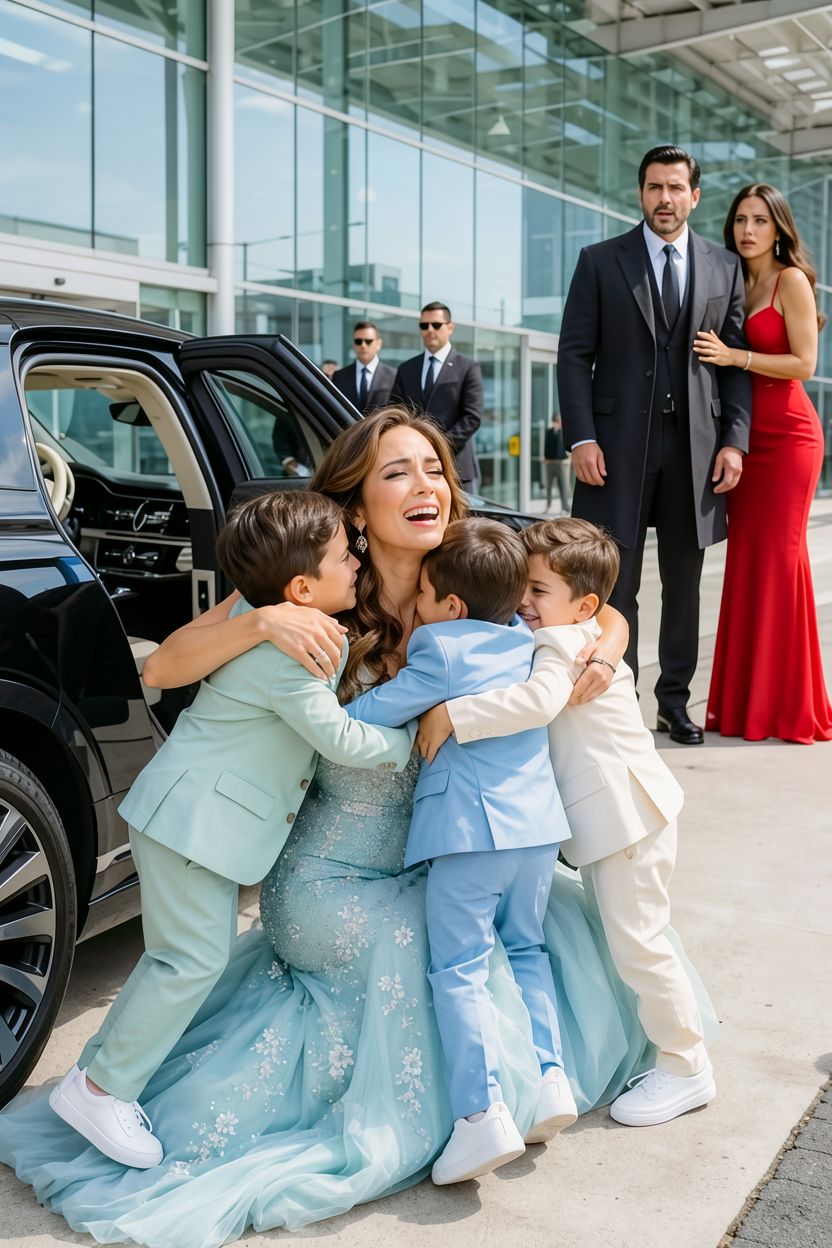 My ex-husband sat beside me to mock my ruined life, but at the airport three children ran toward me and his smile vanished