
“Mr. Volkov, your wife is alive and we know where she is hiding…”
Mikhail held the phone to his ear. Hospital lights spread in cold stripes across the corridor’s white walls.
“Tell me the name.”
“First sign the documents.”
“If you touch her, I will tell the whole city your name.”
The unknown man chuckled.
“It is already too late.”
The call ended.
Mikhail stood motionless for several seconds. Then he turned toward me.
“Anna, you and Grandmother have to leave here now.”

“We cannot leave Misha.”
“Misha is protected.”
“Are you staying here too?”
He could not answer.
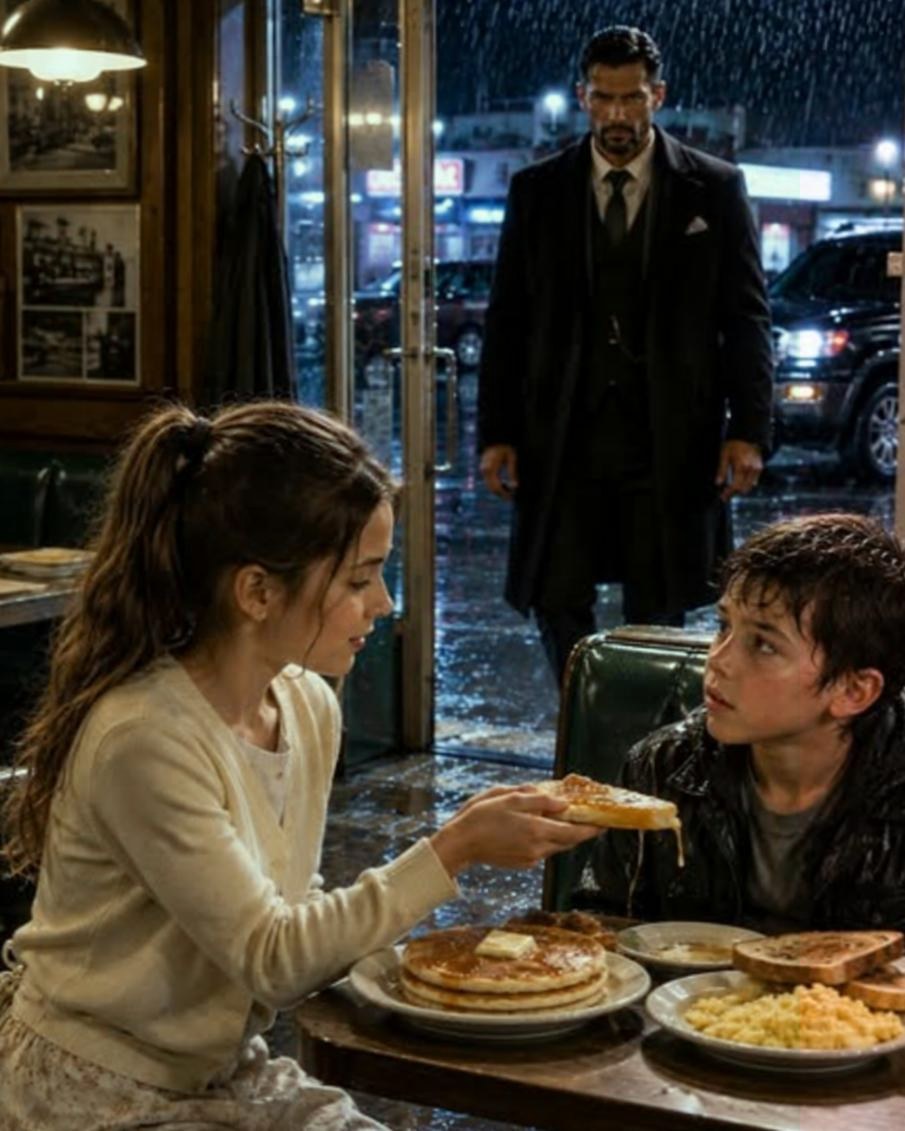
That night everything began moving at once. The police found two cars behind the diner; in one of them were Boris’s phone and a shopping-center security uniform. In another part of the city, Ilya found Boris’s driver. He was so frightened that he started talking at the very first question.
At the same time Boris was waiting for Mikhail in an old warehouse.
Mikhail wanted to go alone, but Police Captain Elena Gomez stepped in front of him.
“This time you are not going alone.”
“It is my son.”
“That is exactly why I cannot allow anger to govern you.”

“You have no idea whom you are fighting.”
“I do,” she told him. “And today, for the first time, he will have to hear his own words.”
The hidden microphone in the warehouse was already on.
Boris stood at a metal table. Two men were visible behind him. He was still wearing the same black watch on his left hand that I had seen on the man who brought the eviction papers in the morning.
“At last you came,” he said.
“Where is my wife?”
“First the signature.”
“Was taking Misha your order?”
Boris smiled.
“Your son was only a key. If we touched the thing most precious to you, you would give up everything.”

“Burning Anna’s diner?”
“Collateral damage.”
Mikhail lowered his head. Boris thought he had won.
“You see? You also know how this city works.”
Mikhail slowly raised his eyes.
“No. Now I know how you worked.”
At that moment Captain Gomez opened the door.
“Enough.”
The smile disappeared from Boris’s face.
His two men were forced to the floor. And in the recording placed on the table remained his own voice: the kidnapping of the child, the destruction of the diner, the false eviction order, and the accounts on which the names of several city officials were also written.

Boris realized that the words he had said to others now stood against him.
“It was a trap,” he shouted.
“No,” the captain replied. “It is your voice.”
Mikhail said nothing.
For the first time his face resembled not a criminal, but a tired father.
Boris and his accomplices were arrested. The court later confirmed that the diner’s eviction papers had been forged, while Boris had been blackmailing the building’s owner. The city port affairs also came under investigation.
Mikhail’s lawyer called his office in the morning.
“It is time to sign,” he told him.
“Which document?”
“The agreement that will prevent everything from the beginning.”

Mikhail looked from the window at the snowy street.
“I no longer want to avoid anything.”
“Mr. Volkov, this way you will lose your company.”
“I may say goodbye to the company. I almost already said goodbye to my son.”
After a long silence the lawyer closed the file.
“Then I will no longer be your lawyer.”
“I understand.”
Mikhail put down the phone.
That same day, at the clinic, Misha laughed for the first time. He held a plastic cup and told the doctor that pancakes were tasty only when there was very much honey on them.
And I stood at the end of the corridor and listened to his voice.

Mikhail came to me.
“Thank you,” he said.
“You already told me.”
“Then I did not understand what it meant.”
“What does it mean now?”
He looked at the small copper whistle placed in my hand. It belonged to Grandmother and hung around my neck during my shifts; when Misha came that night, I gave the whistle to him so that if he got lost again, he could blow it.
“It means that you saved my son, while your grandmother held up a mirror for me.”
“What mirror?”
“She showed me what I had become.”
Mikhail changed everything afterward. He publicly announced that his company’s criminal deals would be handed over for investigation. Some partners turned their backs on him. Newspapers published his name every day. But for the first time he no longer tried to justify himself.

In one week our diner still closed.
Not because we were evicted.
Grandmother said that the smell of fear remained in those walls and that we needed a new beginning.
Empty tables stood in the dining room. By the window I found Misha’s sheet, on which a black car was drawn. Beside it were a small red house and three people.
“Is this us?” I asked.
“Yes,” Misha told me. “Here no one has lost us anymore.”
Grandmother took the copper whistle from the old cash register.
“This will remain with you,” she told me.
“Why?”
“So that you never forget again that you always have a voice.”

Three months later we moved to northern Michigan. Mikhail bought a small diner on the outskirts of the city, only this time he did not register it in his name. He gave Grandmother the right to manage it, and set aside a small table for me by the window, where I did my schoolwork.
In the mornings there was the smell of coffee beans. At noon Misha checked the bell at the door. In the evening Grandmother baked apple pie and each time cut one slice too large.
When the first snow came, Misha made three figures in the yard.
“This is you,” he said and put a hat on the tallest snowman.
“I am not that tall.”
“You are for me.”
At that time Mikhail was slowly learning ordinary life. He went to the store alone, brought the bread himself, and no longer sent men dressed in black to our door. Sometimes he sat for hours at an empty table and silently listened to the sounds of the diner.

One evening he let me listen to the old recording.
On that recording his own voice could be heard asking Boris, “Where is my wife?” Then came Boris’s laughter, threats, and the words that Misha was only a key.
Mikhail turned off the sound.
“It is a strange thing,” he said. “All my life I thought I controlled other people’s words.”
“Now?”
“Now I know that a spoken word never comes back.”
“Is that bad?”
He looked at the snow through the window.
“Sometimes it is salvation.”

More than a year passed. One morning I found an envelope in the diner’s mailbox. My name was written on it. Inside there was only one sentence: “Anna, if you are ever ready, tell me to come.”
Mikhail’s signature stood below.
I showed the letter to Grandmother.
“Do you want to answer?” she asked.
I held the sheet in my hand for a long time. Before, at such times, I was afraid that refusing would finally destroy someone. Now for the first time I understood that another person’s peace was not my responsibility.
“Yes,” I said.
“What will you write?”
I wrote a short answer: “Mikhail, you can be Misha’s father by remaining in his life. But the door to my life will open only when you no longer come running from guilt. I will not wait for you anymore.”
I folded the letter and put it into the mailbox.

That evening Misha gave me a new drawing. It showed our diner, with warm light in the windows. Beside the door he had drawn a small copper whistle.
“Why did you draw this?” I asked.
“Because if you had not had a voice that night, I would have remained lost.”
I pressed the sheet to my chest.
Outside, the first snow was falling silently. The whistle hung around my neck and touched my heart very lightly with every step.
That night it was no longer a sign of alarm.
It was the sound of returning home.
Missed the beginning?
Related posts:
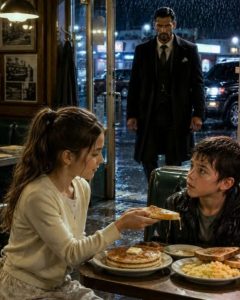 I shared my only dinner with a boy lost at twelve, but at the appearance of his father, the glass slipped from Grandma’s hand
 My mother demanded the apartment I had paid for, and when I refused at my brother’s birthday, his smile suddenly vanished
 I lived with my child in a shed for two years, but when I came to the gate of my own house, Andrei lost color
PART 4 — My mother demanded the apartment I had paid for, and when I refused at my brother’s birthday, his smile suddenly vanished
I lived with my child in a shed for two years, but when I came to the gate of my own house, Andrei lost color
PART 4 — My mother demanded the apartment I had paid for, and when I refused at my brother’s birthday, his smile suddenly vanished
 Part 4 — I lived with my child in a shed for two years, but when I came to the gate of my own house, Andrei lost color
 At the Christmas Table, My Mother Started Humiliating My Sister, but After My Answer the Glass Froze in Vanessa’s Hand