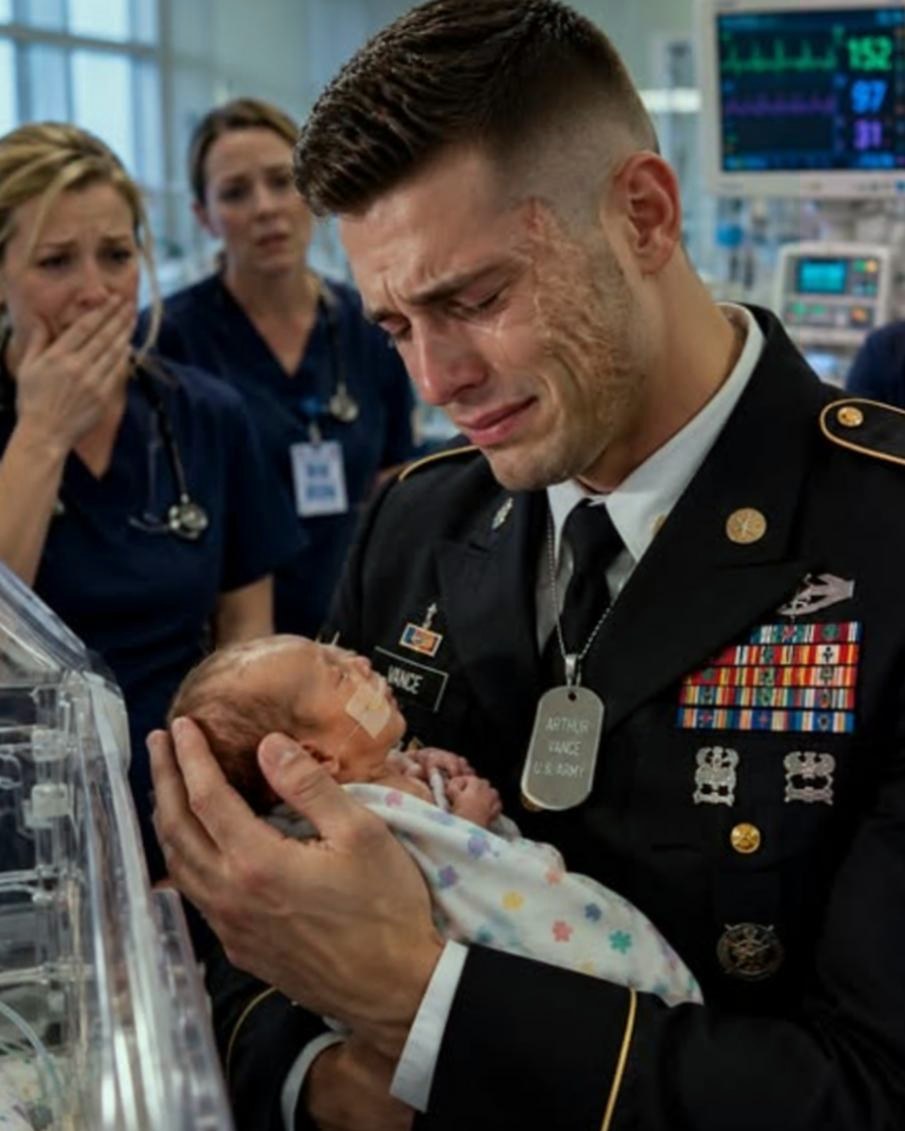

At the moment when Arthur Vance slid his hands into the incubator, every monitor beside bed number seven sounded an alarm at the same time.
For eleven years I had worked as the head nurse in the neonatal unit of Omaha’s St. Jude Medical Center. I knew which machine was temperamental, which door creaked, and which mother prayed quietly when she thought no one noticed.
But Arthur should not have been here.
He was a veteran over fifty, almost two meters tall. He had broad shoulders, a heavy jaw, burn scars stretching across both arms, and such enormous hands that they seemed made for a machine gun or for pulling soldiers from wreckage.
His fingers were trembling.
Under the hospital’s blue gown he wore a dark shirt, and around his neck hung a small metal military tag. Something was written on it, but I could not read it yet.
At that moment, the baby in bed number seven began to cry.
There was no name in her file. Only one line: “The Sterling girl.”
She had been born seven weeks early, weighed less than two kilograms, and was being helped to breathe by a machine. Her mother had disappeared from the hospital a few minutes after admission. Her tests showed narcotic substances. Her father had not even called. Her grandparents had not even asked where the child was.
There was no flower, toy, or small bag beside her.
Only a plastic bracelet and a small white cloth cap, onto which someone had sewn the letter “M” with green thread.
That morning we tried everything. We darkened the room, changed her position, tried feeding her, and checked the oxygen. The baby still cried as if pain had been locked inside her whole body.

Arthur turned his head toward her.
“Is this the little one whom someone simply needs to sit with?” he asked me.
A volunteer badge hung on his chest. He had passed all the checks. The psychological assessment, the safety course, and the training in handling newborns as well.
But I looked at his hands.
“Your hands are trembling,” I said carefully.
“I know.”
“She is very small.”
“I know,” he repeated. “That is why I asked whether I could sit with her.”
I wanted to refuse. But the baby cried out again, and something tightened inside me.
“I will be the only one to tell you when to stop,” I said.
Arthur went to the sink. Water fell unevenly onto his fists. His right hand was trembling so much that soap foam spilled onto the floor.
“If it becomes difficult, look at me immediately,” I warned.
“Nurse, I have dealt with harder things on the battlefield.”
“This is not a battlefield.”
He looked at me for the first time.
“Sometimes it is.”
Then he moved his fingers past the edge of the incubator. The baby’s crying grew stronger. The monitor made a thin, piercing sound. Arthur froze in an instant. His eyes widened, his breathing quickened, and sweat appeared on his face.
I knew that look. Fear left after war sometimes returns the body to the past.

“Mr. Vance, step back,” I said, taking hold of his arm.
“No.”
“Arthur, the machines are making noise.”
“I know.”
“You are here. In the hospital.”
He closed his eyes, took one deep breath, and leaned toward the baby.
“I am holding her,” he whispered.
His hands wrapped around the tiny body so carefully that they no longer resembled those enormous fingers I had thought were meant for a weapon a moment earlier.
The baby suddenly fell silent.
Only the even beeping of the machines remained in the room. One nurse dropped a towel from her hand. And I looked at the metal tag hanging from Arthur’s neck.
I slowly made out the words engraved on its surface.
“Sarah Vance. My daughter. Never forget.”
My gaze moved to the baby’s bracelet.
The same surname was written there.
Arthur saw my face and held the baby closer, more firmly but still carefully.
“Do you know who this is?” I asked.
He was about to answer, but at that moment the unit door opened. The head of social services, Dana Whitmore, came in holding a brown folder. The hospital administrator stood beside her.
Dana walked straight toward Arthur.
“You must hand the baby over to me immediately,” she said.
Arthur looked at the folder for the first time.
“Why?”
Dana stopped. Her fingers tightened around the folder clip.
“Because you have no connection to her.”
And I already knew that this was not true.
Arthur touched the metal tag and reached toward the folder…

Arthur’s hand stopped toward the folder, but did not touch it.
“First I have one question,” he said. “What happened to the baby’s mother?”
Dana Whitmore bit her lips.
“That is none of your business.”
“If she is my daughter’s business, it is my business.”
It seemed as if even the oxygen in the room had grown heavier. I stood beside Arthur.
“Dana, the baby’s record says the mother’s surname is Sterling. Yet you say Arthur has no connection. How do you know?”
“From the documents.”
“Then show them to me.”
The administrator coughed awkwardly.
“Ms. Mary, this is an internal procedure.”
Arthur carefully moved the baby toward me, but did not let go.
“My daughter was Sarah,” he said. “She died in the war nine years ago. I have her name engraved on my military tag. Sarah Sterling. I thought her child had died before birth.”
I looked at the baby’s tiny face.
“Then this baby is your granddaughter?”
Arthur nodded.
“Sarah’s girl. If she was born alive, no one will take her from me.”
Dana turned around quickly.
“You have no document proving that.”
“Do you?” I asked.
Fear appeared on her face for the first time.

At that same moment Arthur’s phone rang. He looked at the screen, turned pale, and answered the call.
“Mr. Vance,” said an unfamiliar voice, “if you want the girl to remain alive, leave the hospital by six o’clock this evening…”
The voice from Arthur’s phone spoke the last word, and silence fell over the unit.
“Who are you?” Arthur asked.
In reply there was only breathing. Then the call ended.
Dana Whitmore immediately grabbed for the phone, but I stepped in front of her.
“I am calling the police now.”
“Not yet,” Arthur said. “First we have to find out what they are hiding.”
It had been six o’clock in the morning when the baby was brought into the neonatal unit. The record of Sarah’s death had been made nine years earlier. Arthur thought his daughter had died alone in the war. But in the folder there was a letter Sarah had written two days before her death.
Dana was forced to put the document on the table.
I read aloud:
“Dad, if I do not return, name my child Mia. She will have the Sterling surname so that no one can find her. I know that you will find her.”
Arthur sat down on a chair. His trembling hands fell onto his knees.
“This is impossible,” the administrator said.
“Why?” I asked.
Dana stood silently.
Arthur looked at her.
“You knew that Sarah was alive when the child was born.”
“I was only processing the folder.”
“Then why is the mother’s signature forged?” I asked.
I put a second sheet of paper on the table. It said that the mother had given up the child and consented to adoption. But the signature had been written in dark ink. And Sarah’s death certificate confirmed that she was no longer alive that day.
Arthur fell silent. For the first time I saw the strength built over years collapse on his face.
“Where is the baby’s mother?” he asked.
Dana leaned against the wall.
“I don’t know.”
“You do,” I said. “Because your department changed her place.”
At that moment a young woman appeared at the neonatal unit door. She was thin, fatigue was written on her face, and an old hospital bracelet was on her left wrist.
Arthur recognized her immediately.
“Sarah?”
The woman’s eyes filled with tears.
“Dad, I should not be alive.”
Arthur went toward her, but stopped halfway.
“You registered my death.”
“I ran away because they told me they would kill the baby. They told me that if I spoke, I would lose you too.”
Dana Whitmore moved toward the door.
“Sarah, do not believe anyone. You are confused.”
Sarah took out her phone.
“No. You are confused. I recorded everything.”
A video began playing on her screen. Dana was visible, saying to her: “If you contact your father, we will send the baby to another family and you will never find her again.”
Arthur watched the recording. Then he said quietly:
“I have heard this voice before.”
The phone rang again. This time the hospital director’s number appeared on the screen. Sarah answered.
“The child’s case has already been transferred,” said a man’s voice. “People will come to take her away in ten minutes.”
She ended the call and looked at me.
“If they have come this far, no one will protect the girl anymore…”
არტურმა წერილი წაიკითხა და პირველად აღარ გაბრაზებულა…
მეგონა, სიმართლე ყველაფერს დაასრულებდა. მაგრამ ყველაზე მძიმე ბრძოლა მაშინ დაიწყო, როცა მათ უკვე დასაკარგი აღარაფერი ჰქონდათ.
„თქვენ თქვით. და ეს თქვენი ხმაა.“
მან თავი დახარა.
👇 ისტორიის ფინალი უკვე გახსნილია
Related posts:
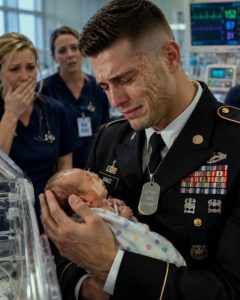 Part 4 — When a Burned Veteran Entered the Neonatal Unit, One Detail Leaning Over the Baby Silenced the Entire Room
 When I Took My Mother to the Hospital, My Husband Demanded That the Screen Be Turned Off and the Doctor’s Face Changed
 The Husband Did Not Call at His Mother’s Funeral, but When His Lawyer Opened the Folder, Brandon’s Smile Disappeared
 I Caught My Fiancée in the Maid’s Room, but When Something Fell from the Pillow, She Stopped Smiling for the First Time
 My Mother-in-Law Looked at the Newborn, Turned Pale, and Asked Us to Give Up the Baby Immediately — Her Strange Reaction Frightened Me
 On the twelfth night after giving birth, my mother-in-law threw us out of the house, but after one answer from my husband his father froze on the spot