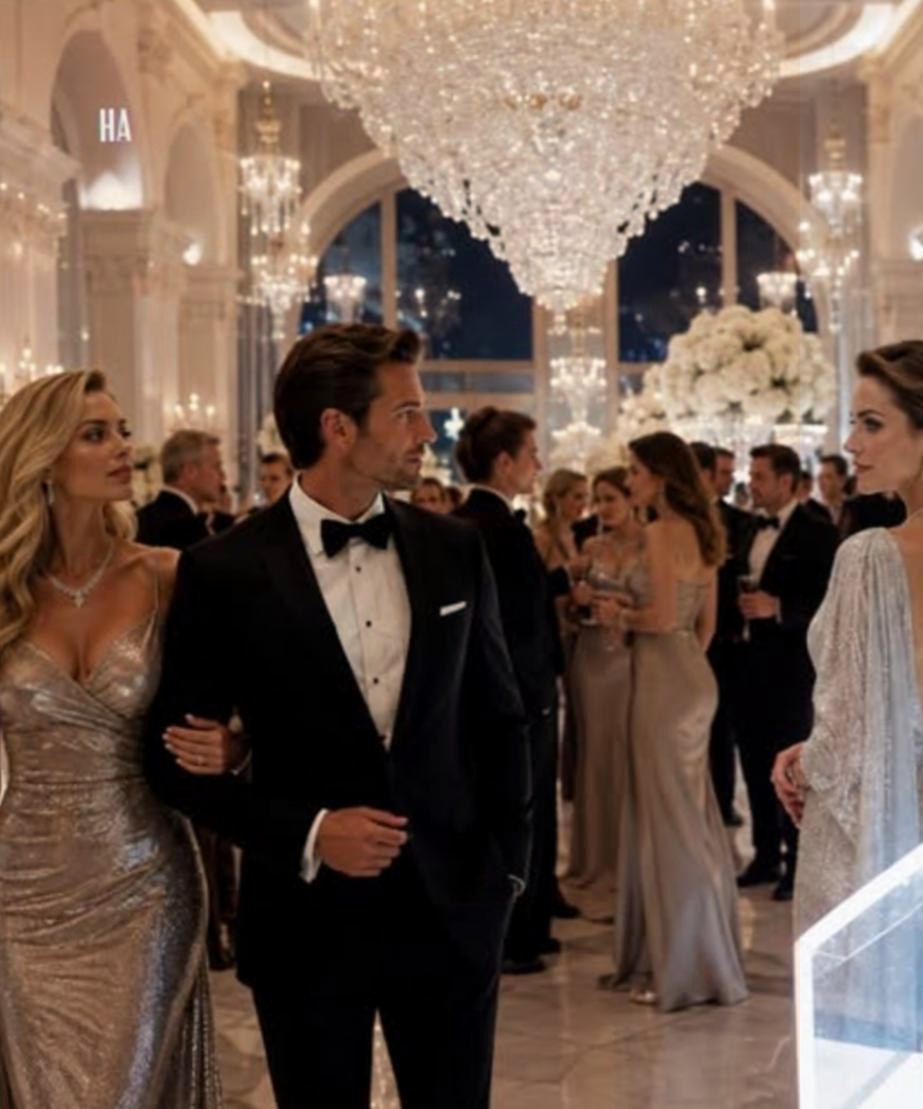

And I still did not know that the most dangerous person that evening was not Preston, but the man who had worked as my mother’s doctor seven years earlier.
After Benjamin’s words, everything in the hall began moving at once.
The investigators blocked Preston’s way.
Tiffany moved toward the wall and took out her phone.
“I knew nothing,” she said. “Do you understand? Nothing.”
“No one is accusing you,” the investigator replied.
“Then why are you looking at me like that?”
Preston moved toward me.
“Vivienne, this is already too much. You cannot use your mother’s death against me.”
“I am not using anything,” I said. “The truth is coming on its own.”
He looked at Benjamin.
“Where is my lawyer?”
“He already called you,” Benjamin replied. “And said that at this stage he would not be able to remain your representative.”
Astonishment appeared on Preston’s face.
“I pay him.”
“Money will not be enough this time.”

His phone rang one time after another. The financial director. The bank. Security service. The lawyer’s office.
Preston answered none of the calls.
For the first time, he understood that he had lost control.
And I was listening to my own breathing. I still had fear, but it was no longer that old, paralyzing fear. Now it moved inside me like water searching for a path.
Benjamin nodded to the investigators.
“Turn on the recording.”
A small clinic room appeared on the hall screen. Preston was sitting there in front of my mother’s doctor, Dr. Adrian Cross.
This meeting had been recorded that same morning.
Preston’s voice was clearly audible.
“If you write that Vivienne is emotionally unstable, the court will temporarily restrict her authority.”
Dr. Cross asked:
“And what will I receive in return?”
“I will cover your debt. Completely.”
“That is not enough.”
Preston placed a small box on the table.
“Then take this. It is the same diamond that disappeared from Mrs. Sinclair’s mother’s collection.”

Someone in the hall let out an exclamation.
Dr. Cross opened the box.
“You said that this stone had been destroyed.”
“People have to believe many things.”
Then my mother’s name was heard in the recording.
“If we reveal the truth to her daughter, you will lose both of them.”
The screen went black.
Preston was looking at his own words as though on the screen there was not his face but someone else’s mask. Tiffany slowly moved away from him.
“You did this?” she asked.
Preston’s voice no longer obeyed him.
“I was only looking for a way out.”
“No. You spent your whole life looking for a way out of responsibility.”
This was the first time Tiffany had told him the truth.
The investigator handed documents to Preston.
“You must come with us for questioning.”
“Am I under arrest?”
“Not yet.”
This answer frightened him more than handcuffs would have frightened him. He had no idea how many doors could still be closed in front of him.
I stood by the window and looked at the rain. Benjamin came beside me.
“Dr. Cross has already been arrested on charges of fraud and concealing evidence. Your mother’s death case will be reopened.”

“Did he kill my mother?”
“We cannot say yet. But a new analysis obtained from his records shows that your mother was given the wrong medicine that evening.”
I lowered my eyes.
My mother’s death had been a locked room inside me for seven years. Now the door opened, but not only pain came out of it. An answer appeared from there too.
Preston smiled at me with his last strength.
“If I fall, you will fall too. I will tell everyone that you knew everything and participated.”
“Tell them.”
“Are you afraid?”
“I am afraid,” I answered. “But no longer of you.”
That night Preston was taken for questioning, while Tiffany remained alone in the hall, holding a crumpled fold of the red dress. I went to her.
“You knew that he was married,” I said.
“I knew.”
“You did not know that he was married to me?”
She shook her head.
“I knew. I just thought that he did not love you.”
“Maybe he did not love me.”
“Then why did you protect him for so long?”
It was precisely this question that I could not answer.
Perhaps because love is sometimes the desire to save a person, even when that person chooses to sink himself.

Three days later I returned to our house. In the hallway there still lay the shard of crystal that had remained from Preston’s champagne glass. I picked it up and threw it into the trash bin.
The room with his things was almost empty. Only one photograph remained on the dresser: our wedding day, where I was laughing and he was looking at the camera.
I did not take the photograph.
My dark burgundy sweater lay on the table. The small moon embroidered with copper thread had come slightly open. I picked it up and for the first time no longer felt that I was carrying my mother’s gift in the past.
Several weeks later Preston was officially charged with financial fraud, falsifying documents, and obstructing the investigation. Dr. Cross admitted that he had changed my mother’s medicines. The case of my mother’s death went to court.
I did not raise my hand in a sign of victory at a single hearing.
I simply sat and listened.
Sometimes justice does not come with noise. Sometimes it only closes a door behind the person who for years left a storm in your life.
Four months passed.
I opened a new office for the Evermont Foundation in Boston. Every morning I went there at seven o’clock. The harbor could be seen from the window, while my mother’s small wooden figure stood on the table.
Now I checked all the accounts myself.
I no longer asked any employee for my trust. I established it simply through processes.

One Friday my niece, Eliza, came to the office. She was seven years old and held colored pencils in her hand.
“Aunt, do you live here?” she asked me.
“No. I work here.”
“Then why do you have a bed?”
“It is a sofa.”
“The sofa looks like a bed.”
I laughed. After a long time, my laughter was not forced.
Eliza drew a house on a sheet of paper. Yellow light came out of the windows of the house, and a woman stood by the door.
“Is this you?” I asked.
“No. This is the woman who returned home.”
The words struck me unexpectedly.
That night I received a letter from Preston. It had been sent through his lawyer.
“I know that I behaved badly. But you are the only person with whom I can still speak. Visit me. I will explain everything.”
I looked at the sheet of paper for a long time.
Then I wrote a reply.
“I am no longer the person who needs your explanation. I wish that someday you will be able to hear your own choices. But you will not return to my life.”
I put the paper into an envelope and sent it back.

That same evening I opened a window at home. The first snow was falling. Under the street lamps in the yard, flakes were descending slowly.
I went to the mirror.
I put on the dark burgundy sweater. The moon embroidered with copper thread was still slightly open, but this time I did not want to repair it. This small flaw reminded me that surviving does not mean being healed perfectly.
My wedding ring lay on the hallway table.
Inside it was still written: “Come home.”
I did not put the ring on again.
I simply placed it on the windowsill, close to the first snowflakes.
And that night I understood for the first time that returning home did not mean returning to Preston.
I returned home myself.
And the moon was no longer waiting for me—it was already with me.
Missed the beginning?
Related posts:
 The husband took his lover to the diamond evening, but when I came down the stairs, the glass in his hand shook
 My Spouse’s Family Mocked Me in Court When I Stood Without a Lawyer, but After My First Words My Father-in-Law Turned Pale
 My husband’s fiancée used my surname on her wedding invitation, but when I mentioned one stolen bracelet, his face went white
 Llevó a su amante a la gala más exclusiva, pero al verme bajar la escalera su sonrisa desapareció por completo
 When a Pregnant Woman at a Gala Barely Touched the Glass to Her Lips, the Strongest Man Suddenly Turned Pale
 Part 4 — My Spouse’s Family Mocked Me in Court When I Stood Without a Lawyer, but After My First Words My Father-in-Law Turned Pale