

At that very moment, the telephones rang simultaneously in the living room.
Victor’s telephone.
Rafael’s telephone.
My telephone.
Beatriz stood in the middle of the room and for the first time could not decide which sound to reach for.
“No one called,” she said.
Rafael showed the screen.
“The police are on their way.”
My mother looked toward me.
“Adrian, this is your family.”
“That is exactly why I allowed all this to continue for so long.”
“I protected you.”
“No. You lost all of us.”
Victor closed the folder and stood up.
“Mrs. Moretti, I no longer represent you.”
“You are my lawyer!”
“I was.”
Beatriz looked toward the door. Two police officers stood there. One held a warrant, and the other held a small bag into which her mobile phone was to be placed.
“This is impossible,” Mother whispered.
The police officer calmly told her:
“Mrs. Moretti, you have the right to remain silent.”
Beatriz shook her head.
“My son will not do this.”
I said nothing.
That silence proved heavier than any words.


They took my mother to the adjoining room to seal the recordings. There was a large screen on the wall. Rafael accidentally turned on again the part where Beatriz was standing in the children’s room.
I left the door open.
My mother heard her own voice.
“Sophia will never have a normal life.”
She stopped.
Her own face could be seen on the screen — cold, tense, confident.
“I will convince Adrian that it is Elena’s fault.”
My mother covered her ears with her hands.
“Turn it off.”
“Those are your words,” I told her.
“I did not mean it that way.”
“That is exactly what you said.”
“I only wanted to preserve the family.”
“A family asks to be preserved, not hidden.”
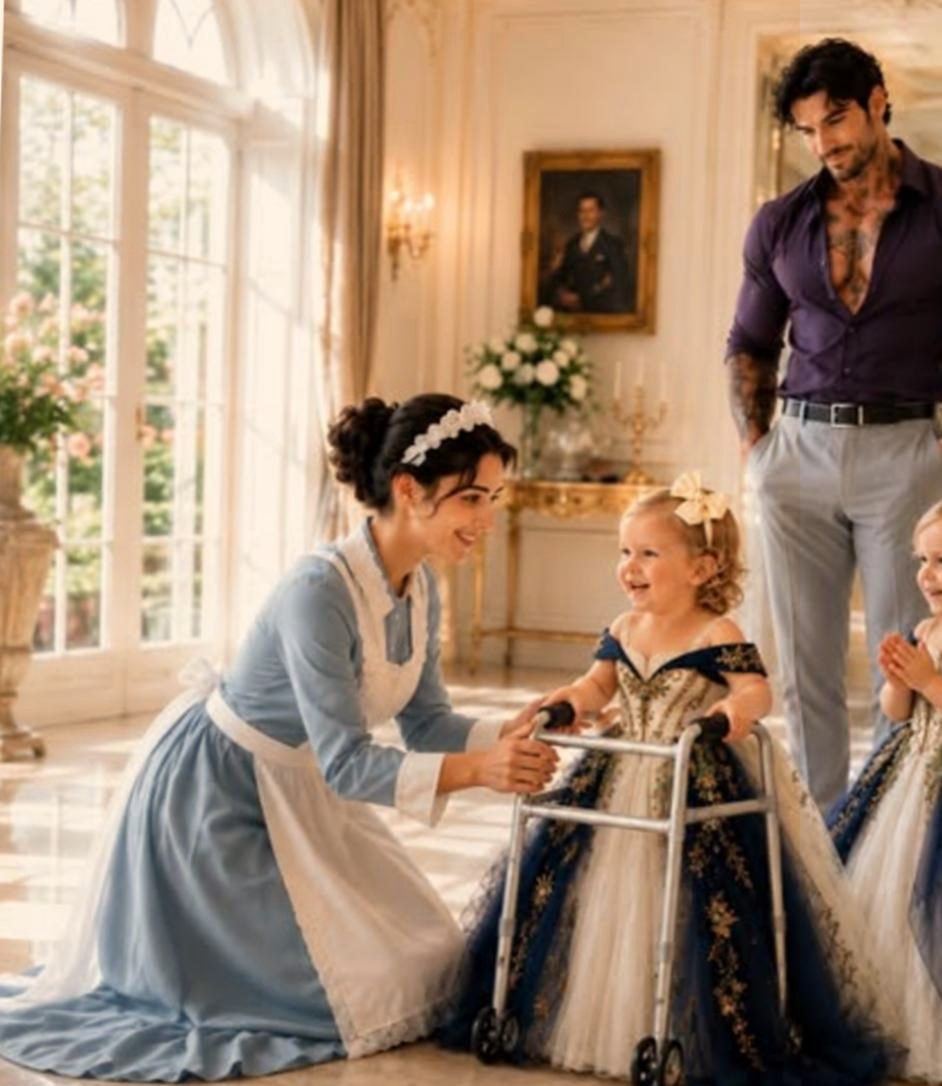
Elena appeared in the video. She was standing barefoot in front of Sophia, wearing one sock, with her dress sleeves rolled up.
“One more step, little girl,” she was telling Sophia. “If you fall, we will try again from the beginning.”
My mother looked at the screen.
“That woman ruined everything.”
“No,” I said. “She saved everything.”

The police took Beatriz away. There was a recording against her of planting the necklace, forging the guardianship documents, and hiding Maria’s medicines. Doctor Rossi testified. Beatriz’s assistant also confessed everything.
The investigation established that Maria’s medicine had been deliberately hidden, causing her condition to worsen. The cause of death was no longer only illness. There was someone else’s greed, fear, and deliberate inaction in it.
I could not call this a victory.
No one could return Maria to me.
At the first court hearing Beatriz did not look at me. Her lawyer had changed. The former one refused to defend her because he himself had become a witness. My mother was no longer angry. She only clutched a small bag, as if she could still hide her life in it.
Elena did not come to court. She told me that this was not a place for Sophia.
“You did not have to protect every secret of my family,” I told her.
“I was not protecting secrets,” Elena replied. “I was protecting the children.”
The bird embroidered with violet thread was still visible on her brown bag. It was now slightly open because Sophia had put a small pencil inside it.
That evening I entered the children’s room alone.
Sophia’s blue armchair stood by the window. Beside it lay the small wooden horse, with one leg. Lily’s rabbit was no longer on the bed. Lily had taken it to the living room because she said she was afraid of the hallway at night.
Maria’s photograph lay on the table.
The corner of the photograph was slightly bent because Sophia often touched her mother’s face with her finger.
I picked up the photograph and looked at it for a long time.
“Forgive me,” I said.
Only the quiet sound of the heating could be heard in the room.


Several weeks later I left the gates of the house without security for the first time. The tall iron gate stood open all day. The neighbors first looked on in surprise, and then brought colorful balls for the children.
I temporarily handed over the daily management of the company to my partner and began going to the city’s children’s rehabilitation center. There, money could not solve anything quickly, but every child was called by a name and not by a diagnosis.
We built a small wooden railing at home for Sophia.
Elena no longer worked every day. She became the girls’ official helper and a trusted member of my family. In the morning, at eight o’clock, the kettle turned on. At nine o’clock Sophia held onto the railing. At ten Lily taught the rabbit to climb the stairs.
The first steps were still unsteady.
But they were already her steps.
One morning, three months after the court’s final decision, Sophia wanted to talk to me. The first snow was falling outside. White flakes were melting on the windowsill.
“Dad, will Grandma return?”
I sat down in front of her.
“She may write to you again.”
“Will she come into the house?”
“No, unless you want her to.”
Sophia thought for a while.
“I do not want anything to happen to her.”
A lump caught in my throat.
“I do not want that either.”
“But I do not want her to tell me anymore what I should be like.”
I kissed her forehead.
“She will not tell you anymore.”
Lily looked into the room.

“Sophia, I finished your drawing.”
She unfolded the paper. Four people stood in front of the house: me, Lily, Sophia, and Elena. A large yellow sun was drawn above them. Everyone held a small bird in their hand.
“This is Elena’s bag,” Lily said. “Now it has wings.”
That evening a message arrived on my phone from an unknown number.
“You met me only once. I am not asking for forgiveness. I want you to know that I did not want Maria to die.”
The second message came several minutes later.
“Tell Sophia that Grandma misses her.”
I looked at the screen. I kept my finger over the reply field for a long time.
I could have written everything that I had been unable to say for years.
I could have shouted.
But I sent only one sentence:
“I will no longer make Sophia carry someone else’s guilt.”
Then I blocked the number.
At night I entered the children’s room. Streetlights came in through the window. Lily was already asleep, while Sophia lay in bed holding the small wooden horse.
Before my eyes I saw Elena’s bag on the floor. The bird embroidered with violet thread looked almost alive in the snow-white moonlight.
I went over, picked up the bag, and hung it beside Sophia’s bed.
In the morning she would hold onto the railing again.
She would probably fall again.
But this time no one would tell her that she would never be able to do it.
Outside the window, snow was falling quietly.
Sophia opened her eyes and smiled at the bird.
Then she took one step.
Missed the beginning?
Related posts:
 When I Returned Home, the Cleaner Was Accused of My Wife’s Necklace, but My Mother Lost Color When I Turned on the Camera
 I Returned Home Five Days Early and Found My Mother’s Friend in My Bed — But I Froze When I Saw My Mother’s Face
 I was bathing Dante’s mother at home when Luka’s unexpected question silenced the entire room
 I took my mother from the house, but when my brother opened her room with a duplicate key, the color drained from his face
 When They Considered Taking My Mother to the Doctor Humiliating, the Color Drained from My Husband’s Face and a Heavy Silence Fell over the Room
 A Flat Tire Stopped Me at a Desert Diner, but When the Waitress Heard My Name, the Color Drained from Her Face