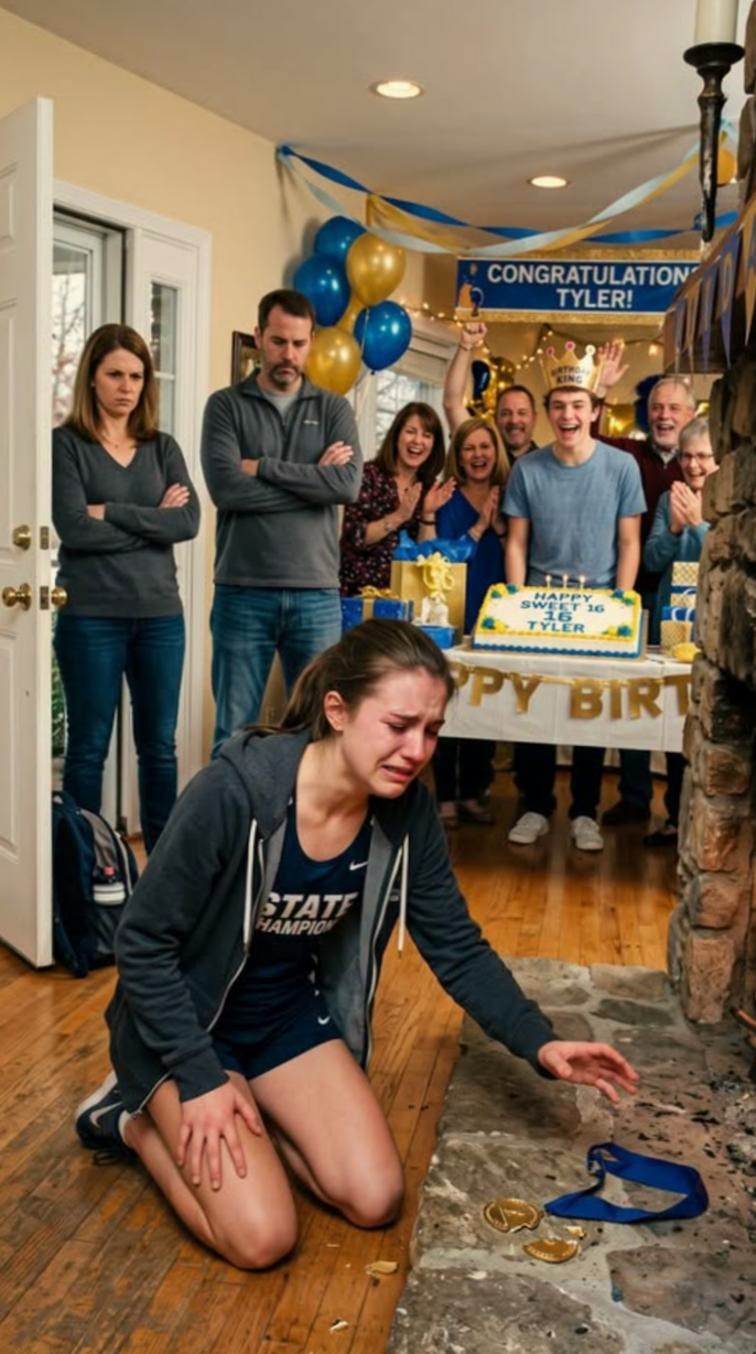

On my sixteenth birthday, my mother smashed my gold medal against the fireplace and threw me out of the house that same night.
That morning, at the city stadium, I became the state champion in the eight hundred meters. I had trained for four years before dawn, in rain, frost, and even on the days when my father told me he could not drive me to competitions. The medal hung around my neck, and the sun reflected off its surface as if the whole world were noticing my existence for the first time.
But at home, blue balloons were waiting for me.
On a huge cake in the living room was written: “Congratulations, Tyler!” My cousin Tyler stood there wearing a plastic crown and waving to the guests.
“What is this?” I asked.
My mother, Marisa, looked toward me only for a moment.
“Tyler was accepted onto the school football team.”
“But today is my birthday.”
Aunt Denise snickered.
“You have a birthday every year. Getting onto the team is something special.”
I looked at my father, Mark. He was gripping a paper plate so tightly that its edge had crumpled.
“Dad?”
“Don’t start drama, Emily.”
Tyler noticed my medal.
“What is that?”
“I won the state championship today.”
Silence fell over the room. For a moment I thought that now, at least, they would come closer. Mother would hug me. Father would put his hand on my shoulder.
My mother only said:
“Good.”
That was all.

Tyler snatched the medal from my hand.
“Let me see.”
“Give it back.”
He held the medal high above his head and began laughing. I tried to reach it, but my mother stepped between us.
“Stop ruining her evening.”
“He took my medal!”
Tyler let go. The medal fell onto the stone floor and made a bell-like sound. Before I could pick it up, my mother kicked it. The golden disk struck the stone corner of the fireplace and split in half.
I stared at that little crack for a long time. A coldness appeared in my heart, as if it were raining at the stadium again.
“Look what you made everyone do,” my mother told me.
I bent down and picked up both pieces.
“Nobody loves me here.”
My father sighed.
“If you are ungrateful, maybe you should not be here today.”
“Are you really throwing me out?”
“Go outside for a while,” my mother said. “Maybe you will learn respect.”
She went upstairs, and two minutes later my backpack rolled down the stairs. An old red stadium ticket fell from the side pocket—the one I had kept from my first competition.
My mother threw the bag onto the porch.
“Go and calm down.”
They locked the door.
Through the window I saw them gather around Tyler. They lit the candles. Everyone began to sing.

I walked three miles to the house of my coach, Rebecca Harris. Water collected in my shoes, my fingers were trembling, but more than anything I clutched the pieces of the medal.
When Rebecca opened the door, everything could be read on her face.
“Emily, what happened?”
I could barely get the words out.
She brought me inside, wrapped a wool blanket around my shoulders, and placed the pieces of the medal on the table. Then she looked at them for a long time.
“Nobody could have done this and thought I would stay silent,” she said.
“Who are you calling?”
Rebecca picked up the phone.
“Someone who should have known about this years ago.”
“Who?”
She dialed a number, and with her other hand took a brown folder from the table drawer. Her fingers went exactly toward the paper I could not yet see…
Rebecca’s fingers touched the first sheet in the folder, but at that moment an anxious woman’s voice sounded through the phone.
“Rebecca, is this really Emily?”
“Yes, Ellen. She is with me.”
“Then do not open the door to anyone. And do not let them take her home.”
Wrapped in the blanket, I stood there and could not understand why all of this sounded as if some crime had happened.
“Who is Ellen?” I asked.
Rebecca put down the phone.
“She is a lawyer. She knew your grandfather.”
“My grandfather died two years ago.”

“I know.”
“Then why would she have to know anything about me?”
Rebecca did not answer me. It was eleven o’clock at night in her kitchen. Raindrops struck one another on the window, and milky tea boiled on the stove. This ordinary smell frightened me strangely. I had never felt as foreign in my own home as I did at that moment in Rebecca’s kitchen.
The doorbell rang.
Rebecca immediately stood in front of me.
“Step back.”
“It is probably Mom.”
“Exactly why.”
Through the small glass window in the door I saw my father. My mother stood behind him. Her face was wet, but I did not know whether it was from the rain or from crying.
“Emily, come out,” my father called. “This is a family matter.”
Rebecca did not open the door.
“Throwing a sixteen-year-old child into the street at night is not a family matter, Mark.”
“You do not know what happened.”
“I know very well. I know about the medal, too. And I also know that I will call the police if you do not leave.”
My mother pounded on the door.
“Emily, come home! You will apologize tomorrow and everything will be over.”
For the first time I realized that she did not want my return; she wanted control of the situation back.
“I am not coming back,” I said.
My mother lowered her eyes behind the glass.
“If you do not come outside now, you will regret it later.”

“I already regret trusting you at all.”
Rebecca dialed the police number. A few minutes later the car’s headlights disappeared. But my mother’s last look stayed with me for a long time.
That same night Ellen Hart came. She was holding a green folder with metal protectors on its corners. First she looked at the pieces of the medal, then at me.
“Is this your signature?” she asked, handing me a sheet.
In front of me lay a form called the Children’s Sports Fund.
“No.”
“A ten-thousand-dollar award is registered in your name. You never received the money?”
I shook my head.
Rebecca lowered her eyes.
“Marisa told me Emily was quitting training.”
Ellen answered calmly:
“Marisa said many things.”
Then she placed a small device on the table.
“This is a recording from your home’s door camera. Rebecca accidentally saved it when she called your parents. It does not capture everything from that evening, but one thing is enough.”
“What thing?”
Ellen turned on the device. First the noise of the cake celebration could be heard, then my mother’s voice. Clearly. Coldly.
“If she does not sign today, we cannot withdraw the money.”
The air disappeared from the room.
“What money is she talking about?” I asked.
Ellen closed the folder.

“We will find out tomorrow. Tonight you must decide whether you want me to become your legal representative.”
“What if I refuse?”
“Then you will return to the house where your signature is considered more valuable than your life.”
I looked at the piece of the medal. The golden surface no longer shone.
“Sign,” Rebecca told me. “Choose yourself for the first time.”
The next morning my mother called me twenty-one times. Then my father. Then Aunt Denise. Each call was followed by the same words: “We are family.”
I did not answer.
Years passed. Rebecca did not let me abandon running, and Ellen helped me with my studies. I received a scholarship, entered university, and then became a coach at a children’s sports center. I never spoke to my mother again.
Fifteen years later, one Monday morning, the phone began ringing as if there were a fire in the house. My mother’s name appeared on the screen. Thirty-seven missed calls.
With a trembling hand I pressed the last voice message.
“Emily, please call me. It is about Tyler. We have to explain everything to you. The bank, the police, and those old papers… if you do not come today, everyone may lose everything.”
I took the broken piece of the medal out of my bag. I had kept it in a small wooden box for fifteen years.
I called Ellen.
“It is time,” she told me before I could say anything. “But first you need to know one thing. That money did not belong only to you.”
“Then whose was it?”
Ellen exhaled.
“Your parents’ worst secret did not begin that night. It began the day your grandfather died. And now they need you to sign a document that may save everyone… or finally destroy them…”
“They will not get my signature unless you tell me what I am signing,” I told Ellen.
We were sitting in her small legal office in the city center. An old clock hung on the wall and made a heavy tick every second. On the table lay the green folder, the piece of the medal, and the recording from fifteen years earlier.
Rebecca was there too. Her hair had turned completely white, but her gaze was still just as stern.

“Tell me from beginning to end,” I asked Ellen.
She opened the folder.
“Your grandfather, Archil Hart, financed the city sports center. Before his death he created a fund that helped talented children. You were the first beneficiary because he left a four-year scholarship in your name.”
“Ten thousand dollars?”
“Ten thousand then. Later the amount increased. But your grandfather added a condition: nobody could touch the money until you turned eighteen, except when it was used for your education.”
“Did Mother know this?”
Ellen looked into my eyes.
“Marisa became the fund’s temporary guardian. She signed a document claiming that you wanted to leave sports, and the entire amount was transferred for the family’s emergency expenses.”
“But I signed nothing.”
“Exactly.”
She took out the next sheet. My name was on it, but the signature did not belong to me. The letters were too straight and careful, as if someone had tried to imitate a child’s handwriting.
“This is forged,” I said.
“The examination confirmed it. That night, when you were thrown out of the house, your mother was trying to make you sign a new application. That is exactly what can be heard in the recording: ‘If she does not sign today, we cannot withdraw the money.’”
Rebecca clenched her jaw.
“You knew all of this then?”
“I suspected it,” Ellen said. “But you were a minor. The police treated the case only as a family conflict. Your parents said that you had run away from home yourself.”
I gripped the chair. My fingers went cold.
“That is why nobody looked for me?”
“Rebecca found you. She fought for you while I was collecting the documents.”
Rebecca said quietly:

“Back then I could not protect you the way I wanted. Now I will not let anyone use you again.”
Ellen played the recording.
My mother’s voice filled the room.
“If Emily does not sign today, we cannot pay for anything for Tyler.”
Then my father’s voice followed:
“Tell her that if she does not come back, she will be left on the street.”
The recording stopped.
I heard my mother’s words with my own ears, but my father’s calm voice hurt me most. He was not shouting. It was as if he were discussing all of this as an ordinary household plan.
“What was wrong with Tyler?” I asked.
Ellen placed a second sheet on the table.
“He had used the fund’s money for years. First he bought a car, then he lost money gambling. Now he owes the bank a large debt. If the audit is completed, your parents will be charged with fraud and forgery.”
“And what do they want from me?”
“Your signature, saying that you used the money with their permission. If you sign, the responsibility will also pass to you.”
At that moment my phone rang. It was my mother.
Ellen nodded.
“Put it on speaker.”
“Emily,” my mother began, “please do not make this difficult. We are family. If you sign that document, everything will be resolved.”
“What everything?”
Silence.
“Tyler cannot go to prison,” she said at last. “He had a bad period.”

“Why do you need my signature?”
“Because the money was in your name.”
“And why did you break my medal?”
My mother’s breathing changed.
“You were a child then. I did not know what you were doing.”
“You knew. You knew exactly.”
She lowered her voice.
“If you do not help us, your father’s heart will not withstand it.”
I ended the call.
Rebecca came over to me.
“You are no longer the sixteen-year-old girl who stood alone on the porch.”
I nodded, but in my heart I saw the old yard again: the balloons, the cake, the locked door, and my broken medal.
At the bottom of the folder Ellen found one more sheet. Its color was not white; it had almost turned yellow.
“Your grandfather wrote this letter three days before his death,” she said.
“Why did you not show it to me until now?”
“Because it contained one name I could no longer trust.”
“Whose?”
Ellen turned the letter over. A signature was visible at the bottom, but the final part of the text had been torn away.
At that moment the office fax suddenly chimed. A new message had arrived from the police station.
Ellen read it, and her expression changed.
“Marisa has already filed a report.”
“Against me?”
“She says that you stole money from the fund.”
Rebecca stood up.
“Are they trying to blame her again?”
Ellen closed her hand around the fax sheet.
“But they do not know that this time the police have the recording, the examination, and your grandfather’s letter. And the worst thing for them is that we have only just learned the letter’s final line…”
დედის ბოლო წერილმა ძველი ჭრილობა გააღო…
მე მეგონა, რომ ყველაზე მძიმე უკვე დასრულდა. მაგრამ ბოლო დოკუმენტმა არჩევანი ისევ ჩემს ხელში დამაბრუნა.
„უთხარი, რომ თუ არ დაბრუნდება, ქუჩაში დარჩება.“
მამამ პირველად ვერ გაბედა ჩემთვის თვალებში ჩახედვა.
👇 ისტორიის ფინალი უკვე გახსნილია
Related posts:
 After My Husband’s and Daughter’s Funeral, My Mother Asked Me for the Insurance Money, but the Bag on My Table Suddenly Erased Her Smile
 Ten Minutes Before the Wedding, My Grandson Squeezed My Hand and Pointed at My Future Wife — The Smile Disappeared from Her Face
 Mother Left Me Alone for a Month, and I Left Something Waiting for Her in the Kitchen — Her Smile Disappeared Immediately
 Part 4 — On my birthday, my mother broke my medal, and fifteen years later her call drained the color from everyone’s faces
 I Quietly Boarded My Husband’s Plane with Our Son, but After His Announcement Mason Turned Pale Beside Me
 On a Rainy Night Emily Asked Me to Take Her Home, but One Question of Mine Suddenly Changed Her Face