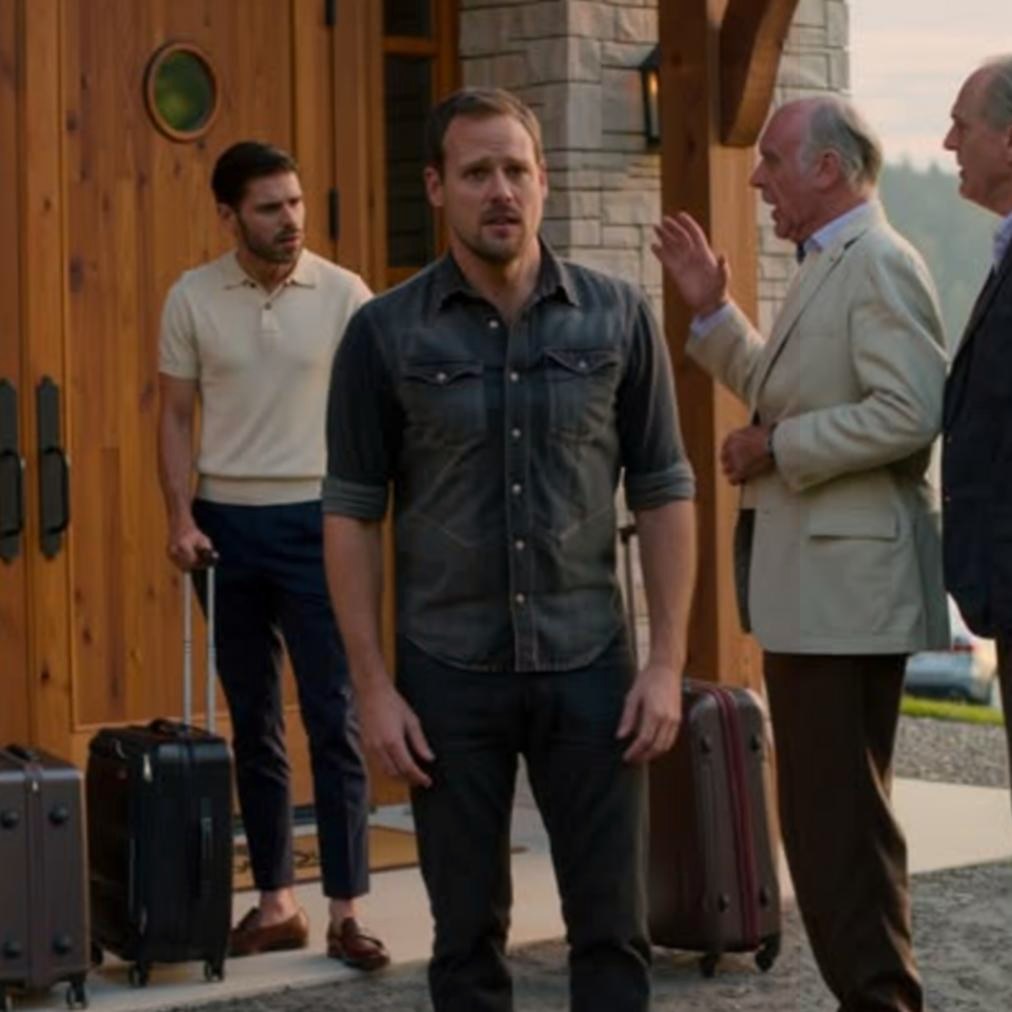

“I never issued a power of attorney,” I told the bank employee.
Everyone in the room fell silent.
Julian let the phone slip from his hand. When it fell onto the floor, the screen cracked.
“This is something else now,” Clara said.
Salome raised her hand.
“No one is leaving. Harrison, keep the call on speaker.”
The bank employee explained that the application had been submitted the previous evening, at six twelve. The amount was two hundred and fifty thousand dollars. My lake house was listed as collateral, while Julian Cole was named as the applicant’s representative.
“How did they get my personal data?” I asked.
“The application includes a copy of an identity document, tax documents, and a power of attorney. Everything appears to be in order externally.”
Externally.
That was exactly how Julian’s signature looked too.
“Send us all the materials,” Salome said. “Now.”


Julian moved toward the door.
“I did nothing.”
“Then you will easily prove that to the police,” I told him.
“Harrison, please.”
For the first time in three weeks, I heard fear in his voice.
And I no longer had the desire to make room for his fear.
Salome immediately called the police, while Nora called Clara’s parents. A few minutes later, Clara’s father canceled the hotel reservation and told Julian to return the paid money that same day.
Julian contacted Mom.
“Mom, talk to him!” he shouted in the corridor. “Tell him that all this is destroying the family!”
Salome looked at him.
“A family is not built by forging documents.”
Julian fell silent.
At half past eleven, two police officers arrived. One placed handcuffs on the table, but did not use them immediately.
“Mr. Cole, please come with us to give a statement as well,” he told me.
Julian looked toward me.
“You are doing this?”
“No. I am simply no longer covering up what you did.”

He shook his head.
“You are my brother.”
“That is exactly why I believed I would never have to stop you.”
The police officer addressed Julian:
“You must come with us too.”
“This is a misunderstanding.”
“The investigator will determine that.”
Julian’s hands were cuffed in front of him. Clara stood by the wall and cried, but in her tears there was no longer any anger toward me.
At the police station, that same day, they played for me a voice message sent by Julian. For the first time I heard my own brother’s voice from the other side of the room, as if he were a stranger.
“Harrison will always give in. He needs a little pressure. In the end his conscience will bother him anyway. The house is his, but we are the family.”
At the end of the recording, his laughter was heard.
Julian was sitting right there.
His face slowly emptied.
“Did I say this?” he asked in a whisper.
“Yes,” the investigator answered. “You did yourself.”
For the first time he heard his own words as others heard them.

That evening I went to my parents’ house for only one purpose—to take their things out of the lake house. Mom met me at the door. She held a copy of my keys.
“I was giving this to Julian only to help,” she said.
“When did you make a copy of my house key?”
Mom looked away.
“Last summer.”
Dad was standing in the living room. A photograph from my childhood lay on the table, its frame tilted.
“We thought you were doing everything for the family,” he said.
“I was. But you thought that because of it I was obligated forever.”
Mom held the keys out to me.
“Julian may go to prison.”
“That is not my wish.”
“But you will allow it.”
“I am only allowing the consequences to belong to his decisions.”

I arrived at the lake house that same night. It was Friday, ten o’clock. Tire tracks could be seen in the yard. No one had entered the house, but a family photograph that had hung on the wall in the living room was lying on the floor. It was not broken. Someone had simply taken it down and left it there.
I entered the bedroom.
On the shelf where the key box stood, I found an empty place. My brass lighthouse keychain was no longer there.
I searched through the entire house.
I found it in the kitchen drawers.
Someone had taken the keychain with them and then, probably frightened, put it back. The crack on the tip of the lighthouse was still visible. Small, but familiar.
That night, for the first time, I did not lock the door to protect the family.
I locked it to protect my peace.

The case continued for several weeks. The bank canceled the application. The examination confirmed that the signature on the power of attorney had been created with a digital copy. Julian returned part of the money to Clara’s parents, and had to sell his car for the rest.
He was charged with attempted fraud and document forgery. Mom and Dad refused to speak with a lawyer. Salome also told me clearly:
“I will no longer represent your family for free. I protect the truth, not kinship.”
Julian made an agreement and received a sentence that no longer included imprisonment, but there remained a suspended sentence, a fine, and a full obligation to return the money.
I did not want to humiliate him in court.
I simply wanted my house to be mine again.
Three months later, in November, my little niece Emma came to the lake house for the first time. Clara was raising her alone. Julian saw her once a week and never again arrived late for those meetings at the agreed time.
Emma stood in the living room and looked at the frozen lake through the window.
“Uncle Harrison, why don’t many guests come here anymore?”
“Because this house is now only for those who want to be here, not for those who think they own it.”
She lowered her head and drew a picture on the floor with colored pencils. It was a small house, and beside it a lighthouse.
“This is you,” she told me.
“The lighthouse?”
“No. The house. You are the light.”

For a long time I could not say anything to her.
That winter my firm moved on to a larger project. I worked from the lake house two days a week. In the morning I lit the wood stove, drank coffee from a small white cup, and in the evening I locked all the doors myself.
No one wrote to me anymore to ask me to do something “for the family, at least once.”
One day I received a letter from Julian. It was short.
“Could we perhaps start over someday? This time on your terms.”
I placed the letter on the kitchen table.
I wrote the answer in the evening.
“Starting over means acknowledging that the old relationship has ended. I want good things for you, but I can no longer pay for your decisions with my peace. If we ever speak, it will only be after responsibility.”
I sent it.
I felt neither victory nor revenge.
Only silence.

The following week the first snow came. I went out into the yard in the morning. The lake was disappearing into white fog. I put my hand into my pocket and took out the brass lighthouse keychain.
It still had the crack.
But it no longer seemed damaged to me.
Some things continue to hold light even with a crack.
I slid the keychain into the door lock.
And this time I was the only one who locked the door.
Missed the beginning?
Related posts:
 My husband humiliated me in front of everyone on his birthday, but the moment I took the microphone, his smile disappeared
 My Former Partner Accused Me of Selling the Song on Stage, but One Calm Question from Me Would Drain the Color from His Face
 My daughter-in-law rented my mother’s lake house for a party, but after my calm response my husband stopped speaking
 My brother deleted me from the wedding, then demanded the key to the lake house — but after my calm answer, the color drained from his face
 I Went to the Cemetery with Five Children, and My Ex-Husband’s Gaze Suddenly Froze
 My Mother Screamed When I Touched Her in the Bathroom, While Downstairs My Brother Smiled Strangely and Fell Silent at Once