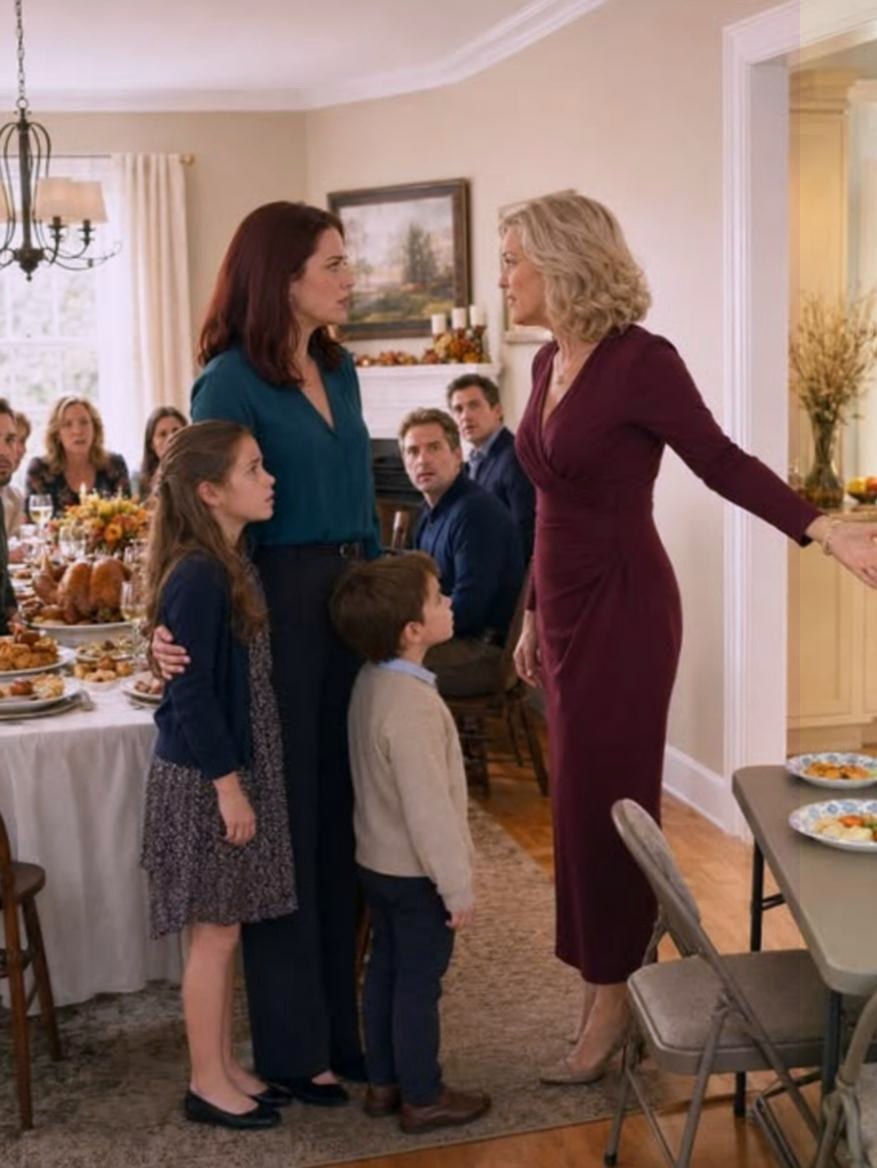

At the Thanksgiving dinner, in front of everyone, Mother told my two children that their place was not at the family table but in the corner, and that was exactly when I realized that I would not return to this house again.
It was half past five in the dining room. Raindrops fell against the windows, while the smell of roasted turkey, cinnamon, and hot bread stood over the table. In my hand I held my small copper thermos, which had a moon-shaped scratch on its side. I carried it with me every holiday because I poured apple juice for the children on the way.
Then I saw the folding table set up in the corner.
There were three plates of different sizes on it and two completely different chairs stood there. The main table, however, was beautifully set: a white tablecloth, silver spoons, glass cups. My mother, Janevra, my brother Hollis, his wife, and their children were already sitting there.
Mother looked directly at me and smiled.
“Here is where the poor relatives will sit,” she said.
Her voice seemed to be joking, but she said it loudly enough for everyone in the room to hear.
Hollis’s boys snickered.
My eleven-year-old son, Rowan, looked first at me, then at the little table in the corner. Eight-year-old Beckett followed his gaze.
At first they did not understand.
Then they understood.
Beckett’s fingers caught in the sleeve of his shirt. Rowan pressed his lips together. Something cold and heavy descended inside me, but I did not show it on my face. At that moment the children needed not my shame, but my calmness.
“Mother, it was a joke,” my sister Variti whispered.
“Then why aren’t you laughing?” I asked.
Silence fell over the room.
Janevra shrugged.
“Don’t dramatize, Saskia. You have always been overly sensitive.”
I looked at her hands. She wore expensive rings on her fingers, the purchase of which she had proudly mentioned to me for years. Then I looked at my children.
“Put on your coats,” I told them.
“Where are you going?” Hollis asked, but he did not lift his head from his plate.
“Home.”
“You haven’t even started eating yet,” Mother said.
“I’ll at least leave the bread,” I added.
“Leave it,” she replied. “There will be enough for everyone.”
My hand squeezed the thermos so tightly that the moon-shaped scratch scraped my skin. I liked the pain. It was real. In that room, everything seemed to be a performance staged for years.
No one followed us.

In the yard, at six in the evening, the rain grew stronger. The children sat silently in the back seat of the car. I placed the thermos between them. The engine stalled twice before I got onto the road.
Twenty minutes later Beckett asked quietly:
“Mom, are we poor?”
I took my hand off the steering wheel and stopped the car at the side of the road. In the rearview mirror I saw his wet eyes.
There are questions a mother should never have to hear, because someone said one sentence to prove their own importance.
“We have less money than some people,” I told them both. “But that does not mean we have less dignity.”
“Then why did she seat us there?” Rowan asked.
I knew the answer, but I could not say it yet.
They did not know that six years earlier, before his death, Grandfather had left a secret for me. Hollis did not know either. Neither did Variti. Mother only thought that everything was in her hands.
That night, when the children were asleep, I remained alone in the kitchen. On the table lay cold tea, the leftover bread wrapped in a napkin, and a folder of my father’s old documents.
On Monday I would open that folder together with attorney Margarete Vos.
The telephone rang at nine in the morning. Margarete’s name appeared on the screen. She said only this:
“Saskia, the bank has traced the money. And the address is… your family home.”
I placed my hand on the folder. Margarete turned over another sheet and told me that it contained the name of a person I absolutely did not expect to hear. My finger moved toward the folder’s clasp…
My fingers stopped at the clasp.
“Margarete, whose address do you mean?” I asked.
A rustling of paper sounded on the other end of the line.
“First you must promise me that you will not go to that house alone.”
“That is my parents’ house.”
“No, Saskia. That is exactly the problem.”
I went to the window. The cold morning light fell across the kitchen floor. In the corner stood the small baking mold Beckett had placed by the oven, in which we had baked a pie the previous evening. I could still remember its smell.
“Tell me whose name is on the document.”
Margarete sighed.
“Daniel Hollis. Your sister’s husband.”

I could not move.
Daniel had a new car. Expensive golf clubs. At celebrations he talked about things no one could afford on an ordinary salary. I saw all of it and still believed that their business was simply going well.
“That is impossible,” I said.
“The signature is forged. The money came out of the education fund.”
“The children’s fund?”
“The fund of all six children.”
I felt coldness in my stomach. My father had left this money for his grandchildren. And he had given me responsibility because I protected everything and trusted everyone.
Margarete added quietly:
“And there is one more thing. One week before the withdrawal, a person came to the bank who had your mother’s power of attorney.”
At that moment I realized that this was no longer only Daniel’s deed.
“Mother knew?”
“This morning we received a record confirming it.”
Margarete did not finish the sentence because someone’s voice sounded in her office.
“She is already here,” she whispered. “And she is demanding the door…”
Someone knocked on the door three times.
It was ten in the morning in Margarete’s office. The clock hanging on the wall ticked so loudly, as if every second were working against me. Margarete left the telephone on speaker and placed her hand on the door key.
“Do not open it,” I told her.
“I have already called the police,” she replied. “But first you need to know what we possess.”},{
She pushed the folder toward me. Inside were bank statements, a signature examination, and a copy of the camera recording. Margarete switched on a small screen.
The bank corridor appeared in the recording. Daniel stood at the counter. Beside him was my mother. Janevra held my father’s dark green folder in her hands.
In the video Daniel asked:
“If the money is in the children’s names, how do I withdraw it?”
Mother answered:
“Saskia will not interfere. She thinks that she still loves the family.”
The blood in my body seemed to freeze all at once.
The recording continued.
“What if she finds out?” Daniel asked.
“She will not find out anything,” Mother said. “She has spent her whole life trying to be convenient for us.”
Margarete turned off the video.
“The money was withdrawn in installments over six months,” she told me. “Two hundred and eighty thousand lari in total. Daniel paid debts, and Mother helped him use the power of attorney at the bank.”

“Did Hollis know?” I asked.
“We do not yet have evidence that he knew.”
“Variti?”
“Nothing about her either.”
Someone knocked on the door again.
This time I heard my mother’s voice.
“Saskia, I know you are here. We need to talk.”
Margarete turned toward me.
“Now you must decide whether you will let her in.”
I looked at the frozen image on the screen. On my mother’s face was the calm smile she had worn on Thanksgiving. Suddenly I realized that she had not said her cruelest words at that little table by accident. She thought I would remain silent again.
“Open it,” I said.
Janevra entered the room. Daniel followed behind her, holding an expensive leather bag. Daniel did not look toward me.
“This is a family matter,” Mother said.
“No,” I answered. “This is the children’s money.”
Daniel opened the bag.
“We can return the money to you.”
“When?”
He looked at me for the first time.
“We need a little time.”
“You had six months.”
Mother struck the table with her hand.
“You always ruined everything, Saskia! We were one family!”
“A family does not secretly take children’s savings.”
Margarete took out another sheet.
“Besides the money, the bank discovered that the fund’s main account had been transferred to another address. And the transfer could be made only with the guardian’s consent.”
Mother’s face changed.
“That does not matter,” she said.
“It does,” Margarete replied. “Because the guardian is not Janevra, but Saskia.”
Daniel closed the bag. My mother seemed to see for the first time that she no longer had power in the room.
At that very moment a message arrived on my phone. The number was unknown.
“If you go to the police, we will come to your children’s school.”
I handed the phone to Margarete. She read it, then her face hardened.
“This is a threat,” she said.
Mother quickly raised her head.
“I did not send it.”
“But do you know who sent it?” I asked.
She did not answer.
Margarete locked the door and called the police. The sound of a siren could not yet be heard outside, but I already knew: now this was no longer only about the stolen money. My mother still had one hidden secret, and it was connected to the person who needed my children’s fear as a weapon…
დედამ ბოლოს გაიგო, ვის ეკუთვნოდა ნამდვილი ძალა…
მე მეგონა, რომ ყველაზე მძიმე უკვე გადავიტანე. მაგრამ ფინალმა მაჩვენა, რამდენად ძვირი შეიძლება დაჯდეს წლების განმავლობაში დუმილი.
„ადამიანებისთვის კუთხე არ არის.“
მე პირველად მშვიდად გავიღიმე.
😱 გაიგე, რას მალავდნენ ისინი →
👇 ისტორიის ფინალი უკვე გახსნილია
Related posts:
 I always protested leaving three children for free, but after my calm answer Sloan’s smile suddenly disappeared
 A Flat Tire Stopped Me at a Desert Diner, but When the Waitress Heard My Name, the Color Drained from Her Face
 I took my mother from the house, but when my brother opened her room with a duplicate key, the color drained from his face
 When They Considered Taking My Mother to the Doctor Humiliating, the Color Drained from My Husband’s Face and a Heavy Silence Fell over the Room
 On the third day after my C-section, three children were left at my door, but after the call my husband’s face turned pale
 After My Husband’s and Daughter’s Funeral, My Mother Asked Me for the Insurance Money, but the Bag on My Table Suddenly Erased Her Smile