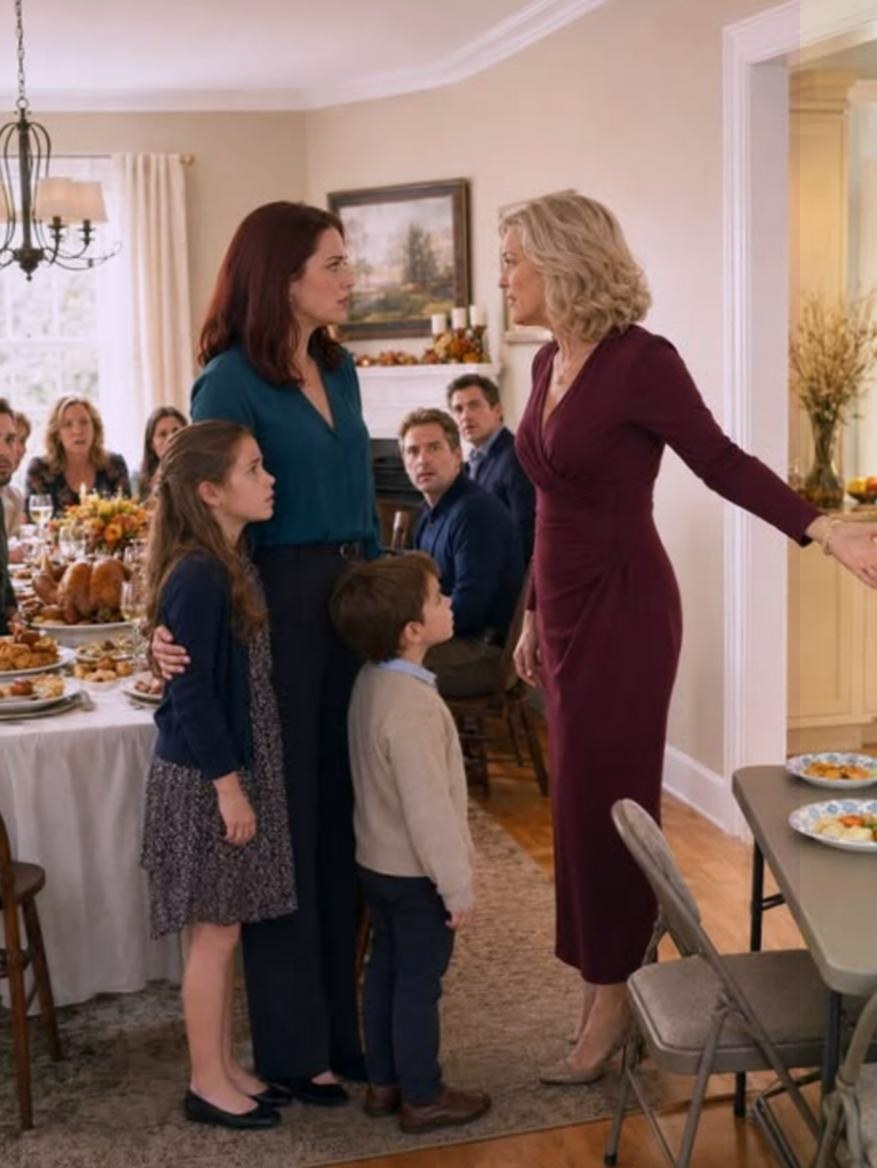

The first sound of the siren came from the end of the street.
My mother looked toward the window and intertwined her hands. Daniel seized the leather bag.
“This is a mistake,” he said. “We came here to talk.”
“Take your hand off the bag,” Margarete told him.
“I need a lawyer.”
“You already had one. For six months they were losing money instead of you.”
Daniel took out his phone. First he called Hollis, then Variti. Both calls went unanswered.
On the third call the lawyer answered.
“It is over,” he said after a brief conversation. “I can no longer represent you.”
Daniel froze.
“What do you mean, you can’t?”
“There is a conflict of interest. The bank records are already with the investigator. Find another lawyer.”
The call ended.
Mother turned toward me.
“You will not do this.”
“I already did.”
“We are your family.”
“That is exactly why I gave you so much time.”

The police officers entered. Behind them stood a bank security employee and a female investigator. Everything in the room suddenly became very small: the bookcase, the low table, my mother’s bag, the keys that had slipped from Daniel’s hand.
The investigator told me that the recording, the signature examination, and the banking trail were sufficient grounds to begin an investigation. Daniel immediately denied everything.
“I was only asking for help,” he said. “Janevra told me she had the right to the money.”
Mother turned her head toward him.
“You are a liar.”
“You told me Saskia would never find out about this!”
A heavy silence fell over the room.
Daniel heard his own words himself.
He fell silent.
Mother heard them too.
Margarete turned on the audio recording. It was the very conversation in which Daniel said that they could no longer hide the money, while Mother answered that I had been silent my whole life.
Janevra covered her ears with her hands.
“Turn this off.”
“That is your voice,” the investigator said.
“I was unwell. I do not remember.”
“The date and time are on the recording.”
My mother looked toward me. For the first time she could not find a word with which to stand above me.
The police opened Daniel’s bag. Inside were several checks, a car-purchase contract, and forged samples of my father’s signature. The main account was temporarily frozen, while the remaining money was to be returned to the children’s fund under court supervision.
Daniel was taken away.
Mother was also taken in for questioning, although she was not arrested that day. The investigator told me that the case would go to the prosecutor’s office and that the question of charges against both would be decided after a full examination of the evidence.
I was not happy.
I could not even feel relief.
I had only exhaustion. The kind that gathers in the bones when a person strengthens someone else’s lie with their own patience for years.

In the evening Hollis called me.
“I did not know anything,” he said.
“Do you believe that Daniel and Mother stole the money?”
“I heard the recording.”
“Then you know.”
He was silent for a long time.
“Can you forgive me for not saying anything at that table?”
I stood by the window. Outside, the rain had stopped, but the trees were still shedding water.
“Forgiveness is possible,” I told him. “Trust has to be built again.”
“How?”
“Tell the children that their place was never in the corner.”
“I will.”
“And do not cover Mother with your own silence anymore.”
“I will not cover her anymore.”
That same week I saw the little folding table in my mother’s house, in the hallway. The investigators had already left. The house seemed empty and strangely quiet.
There was no turkey on the table anymore.
Nor silver spoons.
Only one broken glass by the floor and the little table remaining in the corner stood there. Golden candle wax from Janevra had spilled across its surface.
I ran my hand over it.
Then I remembered how I had held the copper thermos that day. The moon-shaped scratch was still held in my palm, although the thermos had remained in the car.
I took nothing from the house.
Neither a photograph.
Nor Mother’s old letters.
Nor the childhood doll that I kept under the bed.
I took only my calmness with me.
Three months later the court confirmed that I had had full control of the fund from the beginning. Part of the money was returned, and an agreement was made with Daniel for the return of the rest. He was charged with debt, fraud, and forgery of documents. Mother was sentenced to community service, a fine, and strict court supervision.
I did not smile at a single hearing.
Nor did I meet their punishment with joy.
I simply repeated each time that the children’s future was not something to cover up family embarrassment with.


In spring we moved to another city. Into a small, bright house that had a wide window in the kitchen. I started a new job at a clinic. In the morning I memorized the patients’ names, and in the evening I helped Rowan with mathematics. Beckett baked an apple pie every Saturday and put flour on his nose.
Our new table was not large.
But all four chairs were identical.
One evening, when the first snow fell, Rowan asked me:
“Mom, is Grandfather’s money still in our fund?”
“Yes.”
“And are you still its protector?”
“Yes.”
Beckett drew something on a sheet of paper and pushed it toward me.
In the drawing, four people sat at one table. Beside the table there was a small corner, but it was empty.
“What is this place for?” I asked.
“For bags,” he told me. “Not for people.”
My heart contracted.
That night Mother sent me a letter. Then another one. Finally I received a short message.
“I miss you. Come, let us start everything over.”
I looked at the screen for a long time.
I could have answered with anger.
I could have recalled every birthday when she had given me less attention, every dinner where she seated me by the wall, every occasion when she turned my independence into a lack of love.
But I no longer wanted to defeat her.
I wanted to get my life back.
I wrote:
“I wish you peace. But you will no longer be able to return to me and my children. We have already found our place.”
Then I deleted the message.
Not because I was waiting for an answer.
But because for the first time I did not need her approval to prove my decision.
That evening I placed the copper thermos on the shelf. The moon-shaped scratch caught the light coming in through the window. Beside it Beckett was drawing a little paper moon, while Rowan was arranging books on the table.
Outside, snow was falling silently.
All four of us sat at one table.
This time no one seated us in the corner.
And for the first time I understood that no one gives you a place.
You build your own place yourself.
Missed the beginning?
Related posts:
 A Flat Tire Stopped Me at a Desert Diner, but When the Waitress Heard My Name, the Color Drained from Her Face
 Father Left Houses to My Brothers, but Burdened Me with Mother’s Life — Yet My Brother’s Smile Suddenly Disappeared
 I always protested leaving three children for free, but after my calm answer Sloan’s smile suddenly disappeared
 After My Husband’s and Daughter’s Funeral, My Mother Asked Me for the Insurance Money, but the Bag on My Table Suddenly Erased Her Smile
 My husband gave flowers to his former lover, and I left the hall — behind the cameras, his smile disappeared
 I Asked a Man as Strict as My Father for My Mother’s Wages, but When the Boss Dropped the Keys to a New Car, Everyone Held Their Breath