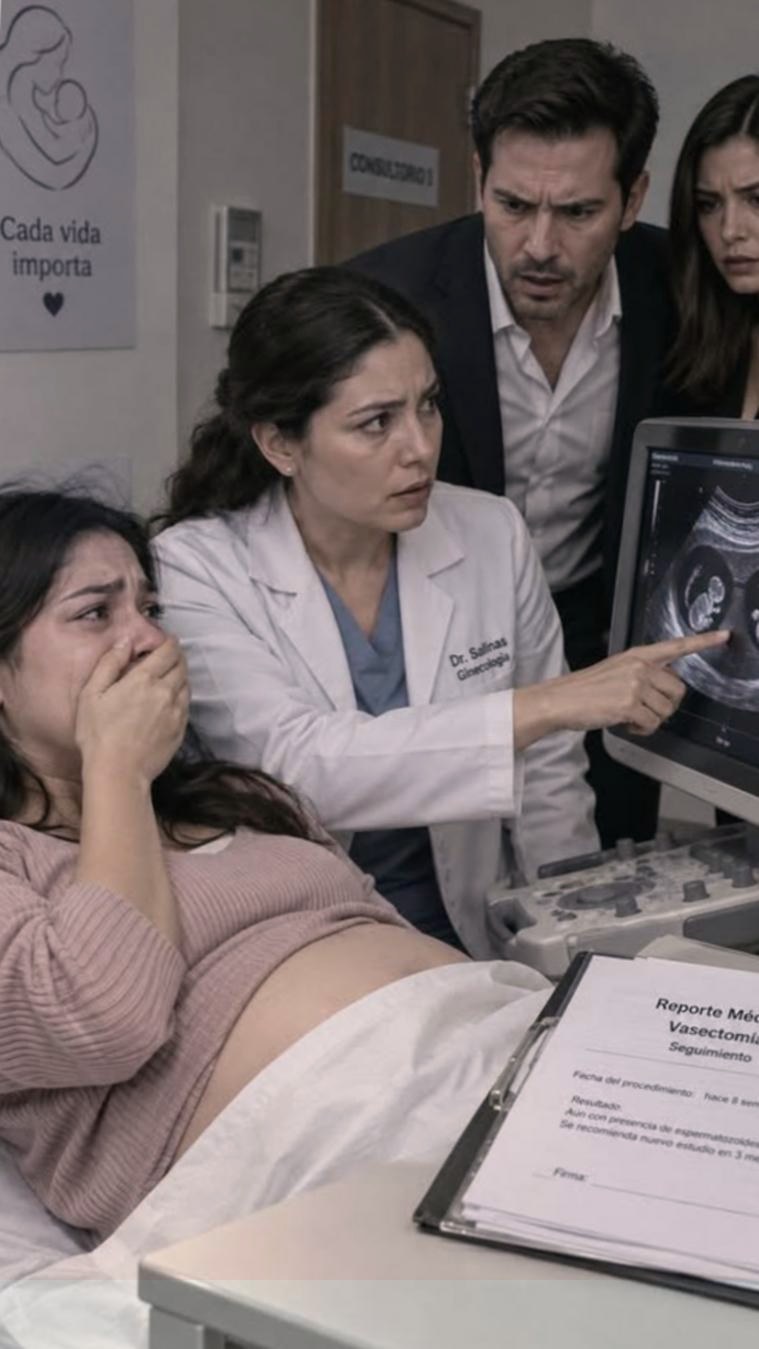

The unknown man said:
“If she does not sign, we will remove her from the house by force.”
Silence fell on the other side for several seconds. Then Diego’s voice was heard.
“Only before the children are born. After that she will no longer be able to do anything.”
The phone fell from my hand.
I was standing in my kitchen. A ripe lemon lay on the windowsill, and the smell of boiled tea filled the room. I listened to the recording once more, then a third time.
It was Diego’s voice.
Not altered, not cut. Exactly the voice that for eight years had told me that everything would be all right.
I called my lawyer immediately.
“Who is the other man?”
“A private security employee whom Diego hired,” he replied. “He provided us with the recording himself. He refused to work for them when he found out that you were pregnant.”
“And now?”
“Now we have grounds to ask the court for a protective order.”

The phone rang again.
It was Diego.
I did not answer.
He called a second time.
And the third time he sent me a message.
“Laura, all this has gone too far. Let’s just talk.”
The lawyer told me not to reply.
But a few minutes later the doorbell rang.
I placed the chair against the handle again. It was exactly the same little wooden chair that I had put in front of the door that first night, when I thought I only had to be afraid of Diego’s shouting. Now I already knew that plans stood behind him.
“Laura, open the door,” he called.
From behind the edge of the curtain I saw him standing in the yard. He was alone. He was no longer holding a folder.
“I will not touch you anymore,” he said. “Just listen to me.”
“I have already heard everything.”

He fell silent.
“This recording is illegal,” he finally said.
“Your words did not become illegal only because they were recorded.”
His breathing shook the door.
“I wanted to protect the family.”
“You do not protect a family by throwing a pregnant wife out of the house.”
“Paola made me lose my head.”
“Paola was not making decisions in your place.”
When I said these last words, I felt for the first time that his shadow had remained on the other side of the door. Before, I listened to any explanation of his because I wanted to save the marriage. Now I only wanted to protect the safety of myself and the children.
That evening a police officer came and gave me a copy of the protective order. Diego was forbidden to approach the house. He read the document and clenched his hand so tightly that his fingers turned white.
“Are you also on her side?” he asked the police officer.
“I am enforcing the document, sir.”

That was the first time Diego heard his own words through someone else’s mouth. The police officer read one phrase from the recording aloud:
“Before the children are born. After that she will no longer be able to do anything.”
Diego froze on the spot.
That confident expression with which he had pushed the folder at me in the café was gone from his face. Only one thing could be seen there: a man who had heard his own voice from the outside for the first time.
“I did not mean it that way,” he whispered.
“But that is what you said,” I answered.
Then I closed the door.
The divorce process lasted several months. Diego’s lawyer initially tried to deny all the evidence, but he could no longer separate the audio recording, bank statements, Paola’s written testimony, and the doctor’s conclusion from one another.
Paola came to court in a simple black coat. She was no longer wearing the earrings. She said that Diego had hidden the true state of our marriage from her and had lied to her about his vasectomy.

My mother-in-law also finally called me.
“Laura, I did not know everything,” she said.
“But you knew that you had not yet listened to me.”
“He is my son.”
“I was also part of your family.”
She was silent for a long time.
“Will you forgive me?”
I stood by the window and watched a bus traveling along the street.
“I may be able to forgive you someday, but I can no longer return to the old house.”
The court divided the house based on our rights. The children and I retained housing, while Diego was awarded his share after the sale. He was ordered to pay alimony and part of the children’s medical expenses.
He did not lose everything on the day the judge announced the decision.
He lost everything earlier, when he decided that humiliating me would be easier than hearing the truth.

Mateo and Lucia were born at the beginning of summer. Two little cries mixed together in the maternity room. I was looking at one of them, while the midwife held the other in her arms.
Diego stood in the corridor.
“May I come in?” he asked.
His eyes were red that day, but I no longer knew whether it was remorse or fear.
“You will see the children when the doctor says it is safe,” I answered. “You do not need to talk to me anymore.”
He nodded.
Six weeks after their birth, I moved into one small room of the house. I painted the walls white. I placed two beds by the window. In the closet I arranged their tiny clothes: Mateo’s green socks and Lucia’s yellow hat embroidered with a little sun.
The old bedroom remained empty.
Only our wedding photograph remained there, attached to the wall. One day I took it down. In the photograph Diego was smiling, while I stood beside him and still believed that promises endured on their own.
I put the photograph in a drawer.

Not so that I could look at him.
So that I would remember how much I had learned.
Five months later I moved into a small apartment near the metro station. In the mornings I fed the children, then worked part-time in the hospital administration. In the evenings, when both of them fell asleep, I sat by the window and wrote down the expenses.
Before, Diego took care of the money.
Now I managed my account myself.
I met the first snow together with the children on the balcony. Mateo reached his hand toward the flakes, and Lucia began to laugh. They did not yet know how many doubts had passed before their birth.
One evening Mateo drew three people on a sheet of paper. One large woman, two small circles, and a yellow sun above them.
“Who is this?” I asked.
“Mommy, me, and Lucia,” he told me.
“Where is Dad?”

Mateo took the pencil, thought for a while, and drew very small lines in the corner of the sheet.
“He is far away.”
Lucia took my hand.
“We are here.”
That night I looked at their sleeping faces for a long time. The court, the doctor, and all the documents confirmed only the facts. But their breathing meant more to me than any decision.
A few weeks later Diego sent me a letter.
“I want to start over. Now I know that everything was my fault. Children need a father.”
I read the letter to the end.
Then I wrote a reply:
“Children need a responsible father, not an old marriage. You will be able to see them according to the procedure established by law. But do not ask to return to our life.”
I pressed the send button calmly.
I had no fear.
No anger.
Only clarity.

In the evening I looked at the little wooden chair that I had once placed by the bedroom door. Now it stood in the children’s room. Mateo’s sheet lay on it, with three figures and a yellow sun drawn on it.
I also draped Lucia’s little hat over the chair.
I left the door open.
This time I was not waiting for anyone.
Missed the beginning?
Related posts:
 After the Pregnancy News, My Husband Humiliated Me at the Clinic with His Lover, but One Question from the Doctor Suddenly Changed His Face
 I lay unconscious on the floor with my child when my husband made one call and lost the color in his face
 When I Returned Home, I Saw That My Parents Asked Permission Even in Their Own Kitchen, and My Brother’s Smile Suddenly Disappeared
 My Husband Left Me at Home for the Most Important Contract, but One Question from My Father in the Hall Took His Smile Away
 A Flat Tire Stopped Me at a Desert Diner, but When the Waitress Heard My Name, the Color Drained from Her Face
 I always protested leaving three children for free, but after my calm answer Sloan’s smile suddenly disappeared