
That voice was mine.
I recognized its low, tired tone immediately, even though the recording was from eight years earlier.
“No,” I said.
Victor put the phone on the table.
“Caleb, listen to me.”
“Is that my voice?”
“You were ill.”
“Is that my voice?”
Elena played the recording again. My past voice sounded through the room.
“If anything happens to Audrey, you will hand everything over to Victor. I will not be able to stand. I will not be able to run the port. He knows how to convince me.”
Then Audrey’s voice was heard.
“Caleb, look at me. You do not want the medicine. You are afraid that if you stand up, you will have to find out who deceived you.”
Something fell in the recording. Audrey screamed. Then Victor’s voice was heard.
“He has already believed it. Now we only need time.”
Cold spread through my chest.
For eight years I thought that Audrey’s death had broken me. Now I understood that after her death someone had used my grief as a lock.
Victor picked up the phone and backed toward the door.
“You cannot use this recording in court. The memory card is damaged.”
“But the voice is yours,” Daniel said.
“You are security, not an expert.”
“Today I will become both, if necessary.”
Victor called the house number. No one answered. He called a second time. A third.
“Someone should have stopped them,” he muttered.
“Who are they?” I asked.
For the first time he looked at me like a person he could no longer deceive.
“The port council. They were using your condition. If the truth is revealed, every deal will be canceled.”

“And Audrey?”
Victor lowered his eyes.
“Audrey discovered everything. I only wanted to silence her.”
“Only?”
Lily’s small hand remained on my wrist. Her fingers were cold, but they held me firmly.
“My mother said that Mrs. Audrey was asking for help that night,” she said.
Victor looked toward her.
“You heard nothing.”
“I heard,” Lily replied. “Mother hid me in the kitchen that night. You told her that if she called the police, you would make her lose my brother.”
The sound of footsteps came from the corridor.
Sofia, Lily and Tomas’s mother, entered, holding an old cloth bag. Her face was pale, but this time she did not step back.
“I kept silent for eight years,” she said. “Because I was afraid. But these children must not grow up believing that the truth belongs only to the rich.”
She took a small voice recorder out of the bag.
“Audrey gave this to me that night. She told me that if she did not survive, I should give it to you.”
Victor stepped back.
There was a loud knock at the door.
“Federal investigators! Open the door!”
Victor moved his hand toward the weapon, but Daniel quickly seized his wrist.
“Do not,” I told him.
“You do not understand what you are starting.”
“For the first time I understand exactly.”
The door opened. Three investigators entered. In their hands they had a court warrant and copies of the port accounts. Victor’s lawyer came ten minutes later, but after hearing the recording, he no longer even wanted to speak with me.
“I cannot defend you,” he told Victor. “You wrote a confession with your own hand.”
Victor sat down in the armchair.
That same evening I heard his words again, this time on a large screen in the port security room. The camera had recorded him saying that he changed the accounts in my name and sent my medical records to the doctors.
When his face heard its own voice, he lost for the first time the cold expression with which he had frightened the entire city.
“I did not say this,” he whispered.
“You did,” the investigator replied.
Hearing his own words from the outside turned out to be the harshest punishment.

Victor was arrested. The port council canceled all his positions. The falsified reports were handed over to the investigation, and the doctors confirmed to me that for years my body had been capable of much more than I thought.
But that night I thought neither about Victor’s arrest nor about the millions lost.
I opened my room for the first time.
Everything there stood as Audrey had left it: a book beside the bed, a glass cup by the window, and a white shawl hanging over the back of the armchair. Our photograph hung on the wall. Audrey’s fingers rested on my hand.
I left the metronome on the table.
Its brass body was rusted, and the crack on its glass cover glimmered faintly.
Two weeks later I took my first step at the clinic.
One.
Then a second.
I fell on the third and laughed. Elena looked at me.
“Are you in pain?”
“Very much.”
“Then why are you laughing?”
“Because this is my pain. For the first time it belongs to me.”
Three months later I moved to a small seaside town. I temporarily left the management of the port to others and opened a rehabilitation center for children. There were neither dark wooden panels nor armed security on its walls. Only wide windows, colorful balls, and a wooden floor.
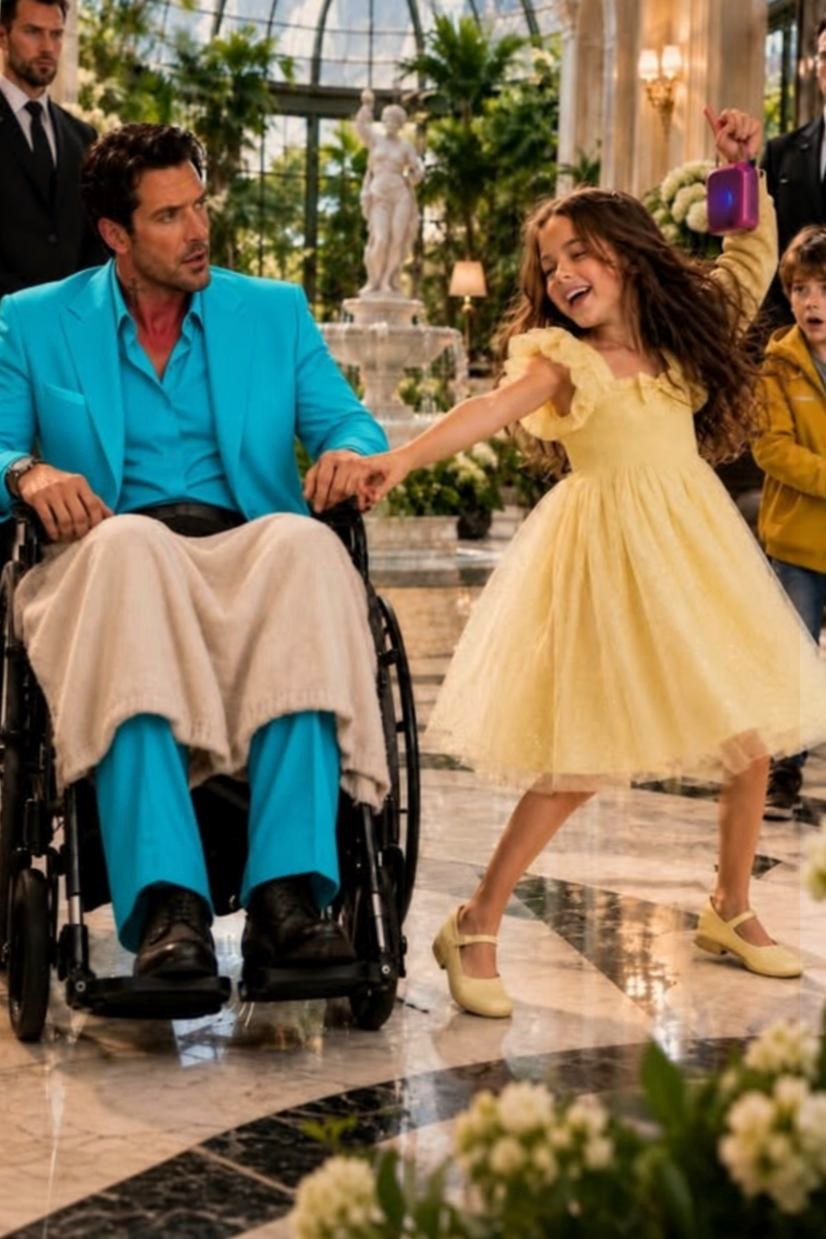
Lily came every Saturday. She taught the children to dance, although she still danced terribly. Tomas played the music and no longer tried to hide it.
One evening Lily brought me a sheet of paper.
“I drew you.”
In the drawing stood a large man, and beside him a little girl. The man’s legs were tangled together, and the girl held a metronome in her hand.
“Why am I so tall?” I asked.
“Because in the end you grew taller.”

The first winter snow came in November. I stood by the window and watched the yard turn white. My leg still hurt. Sometimes I needed a cane. But doors no longer closed by themselves in front of me.
Six months later I received a letter from Victor. He had sent it from prison.
“I am not asking you for forgiveness. I only want to talk to you once. I know I destroyed everything, but perhaps we could be brothers again.”
I looked at the letter for a long time.
Then I asked Sofia what she would do.
“You decide, Mr. Marino.”
“Do not call me ‘sir’ anymore.”
She smiled.
I did not send the letter. In reply I wrote only one sentence and gave it to the lawyer.
“It is no longer my duty to save you from your loss.”
That same evening Lily was dancing again in the center. Tomas was laughing. The children were slapping their hands on the floor.
I stood by the wall and held the little brass metronome in my hand. The crack was still visible, but now the sound could be heard clearly.
Tick.
Tock.
Tick.
Tock.
Lily turned off the music.
“Now you will dance,” she told me.
“I cannot dance.”
“You have been saying that for eight years.”
She held out her hand.
I looked at her little fingers, then at the metronome, and finally at the foot that had once been a prisoner of someone else’s lie.
I took her hand.
I took one step.
Then a second.
I took the third without music.
The brass metronome in my hand calmly continued counting the beat.
This time I followed not fear, but the sound.
And the door that I had thought locked for eight years closed forever behind me.
Missed the beginning?
Related posts:
 Eight Years Later, His Leg Moved When a Little Girl Entered the Forbidden Room — and the City’s Most Dangerous Man Lost His Smile
 When my husband spoke about me in English to his family, I understood everything and watched his smile disappear
 I sang every night at her mother’s bedside, but when the girl appeared at the hospital, her first words froze me
 I Sheltered an Abandoned Woman at a Snowy Stop, but When the Black Car Stopped, Her Father Smiled Strangely
 Nyolc év után a lábam megmozdult, amikor a cselédlány kislánya kigúnyolta a város legrettegettebb emberét — ő pedig elsápadt
 I saw a new bandage on my niece’s shoulder at the camp, and on the way my sister ordered me to turn back — her voice suddenly cut off





