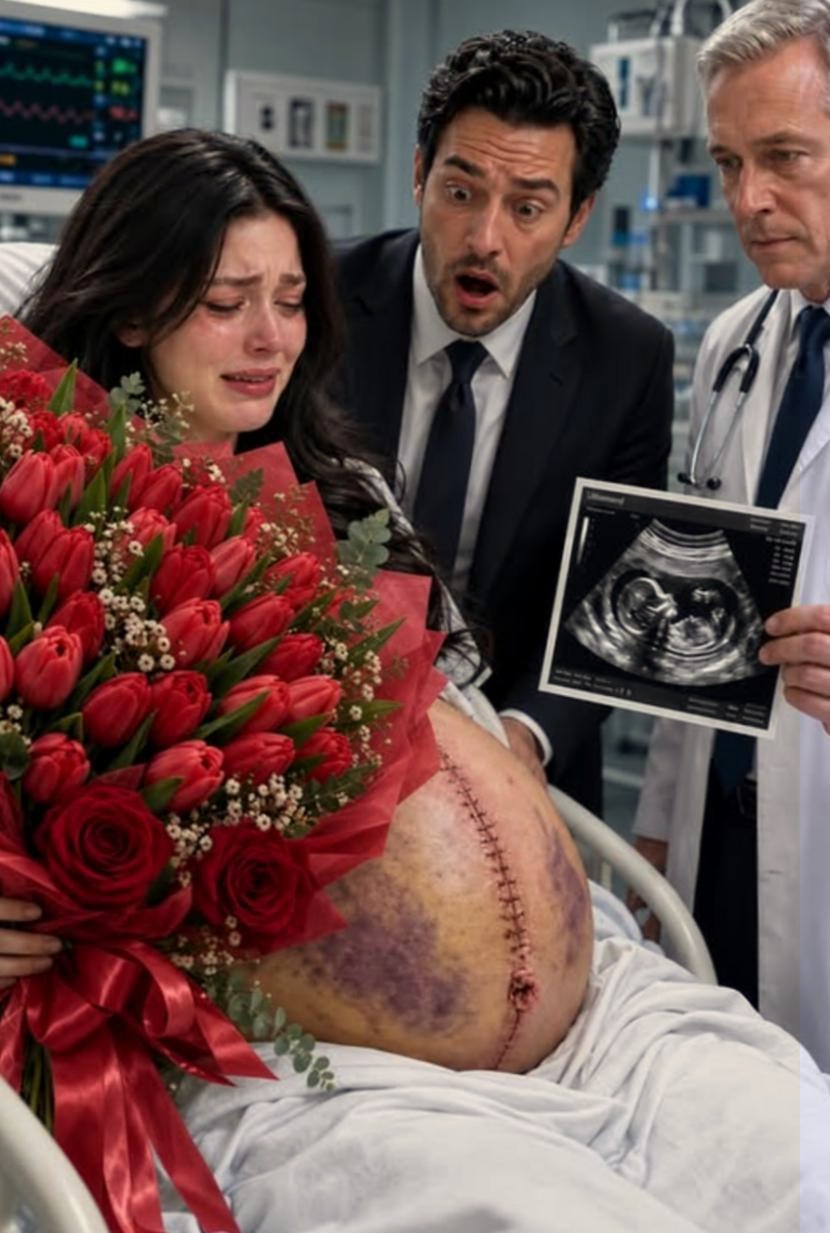

After Nora’s words, every sound in the room disappeared except for the heart monitor.
Flynn let the phone fall from his hand.
“This is a joke,” he said.
Nora picked up the phone and turned the screen toward us. The message contained only one sentence: “Mabel must know what happened on the night her father died.”
Flynn looked at Marcus.
“You cannot take her out of here.”
“I am not going anywhere,” I told him, although the pain in my stomach almost cut the words off.
Marcus called security. Two men entered and pushed Flynn and Selina toward the door.
“I am her husband!” Flynn shouted.
“Today that is no longer an advantage for you,” Marcus answered.
Selina stopped at the door.
“Mabel, you must not trust him. That man is destroying your family.”
“The two of you destroyed my family,” I told her. “I am only collecting the truth.”
Nora transferred the recording to three different devices. She sent one copy to a lawyer, the second to the police, and stored the third in a secure vault.

Flynn watched this and, for the first time, could do nothing.
Then his phone rang.
“Who is it?” he asked.
Nora answered:
“Your lawyer.”
Flynn answered the call.
“Dan, fix everything. Come immediately.”
His lawyer’s voice could be heard so clearly that everyone in the room heard it.
“Flynn, I can no longer defend you. I have already received the recording. And one more thing: the company’s board has called an emergency meeting.”
“You are my lawyer!”
“I was. Until I found out that you had planned all of this in advance.”
Flynn ended the call and sank into a chair.
I looked at his face, but I felt no revenge. Only emptiness. As if I were attending the funeral of the man I thought I loved.
The next day the police questioned me at the hospital. I placed the watch on the table. Dried blood could still be seen in the small cracks of the pink band.
“Are you ready to officially confirm the recording?” the investigator asked me.
“Yes.”
“Then it may seem difficult to hear your own husband’s voice.”
“I have already heard his voice when he thought I had died.”

Flynn and Selina were arrested that same evening. Until the last minute Selina repeated that she loved Flynn. Flynn, meanwhile, said that everything had been her idea. Both tried to use the other’s guilt for their own survival.
But the recording proved stronger than them.
Three weeks later, in the courtroom, Flynn heard his own voice from large speakers for the first time. The courtroom was full. Behind him sat members of the company’s board, and in front was me — with the doctor’s permission, still walking carefully.
The speakers sounded:
“I did it, Selina. Now we are free.”
Flynn lowered his head.
The judge asked:
“Is this your voice?”
He could not answer.
“Mr. Vance, shall I repeat the question?”
Flynn cleared his throat.
“Yes.”
That one word was heavier than all his shouting.
Selina immediately looked toward him.
“Tell them that you deceived me!”
“You came up with everything,” Flynn answered.
“You said that you killed her!”
The judge struck the gavel.
“Both of you be quiet.”
Then it became clear that my father’s death had not been natural. His doctor worked at Selina’s private clinic and filled out the death certificate with false data. My father’s trust would be transferred to Flynn only if I and my future children no longer existed. That was exactly why Selina and Flynn found a way for me to be slowly poisoned first, and then for everything to look like an attack.

They had not taken my watch into account.
They had not taken my silence into account either.
Flynn was sentenced to a long prison term, and Selina to less than him, because through a deal she gave up all the bank records and the doctor’s name. The company shares were confiscated, while my father’s property was transferred by the court into the children’s names.
I listened to this decision calmly in the courtroom.
It did not resemble victory.
It resembled more the opening of a room’s window where air had not entered for years.
Six months later the twins were born.
The first was a girl, slow and peaceful. The second was a boy, and he immediately began to cry, as if he had to prove his arrival to the world. I named them Lea and Noah — after the heroes of my parents’ favorite book.
Marcus came to the maternity ward holding a small wooden box.
“This belongs to your watch,” he told me.
The watch no longer worked. The screen remained broken, but the recording survived. I cleaned the pink band so that no trace of blood could be seen anymore.
“I will not turn this on again,” I said.
“Then why are you keeping it?”
“Because once it saved my life.”

Three months later I moved to a small coastal town. My father’s old house was waiting for me there, with white traces of salt on the windows and a lemon tree in the yard. My new job was as a legal assistant. At first, arranging court documents seemed difficult to me, but soon I realized that defending someone else’s truth resembled saving my own truth.
In the mornings I prepared Lea’s milk, while I could not take a wooden spoon away from Noah’s hand. In the evenings I sat the children on the floor and taught them how to draw the sun.
One winter, when the first snow began outside the window, Lea brought me a drawing. There were four figures on it: two small children, one woman, and a large sun.
“Who is this?” I asked.
“You,” she told me.
“Why are you the sun?”
Lea shrugged.
“Because you brought light into the house.”
That night I sat in the kitchen for a long time. The kettle was whistling again, as on that day, but this time the sound no longer frightened me.
Months later I received a letter from Flynn. There was a prison stamp on the envelope. He wrote that he regretted it, that he had been mistaken, that Selina had confused his mind, and that he wanted to see the children.
I read the letter to the end.
Then I put it in the drawer with the children’s drawings.
I did not send an answer.
A week later a second letter arrived. This time it contained only one sentence: “You cannot simply forget me like this.”

I was standing by the window when I read this. Snow was falling outside. Lea and Noah were laughing in the living room, building a tower with wooden blocks.
I picked up the phone and called Nora.
“Is he writing again?” she asked me.
“Yes.”
“Do you want us to request a restriction from the court?”
I pressed my forehead against the window.
“No. This time I will answer him myself.”
On the back of his letter I wrote only four words: “My life no longer belongs to you.”
Then I folded the paper and did not send it. I simply realized that I already had the answer — within myself.
I was still wearing the watch on my wrist. The pink band had been shortened because I could no longer find one of the links. The broken screen reflected the morning light and strangely resembled a small window.
That day I went down to the seashore with the children. Noah was burying his hands in the sand, while Lea was collecting shells.
“Mom, this is yours,” she told me and handed me the smallest shell.
I placed the shell beside the watch.
Then I checked my wrist.
The watch had stopped at the same minute when Flynn thought that my life had ended.
And I looked toward the sea, where a new day was beginning.
And for the first time I no longer wanted to turn back time.
Missed the beginning?
Related posts:
 The husband accused me because of his former lover and stabbed me twice, but one gesture from the doctor changed his face
 My Husband Stabbed Me Twice for His Lover, but One Sentence from a Doctor at the Hospital Drained the Color from Flynn’s Face
 On Our Honeymoon, My Husband Was Planning to Murder Me, but After One Call, the Smile Disappeared from His Face
 Part 4 — The husband accused me because of his former lover and stabbed me twice, but one gesture from the doctor changed his face
 My husband humiliated me in front of everyone on his birthday, but the moment I took the microphone, his smile disappeared
 Rowan seated a secretary in my place and told me, “Remember your place” — but he turned pale at the sight of my calm smile