
The phone froze in my hand.
Everyone in the hall was still looking at my face, but I could hear only the lawyer’s breathing.
“Where is this document?” I asked.
“In the bank archive. It has already been sent to the investigative department. If we do not obtain a court protection order today, you will be charged tomorrow morning.”
Preston saw my face and immediately understood that something had changed.
“What happened?”
I did not answer him.
His father quickly took the phone.
“All guests will leave the hall! Now!”
The men standing by the exits locked the doors.
“No one will leave until all the recordings are saved,” one of them said.
Preston’s mother came to me. Her old confidence was no longer visible on her face.
“Sophie, let’s settle this calmly.”
“You already settled it,” I replied. “You signed in my name.”

“It is just a technical matter.”
“A technical matter does not disappear in prison.”
Preston looked at his father.
“You used my signature too?”
“Be quiet,” his father roared.
“Answer me!”
“I was doing everything for you!”
“Not for me, for your debts!”
Their quarrel echoed through the hall. The forged contract, with my name on it, was still visible on the screen. The letters seemed to threaten me alive.
My mother placed her hand on my shoulder.
“Do not be afraid. This time you are not alone.”
“But they will use everything against me.”
“They cannot use the truth against you if we no longer intend to hide it.”
At ten at night the lawyer entered the hall. He held a black folder in his hand and had the expression I had seen before only on difficult days.

“Besides the marriage contract, we found an audio recording,” he said.
Preston’s father suddenly fell silent.
“What recording?” Preston asked.
The lawyer placed a small device on the table.
“A meeting that took place in the Veil office three weeks ago.”
He pressed the button.
First the sound of chairs was heard. Then Preston’s voice.
“Sophie will sign everything. Her mother’s money is her only way into our family.”
Someone in the hall held their breath.
Preston’s mother’s laughter sounded in the recording.
“If necessary, we will make the girl believe that she is helping her mother. After the wedding, control will be in our hands.”
Then Preston’s father’s voice was heard.
“The main thing is that she must never find out that the real owner of the company is her mother. Sophie is only a means of obtaining a signature.”

Preston lowered his head.
“That was not my recording,” he said.
I looked at him.
“But it was your voice.”
The voice I had heard as love for years now seemed to be the voice of another person.
The police came that same night, although they arrested no one. They took only the documents, the device, and the guests’ statements. The court protection order temporarily stopped the debts taken in my name. The next day the banks froze the Veil accounts.
Preston tried to stay with me.
“Sophie, I did not know everything.”
“You knew enough to drop money at my mother’s feet.”
“I loved you.”
“Maybe you loved me once. But love does not require humiliating a person.”

His lawyer called the next morning.
“In the interests of my client, we can no longer represent you in this case,” he told Preston’s father.
“I pay you!”
“You can no longer.”
For the first time I saw the Veil family lose control not through words, but through a quiet refusal.
Three days later, an interrogation room was arranged on the upper floor of our wedding hall. The people present were made to listen to the recording again. Preston sat at the back.
When his own voice was heard—“Sophie will sign everything”—he buried his head in his hands.
“Turn it off,” he said.
“No,” the investigator replied. “You said it. Now you must listen.”
For the first time Preston heard his own words the way I had heard them.
His face became gray.

When I returned to my mother’s office, I found my former bridal room empty. The white dress that should have been hanging on the chair lay on the floor. On the windowsill only one thing remained—a small pearl fallen from the light-blue dress sewn by my mother.
I picked it up.
My mother stood at the door.
“Is everything over?” she asked me.
“No,” I told her. “But now at least we decide how it will continue.”
The investigation lasted four months. It was established that the Veil companies had arranged two loans in my mother’s name and inserted the signatures into previously prepared wedding documents. Preston’s father was charged with financial fraud and document forgery. Preston’s mother chose to cooperate and testified before the court.
Preston received no sentence because he handed all correspondence over to the investigation. But this was not his victory. The wedding was canceled. His family removed him from its companies. The friends who had laughed that night no longer answered his calls.

I did not feel revenge.
Only exhaustion.
Six months later, together with my mother, we opened a small branch in Batumi. In the morning I made coffee for the employees, and in the evening I read new contracts. For the first time I was working on something that my family had built without lies.
Every Saturday my mother came to me. She still carried the same old leather bag that the Veil family had mocked. Now the bag held contracts, colored pencils, and my niece’s drawings.
One day little Luka gave me a drawing. Three people stood under the sun in it. Above them he had written in large letters: “Our home.”
“Why didn’t you draw a palace here?” I asked.
“Because home is where no one frightens you,” he answered.
His answer stayed in my heart.

When the first snow came, Preston finally wrote to me. It was only one sentence.
“If you ever can, I want to explain why I did this.”
I looked at the screen for a long time. Then I wrote a reply.
“I already understand. I do not need an explanation anymore.”
I sent the message and locked the phone.
My mother stood by the window. The old stitching was still visible on her worn bag, but beside it there was a small sun sign made with new, golden thread.
“Did you make this?” I asked.
“No,” she smiled at me. “Your life did this.”
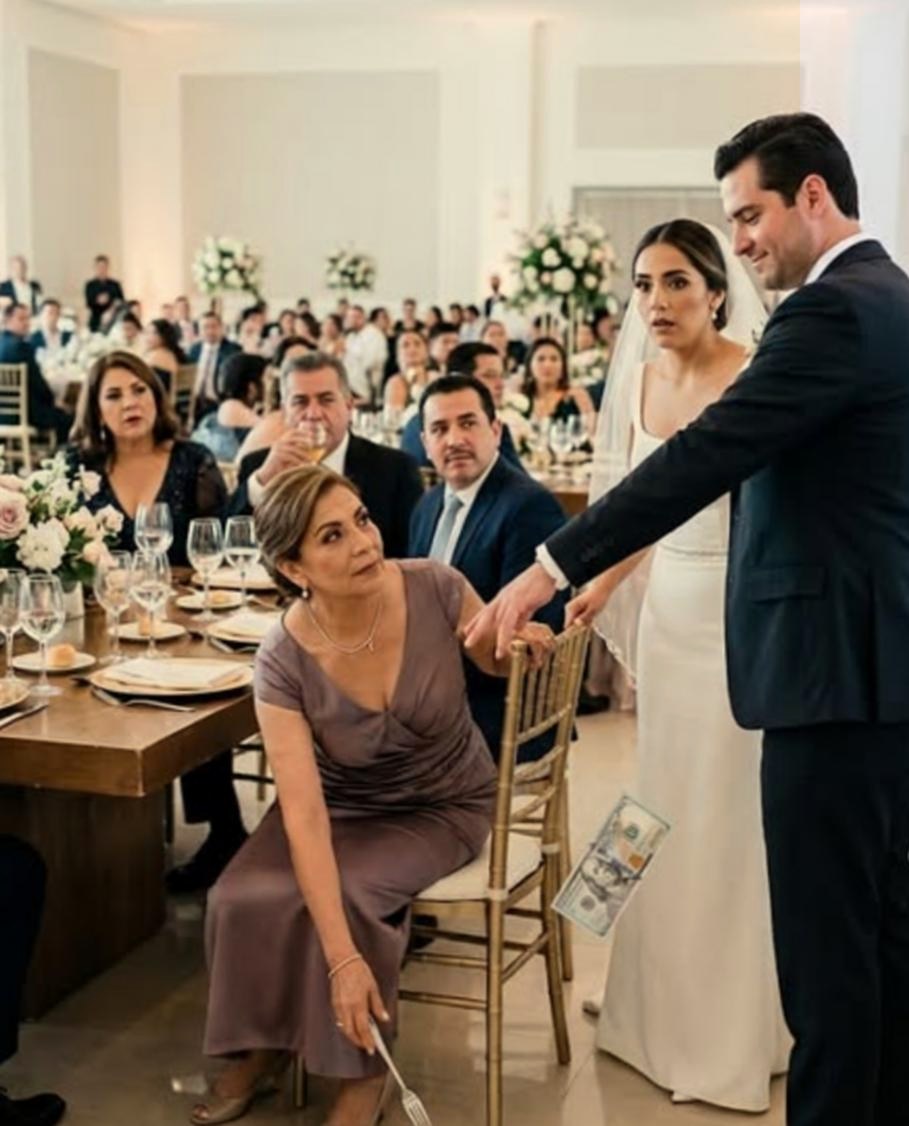
She took out the hundred-dollar bill that she had picked up from the floor on the wedding night. The money was still unspent.
“What will you do with it?” I asked.
My mother placed the bill on the table.
“I will put it in a frame. Not so that we remember that man. So that we never forget how cheaply they tried to buy our dignity.”

Outside the window, snow was falling quietly. The room smelled of coffee and new wood. Luka’s drawing hung on the wall, and my mother’s bag rested on the chair.
I was no longer the woman waiting to enter a rich family.
I was a woman who had opened her own door.
And when the snow covered that hundred-dollar bill in its frame, for the first time I exhaled with all my heart.
Our dignity was never for sale.
Missed the beginning?
Related posts:
 The husband took his lover to the diamond evening, but when I came down the stairs, the glass in his hand shook
 At my wedding, the groom dropped a hundred-dollar bill at my mother’s feet, but when the screen lit up, his smile disappeared
 My Spouse’s Family Mocked Me in Court When I Stood Without a Lawyer, but After My First Words My Father-in-Law Turned Pale
 Llevó a su amante a la gala más exclusiva, pero al verme bajar la escalera su sonrisa desapareció por completo
 My husband’s fiancée used my surname on her wedding invitation, but when I mentioned one stolen bracelet, his face went white
 Mi futuro cuñado me humilló delante de doscientos invitados y exigió que peleara, pero al verme descalza dejó de sonreír