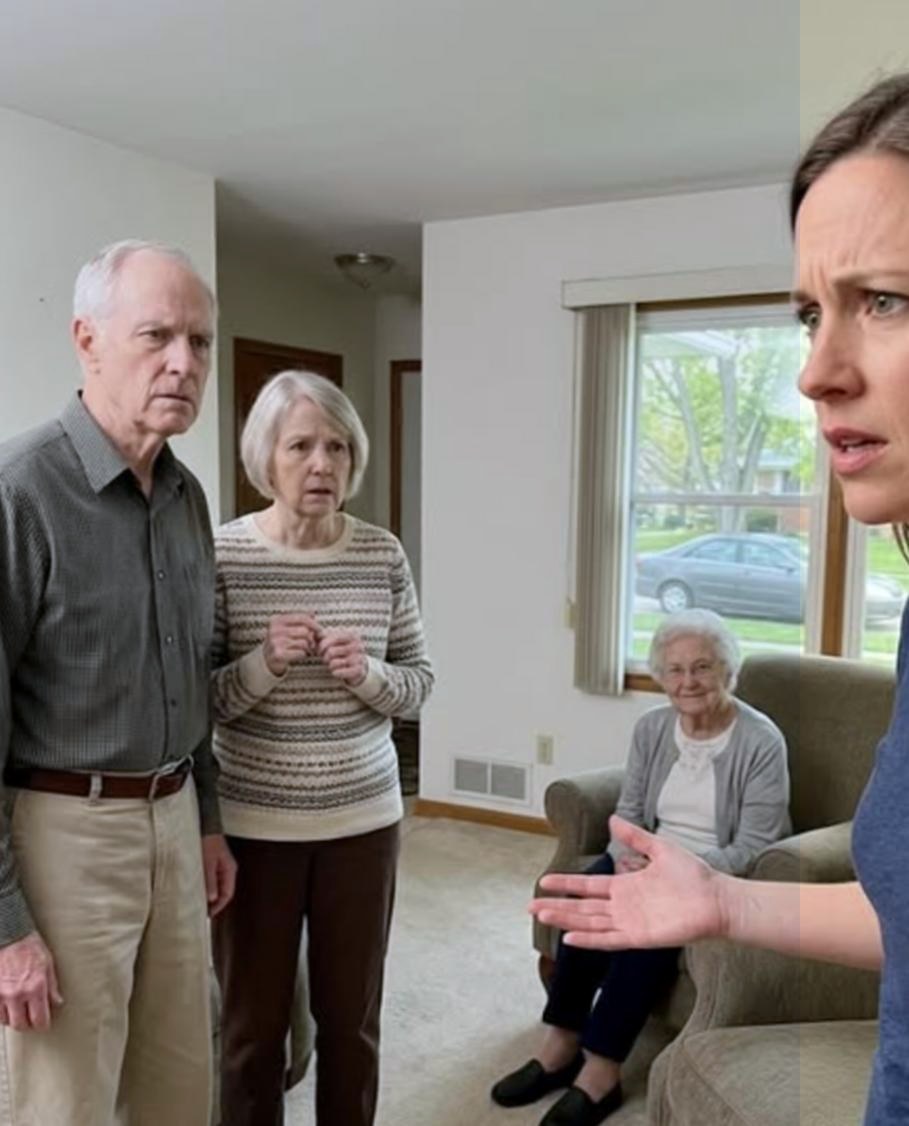

On the other end, the voice of a bank employee could be heard.
“Mr. Hayes, your accounts have been temporarily frozen.”
Father pressed the phone to his ear.
“You do not have the right to do this.”
“We have the appropriate request and a temporary court order.”
“This is my money!”
“The origin of the money entered into the account is being checked.”
Father ended the call and stood motionless for several seconds.
Mother went toward him.
“John, do something.”
It was the first time I heard her call him by his full name. It was as if this was no longer a family party, but a meeting of strangers.
“I will call the lawyer,” Father said.
He searched for a number on the phone and called.
“Robert, things have changed. My mother went to the police and they froze our accounts.”
He listened for several seconds.
“No, we had the right to sell the cello.”
He fell silent.
“What do you mean, you cannot defend me?”
Mother slowly approached.
Father switched the phone to speaker mode.
Everyone heard the lawyer’s voice.
“John, I have seen the documents. The deed of gift is very clear. I have also seen the recording and the preliminary conclusion of the handwriting examination.”
“You are my lawyer!”
“That is why I am telling you the truth. If I defend you in this case, it will only be if you immediately admit to the sale and present a plan for returning the money.”
“Are you threatening me?”
“No. I am telling you that I am withdrawing from this case.”
The call ended.

Father’s hand fell.
Mother immediately looked in my direction.
“Emily, you can make Grandma change her mind.”
“No.”
“We are your parents.”
“That is exactly why I trusted you.”
“A family should not fall apart because of a mistake.”
“This was not a mistake. You had six weeks to tell the truth.”
Father suddenly rushed toward me.
“You planned all of this!”
Grandma moved in front of me.
“One more step and I will call the police right now.”
Father stopped.
Behind him, Rachel’s children were no longer visible in the pool. Probably Mother had quietly taken them out. Only the sound of the water pump remained in the yard.
Andrew played the recording again.
This time everyone was forced to listen to it to the end.
My father’s voice, which I had always considered firm and convincing, sounded strangely small and selfish from the speaker.
“Lucy is little and will forget soon.”
Mother’s voice answered:
“Emily will not tell Grandma anything.”
Father lowered his eyes.
For the first time he heard his own words through someone else’s mouth.
The recording ended.
“Turn it off,” he said.
“Why?” I asked. “You want the truth to be on your side, don’t you?”
He had no answer.
That evening the police came to the house. No one was arrested. They only took the documents, sealed the pool contract, and explained to Father that until the investigation was finished he would not be able to sell the property.

The next day the collector brought the cello to the police station.
Lucy went with me.
The instrument lay in a wooden case. When the case was opened, the room filled with the smell of old rosin and warm wood. One small scratch had appeared on the surface of the cello, but its sound was still the same as I remembered.
Lucy drew the bow across the strings.
The first note trembled slightly.
The second was firmer.
Grandma sat in a chair and listened silently.
My father could not return part of the money. Construction of the pool stopped. The bank wrote off the remaining money from the frozen account, and my parents had to sell the house to cover the rest.
The court established that the sale of the cello was illegal and that the money belonged to Lucy. Rachel admitted that she had participated in finding the buyer. She was sentenced to community service and a fine.
Father received a suspended sentence because he had signed in someone else’s name and concealed the origin of the sale.
Mother did not look at me even once in the courtroom.
I was not happy about their punishment.
I simply no longer intended to save them from the consequences of their actions.
Three weeks later I entered the music room in my parents’ house.
The room was empty. On the wall there was only one pale rectangle left, where the cello stand had stood for years. Lucy’s small copper-colored bookmark lay on the windowsill.
I picked it up.
The scratched letters could still be seen on it.
L.
“Mom, shall we take it?” Lucy asked from the doorway.
“What?”
“The stand.”
“We need nothing here anymore.”
Lucy looked at the stand and shook her head.
“Then this place is no longer Grandma’s music room.”
“No,” I told her. “Now it is simply an empty room.”

Several months passed.
We moved to another city, into a small apartment from whose window the tram line could be seen in the morning. I began working in the administration of a concert hall. Every morning I got up at six, made Lucy breakfast, and checked the small box of rosin for her cello.
Lucy continued attending lessons.
Her teacher told me that her playing had changed.
“Now she no longer asks the instrument whether it is allowed to sound loudly,” he told me.
A new drawing hung on the wall in Lucy’s room. Grandma was drawn in it, holding a cello, under a blue sky. The pool did not appear in the drawing at all.
One morning the first snow came.
Lucy stood by the window and played a small passage on the cello. Snowflakes struck the glass. The sound spread softly through the room, and for the first time in a long while I was not afraid of anyone’s words.
That evening Father wrote to me.
“I want to talk to you. Let’s start everything over. I cannot remain without a family.”
I looked at the message for a long time.
Then I wrote back briefly:
“You did not lose your family. You sold trust. I will not go back.”
The next day another message arrived.
“Let us apologize to Lucy.”
I handed the phone to Lucy.
“Do you want to answer?”
She read it, then shook her head.
“No. I already know what he will say.”
“What?”
“That he was a good person, he just made a bad choice.”
Her answer squeezed my heart.
“What do you think?”
Lucy looked at the snow through the window.
“I think good people do not exchange children’s possessions for pools.”
I said nothing.

I only hugged her.
That same evening Grandma called us. Her voice was weak, but calm.
“Lucy, play me the passage you love the most.”
Lucy placed the cello between her knees.
Before she began playing, I saw the copper-colored bookmark beside the instrument. It was now attached to a small string so that it would not be lost again.
Lucy took the first note.
The sound scattered through the room.
I closed my eyes and imagined Grandma’s old music room, the empty wall, the stopped pool, and my father’s face at the moment when he heard his own words.
Then I opened my eyes.
Lucy was playing.
And this time no one could sell her voice.
The copper-colored bookmark swayed lightly on the strings.
Lucy’s music remained in the house.
Missed the beginning?
Related posts:
 My Parents Were Celebrating Selling Their Eleven-Year-Old Granddaughter’s Cello, but Grandma Opened a Folder and Father’s Face Changed
 They Took Grandma to Dinner and Abandoned Her in a Nursing Home, but Dad Suddenly Turned Pale When He Heard My Decision
 My eight-year-old son bought a red dress for Lucy, and in the morning unknown bags appeared in our yard and his face turned pale
 Part 4 — My eight-year-old son bought a red dress for Lucy, and in the morning unknown bags appeared in our yard and his face turned pale
 I left my job because my director ruined my life, but when she saw me with a suitcase at her door at night, her hands began to tremble
 I took my mother from the house, but when my brother opened her room with a duplicate key, the color drained from his face