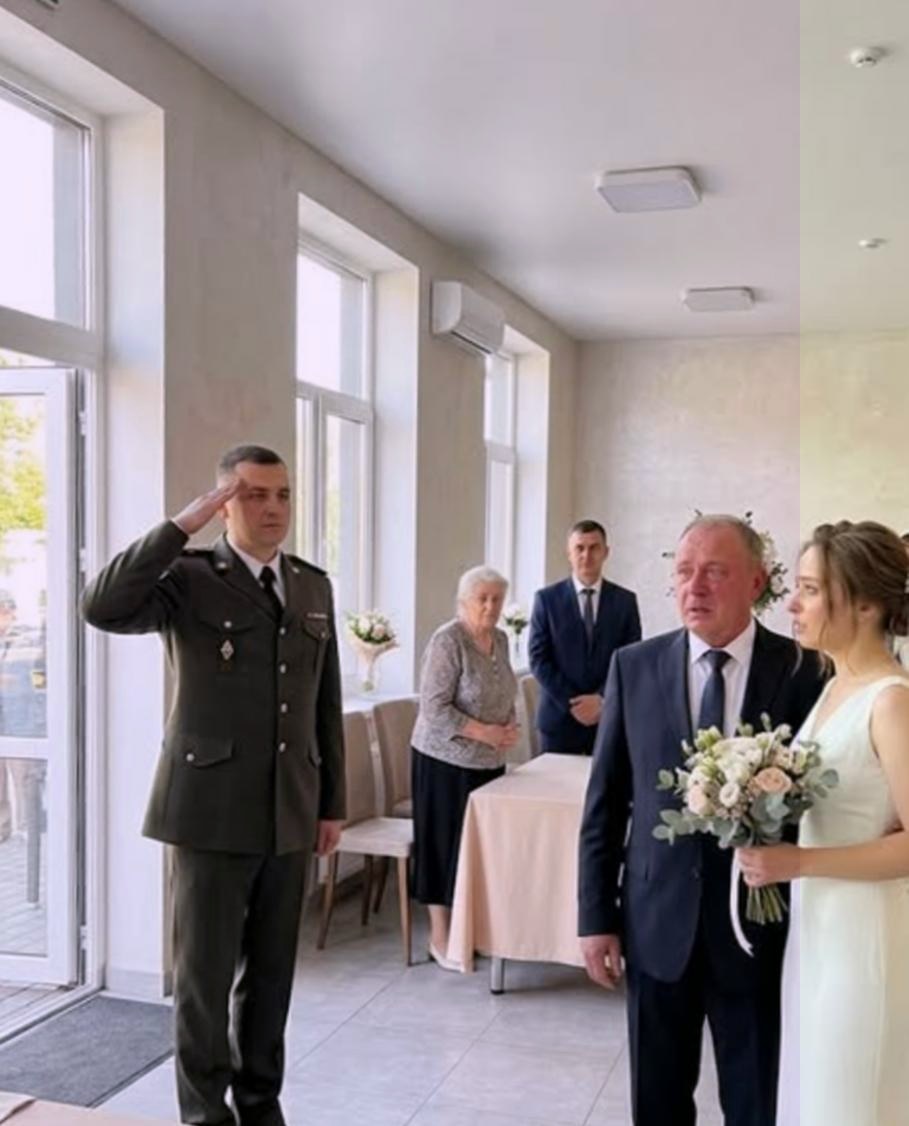

After Irakli’s words, my father moved so quickly that the man who had fallen to his knees a few minutes earlier was no longer visible.
“Where is the storage place?” I asked.
“By the old station,” Irakli answered.
Givi K’avtaradze took out his phone.
“I am calling my lawyer.”
“Call him,” Irakli said. “But first tell him that the investigation has already begun.”
Larisa rushed to Maxim.
“We must leave immediately.”
“You are going nowhere,” Irakli told her calmly.
Two military police officers stood behind him. They had not touched their weapons. There was no need.
Maxim looked at me again.
“Marisha, tell me that all this is a misunderstanding.”
“I cannot tell you something I no longer believe.”
“I loved you.”
“Perhaps. But you did not dare stand before your own family. Before me, however, you humiliated me very easily.”
Irakli placed his hand on my father’s shoulder.
“We must go now.”
My father looked around the hall one more time. Unopened dishes lay on the tables, the candles were half burned, and white flower petals were scattered across the floor.
“My daughter is coming with me,” he said.
“Not this time, Father,” I answered. “I am coming myself.”

When we arrived at the old station, we found the storage door open.
Inside, everything was upside down. Wooden boxes were broken, papers were scattered across the floor, and the iron cabinet was empty.
My father stopped at the cabinet.
“Your mother’s belongings were here.”
“The letter too?”
“The letter too.”
Irakli found a small memory device on the floor, although using it was no longer necessary. A red light blinked on a camera mounted in the corner.
“We have a recording,” he said.
The next day, at seven in the morning, we were all sitting in an investigative service room. Maxim’s family was being held in a separate room. A screen stood before me.
The recording began.
I heard my own voice in the hall.
“I will never marry a gardener’s daughter.”
I saw Maxim on the screen. His face, his finger pointing at my father, his mother’s smile.
Then I heard my own voice:
“You are my richest person.”
My father lowered his head.
Maxim looked at the screen and heard his own words from the outside for the first time. It was as though it were someone else’s voice, evil and cold.
“I do not speak like that,” he said.
“You were speaking,” the investigator answered.
“I was angry.”
“Anger did not force the words out of you. You thought them up.”
Maxim closed his eyes.

That same day investigators took documents from his father’s company. The old fraud case was reopened. The case of my mother’s death was also reopened.
Givi K’avtaradze was arrested. Before the court, Larisa told journalists that she knew nothing, but letters were found in her phone in which she called my father a “silent threat.”
Maxim changed his lawyer.
After two meetings, the new lawyer refused to defend him.
“You are asking me to hide the truth from them,” he told him. “I cannot do that.”
Maxim called me twenty-three times.
I did not answer the first call.
Nor the second.
On the twenty-fourth, I answered the phone.
“Marisha, please, just listen to me.”
“I am listening.”
“My father arranged everything. I did not know.”
“Perhaps you truly did not know. But you knew you were ashamed of my father.”
“You loved me too, didn’t you?”
“I loved you. That is why I did not notice how I was disappearing beside you.”
Silence fell.
“If you wait for me, I will explain everything.”
“I will not wait for you anymore.”
“Why?”
“Because my whole life I have been correcting the consequences of other people’s mistakes. Now, for the first time, I choose myself.”
I ended the call.

Several weeks later my father returned to the old storage place. Investigators found some of my mother’s belongings. The letter had been hidden elsewhere, in the double wall of an iron box.
My father could not read it alone.
I opened it.
Mother wrote that she did not think Father had run away. She knew that he would protect me. She wrote that if I ever read the letter, I must not live in fear.
My father stood by the window.
“Why did you never tell me that Mother had left a letter?”
“Because when even my last hope was lost, you were what remained.”
“Now you are both with me.”
He nodded, but tears still came to his eyes.
Three months later I changed cities.
I began working in a library in a town beside a small river. In the mornings I opened the windows, dusted the bookshelves, and read fairy tales to the children.
My father built a small greenhouse nearby. He still worked with the soil, but now under his own name. His first seedlings were tomatoes, basil, and white roses.
Every evening I walked home and saw him checking the plants.
Once a little girl whom I helped at the library gave me a drawing. In it, a woman in a white dress stood, and beside her was a tall man holding a small copper whistle.
“This is you and your father,” she told me. “But nobody is crying here.”
I attached the drawing to the refrigerator.

The first snow came at the end of December.
My father stood in the yard covering the seedlings. I brought him hot tea.
“Does your back not hurt anymore?” I asked.
“When I am happy, less.”
“That simply?”
“No. That difficultly.”
That evening I received a final letter from Maxim.
He wrote that he had testified against his father. He wrote that for the first time he understood what silence meant. At the end he asked to meet me, for only ten minutes.
I held the letter in my hands for a long time.
Then I wrote a reply.
“I am glad that you chose to tell the truth. But I am not going to return to your life. I want nothing from you. Neither revenge nor an apology. I simply ask you not to open my door again.”
No reply came.
In one week the court found Givi K’avtaradze guilty. The investigation into my mother’s death also continued. The truth could not return everything, but it took from us the fear in which we had lived for years.
At last my father took his military uniform out of the closet in his room. The medals were still attached to the uniform.
“I will not put it on,” he told me.
“Why?”
“Because for you I only want to be a father.”
“You are both.”
He smiled.
I had kept the white glove bought on the wedding day for a long time. The silver leaf near the wrist had darkened slightly. One morning I hung it by the greenhouse door, beside my father’s copper whistle.
When the wind blew, the two lightly touched each other.
Then I understood that my life had not ended at the altar. There only ended what looked like love, but demanded constant humiliation from me.
My father closed the greenhouse door.
“Will you come home?”
“Yes.”
It was snowing outside.
The copper whistle sounded once in the wind, very quietly.
This time nobody hid.
Missed the beginning?
Related posts:
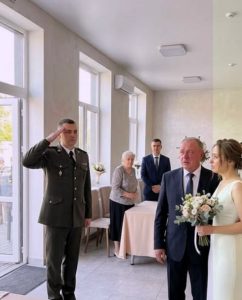 At the altar, the groom insulted my father, but the commander who entered the hall looked at his family and froze
 My husband demanded a share of my inherited apartment, but when his mother pointed at the deed, his confident smile vanished
 Soțul meu a cerut divorțul în fața mamei lui, iar răspunsul meu liniștit a făcut-o să-și piardă zâmbetul
 My Father Was Fed by a Poor Woman at Night, but When I Followed Her Trail, a Stranger’s Face Suddenly Turned Pale
 After My Husband’s and Daughter’s Funeral, My Mother Asked Me for the Insurance Money, but the Bag on My Table Suddenly Erased Her Smile
 I took my mother from the house, but when my brother opened her room with a duplicate key, the color drained from his face