
Slava’s face appeared on the screen.
He entered my study at two o’clock at night, although that night he told me he had stayed at a friend’s.
In the video he carefully closed the door, took a key out of his pocket, and went to my drawer.
Inna was covering the camera’s angle.
“Quickly,” she whispered. “If she finds out anything, everything will fall apart.”
“Don’t worry,” Slava replied. “In the end she will still believe me. For years I have given her everything.”
I was looking at the screen and, for the first time, heard my husband’s voice the way others heard it.
Not as the voice of a man who forgot promises because of tiredness.
Not as the voice of a husband who wanted peace in the family.
But as the voice of a person who considered my patience a weakness.
In the video he took a sheet out of the folder and photographed it.
“The forged signature is ready,” Inna said. “Tomorrow we will let the buyer in.”
“Where will we take Oksana?”
“You tell her to go away for a few days to rest. Then the door will already belong to someone else.”
My fingers went cold.
Marina turned off the recording.

“We will officially hand the rest over to the appropriate authorities in the morning.”
Inna collapsed onto a chair. Her towel fell onto the floor.
“Slava could not have done this,” she said.
“He is speaking himself in the video,” I said.
“I was only helping!”
“Whom?”
She could not find an answer.
The phone came to life again. This time Slava was calling repeatedly. I answered on the fifth call.
“Oksana, listen to me. I only helped Inna because I thought the apartment should belong to both of us.”
“Mother left the apartment to me.”
“You are my wife. We are one family.”
“In a family, a person is not thrown off a bed with dirty boots, and their signature is not forged.”
“If you go to the police, everything will fall apart for us.”
“You have already destroyed my life. I am simply seeing the ruins for the first time now.”
He held his breath.
“Open the door for me. I need to come home.”
“No.”
“Oksana, I am your husband.”
“That is exactly why I trusted you.”
I ended the call.

At nine in the morning two investigators and the district inspector came. Nino poured tea, but none of them drank it. Mother’s letter, the forged power of attorney, and the memory card lay on the table.
Inna tried to appear calm.
“It is all a misunderstanding,” she repeated.
The inspector turned on the recording.
Slava’s voice sounded in the room again: “In the end she will still believe me. For years I have given her everything.”
Inna listened to her own words as well.
“Where will we take Oksana?”
Something collapsed on her face.
“Did I say that?” she whispered.
No one answered.
Slava came at noon. He stood in the doorway, holding a small bag. He probably thought he would return home and I would calm down, as always.
But the inspector was already standing beside the door.
“Mr. Slava, we have several questions for you.”
He looked toward me.
“Oksana, tell them this is not your wish.”
I answered calmly:
“This is the result of your decision.”
That same day my lawyer called me. She told me that the power of attorney would be declared invalid, the attempt to sell the apartment had been stopped, and a case had been opened against Slava and Inna.
But the hardest part was still ahead.

In the evening, when Inna left with the investigators, I went into the bedroom. The muddy bedspread still lay on the bed. On the pillow lay the little dried crumb of earth that had fallen from her boot.
I ran my hand over the wooden case of the sewing machine.
Then I noticed that the small metal lock on the back wall was open.
Mother’s letter had said nothing about this case.
Inside there was only one folded paper, with one sentence written on it: “If it has come this far, you will understand why you must not trust any signature that Slava does not make before your eyes.”
On the other side of the paper, in Mother’s handwriting, were a place, a date, and one surname I had never heard.
The next morning I went to that address.
An elderly man was waiting for me in a small legal archive. When he saw my mother’s surname, he looked at me silently for a long time.
“Are you her daughter?”
“Yes.”
“Then you must know that your mother saved one thing many years ago. Not only for you.”
He opened a cabinet and took out a thick folder.
Slava’s father’s name was written on the folder.
“These are financial records,” the man told me. “Your mother discovered that your husband’s family had been taking possession of other people’s apartments by forging documents. She left testimony, but did not manage to continue the case.”
“Why did she not tell me?”
“Probably so that the danger would not reach you.”
At that moment everything connected into one line: Inna’s arrival, her taking control of my room, the missing folder, the threat, and Slava’s calm certainty that in the end I would still give in.
Even after death, Mother had tried to protect me.


The legal process lasted several months. I had to listen to the same video many times in the courtroom. Each time Slava avoided my eyes.
One day the judge played the recording again.
“For years I have given her everything.”
Slava lowered his head.
This time he understood for the first time that these words said everything not about me, but about him.
The lawyer stopped cooperating with him because Slava tried to hide several documents. Inna had to move out of the apartment, and a separate investigation began against her. In the end, the case of the forged documents was proven, the right to sell the apartment was canceled, and the court imposed punishment on both of them.
I did not perceive this as a celebration.
I felt relief only once—when the lock was officially changed and I held the new key in my hand.
Slava still tried to return.
First he sent me a letter through a lawyer.
“We can start again.”
I folded the letter and put it in the trash can.

Then he came himself.
It happened three months later, on a cold February evening. Thin frost patterns had appeared on the windows, while in the kitchen the new kettle quietly boiled water.
When he knocked on the door, I already knew who it would be.
I opened it, but did not let him beyond the threshold.
“How are you?” he asked.
“At peace.”
He looked behind me.
“Is everything still the same?”
“No. Now everything is in its place.”
“Oksana, I made a mistake.”
“You did not make one mistake. You made many decisions when you thought I could do nothing.”
“Inna confused me.”
“You are an adult man. Do not blame someone else for your own signature.”
His face became tired.
“Do you still love me?”
I had thought about the answer to this question for a long time.
“Maybe I loved you once. But now I take better care of myself.”
He lowered his head and left.
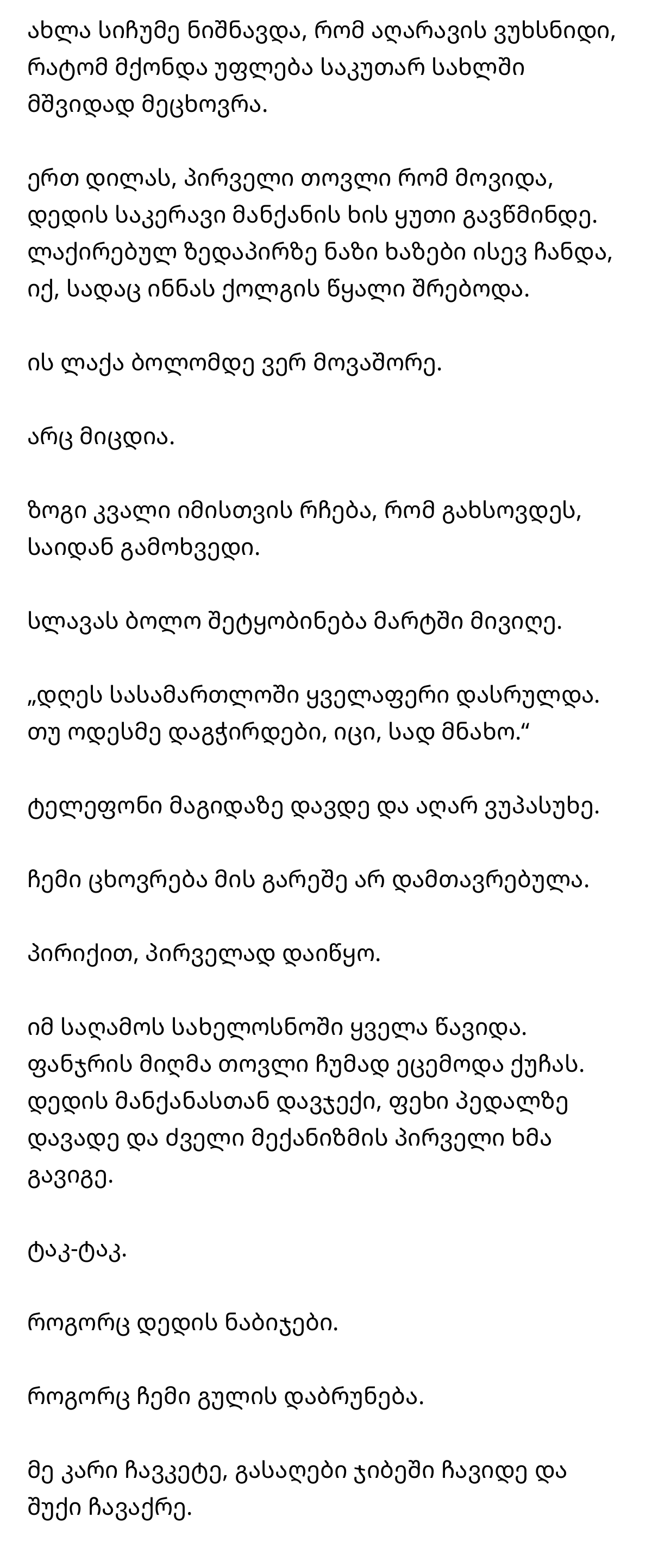


Several weeks later I turned the living room into a small workshop. The neighboring women came twice a week, and I taught them to use Mother’s sewing machine. Sometimes children came in too. Nino’s grandson, Luka, drew houses on colored paper.
One day he gave me a drawing.
“This is your house,” he told me. “Here the door is big, so bad people cannot come in.”
I smiled.
“You drew a good door.”
“Did you make it yourself?”
“No, Luka. Mother left me a key. I only understood late how to use it.”
The apartment changed. I spread a new bedspread in the bedroom. In the bathroom my things were again on their own shelf. I put a pot of basil by the kitchen window, and in the morning, before going to work, I always touched several leaves.
Most of all, the silence changed.
Before, silence meant that I was swallowing something.
Now silence meant that I no longer explained to anyone why I had the right to live peacefully in my own home.
One morning, when the first snow came, I cleaned the wooden case of Mother’s sewing machine. Gentle lines were still visible on the lacquered surface, where the water from Inna’s umbrella had dried.
I could not remove that stain completely.
I did not even try.
Some traces remain so that you remember where you came from.
I received Slava’s last message in March.
“Everything ended in court today. If you ever need me, you know where to find me.”
I put the phone on the table and did not answer.
My life did not end without him.
On the contrary, it began for the first time.
That evening everyone left the workshop. Outside the window snow was quietly falling on the street. I sat down at Mother’s machine, put my foot on the pedal, and heard the first sound of the old mechanism.
Tap-tap.
Like Mother’s steps.
Like the return of my heart.
I locked the door, put the key in my pocket, and turned off the light.
The house was mine again.
This time, truly.
Missed the beginning?
Related posts:
 She lay on my bed with dirty boots, and when I returned, the smile suddenly disappeared from her face
 I took my mother from the house, but when my brother opened her room with a duplicate key, the color drained from his face
 A Flat Tire Stopped Me at a Desert Diner, but When the Waitress Heard My Name, the Color Drained from Her Face
 I always protested leaving three children for free, but after my calm answer Sloan’s smile suddenly disappeared
 When They Considered Taking My Mother to the Doctor Humiliating, the Color Drained from My Husband’s Face and a Heavy Silence Fell over the Room
 The Meat My Mother Sent Was Being Saved by My Husband for His Mother-in-Law, but When He Opened the Refrigerator, His Face Suddenly Turned Pale