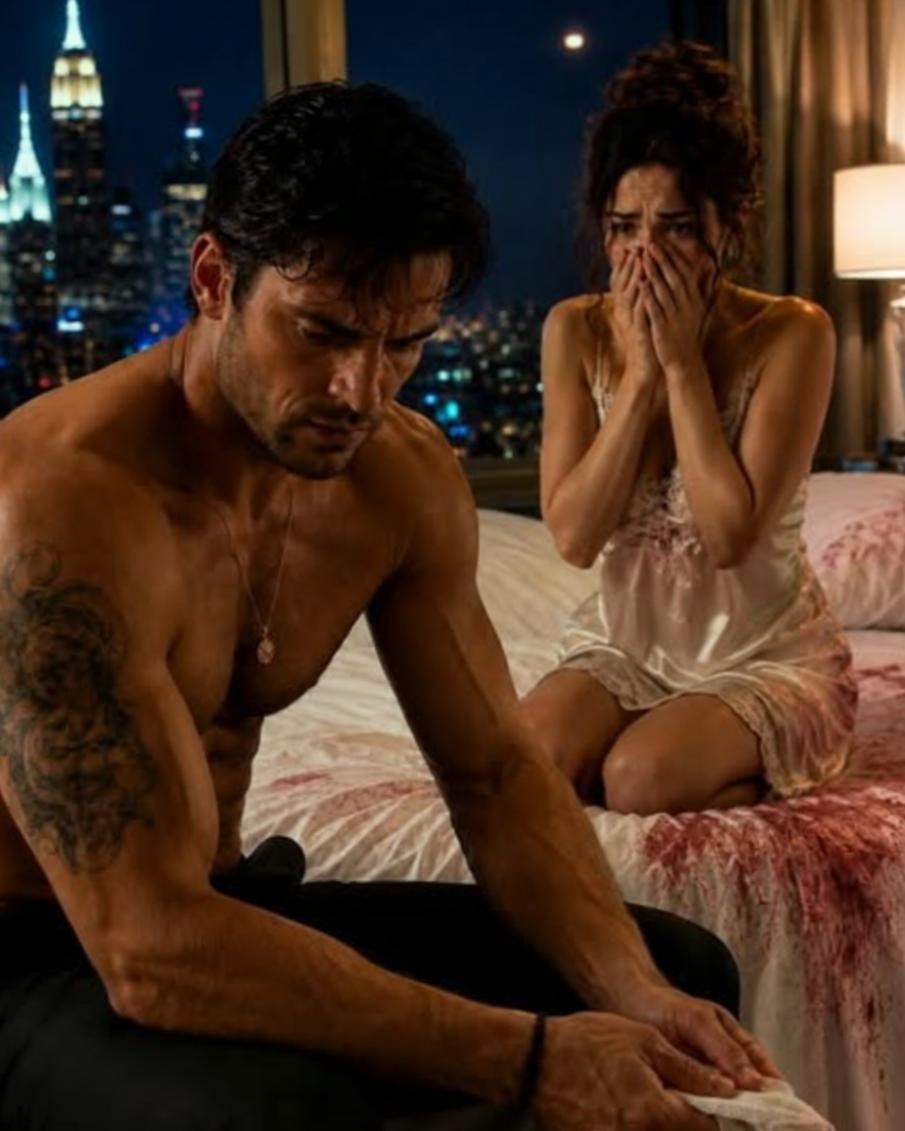

For several seconds after Elene’s last words, none of us dared to move.
Then everything happened at once.
There was another knock at the door. This time the wooden surface creaked. Sofia jumped, and I put the voice recorder into the inner pocket of my jacket.
“The back stairs,” I said.
“They will be there too.”
“Then we have to reach them before they do.”
The telephone came to life again. An unfamiliar man called instead of the head of security.
“Luka Vitali,” he said. “Your father advises you not to perform pointless heroics.”
“Tell him that on my wedding night I no longer take advice.”
“Sofia Bellucci must return to us.”
When Sofia heard this, her face tightened.
“Why?” I asked.
“Because her brother’s case is not finished yet.”
“It is finished. You simply do not know how.”
I hung up.
Sofia pulled a small bag out from under the bed. There were only an apartment key, two passports, and her mother’s old sewing scissors inside.
“Why did you bring this?” I asked.
“Mother told me that if I needed to escape, I should leave nothing behind that would lead them to me.”
“We are not going to escape now.”
“Then what are we going to do?”
“Bring the truth out of the room where they hid it for six years.”
The back door was behind the bathroom cabinet. Only members of my family knew about it. When I opened the door, we entered a narrow service corridor. There was a smell of dust and washing powder. Far away, the elevator motor hummed.
We went down to the third floor, then to the underground parking garage. My driver, Niko, was waiting for us beside an old truck. His shirt collar was torn.
“The others?” I asked.
“Killed or fled. Your father’s men have taken over the entire hotel.”
“Why did you stay?”
Niko looked at Sofia.
“Because once before I was late to save your brother.”
Sofia stopped.
“You were there?”
Niko lowered his head.
“I was. Daniel asked me to go to Luka, but I was afraid of Vito.”
That confession was written on his face. For the first time I understood how many people carried the burden of that night.

We went toward the harbor. It was four o’clock in the morning. The city streets seemed almost empty, although at every corner I expected my father’s cars.
Elene met us in an abandoned warehouse at the harbor. She was holding a small wooden box.
“I took this from the safe,” she said.
“The letter?”
“And something else.”
Daniel’s watch lay in the box. The glass of the watch was cracked, and its hands had stopped at twelve minutes past four.
Under it lay a folded letter.
“Luka, if you are reading this, Father has already made you believe that my death was the Belluccis’ fault. Do not seek revenge. Seek the place where the money is hidden. There you will find all the names.”
Along with the letter there was a bank statement. For six years, every month the same amount was transferred from Vito’s fund to a private clinic, under a name that did not belong to Sofia.
Elene lowered her eyes.
“This is your mother’s treatment account.”
Sofia let go of the box.
“Mother died two years ago.”
“The clinic records do not say that,” Elene said. “They indicate that she is still alive. And last night she was taken away from there.”
Sofia leaned against the wall.
“My father hid my mother alive from me?”
“Probably so that you would obey,” I said.
At that moment, a message arrived on my phone.
“If you want to see your mother, come alone to the old church. Bring the recording. If you inform the police, she will not wake up in the morning.”
Sofia read the message and shook her head.
“You will not go alone.”
“This is very dangerous.”
“At the wedding I already went to the person I had feared all my life. Now I will go to the person who created this fear.”

We arrived at the old church at half past five in the morning. The door was half-open. Candles were burning inside, although the temple seemed empty.
Then Vito came out from behind the altar.
He was holding a gun.
“The recording,” he said.
“First Sofia’s mother.”
“You were always too emotional, Luka.”
“And you always thought that fear meant loyalty.”
Vito smiled.
“Your brother also thought that truth was power.”
Sofia stepped forward once.
“Where is my mother?”
“Alive. For now.”
“Why did you sacrifice me?”
For the first time fatigue appeared on Vito’s face.
“Because Bellucci blood had to remain in the Vitali house. The wedding was not for peace. It was an inheritance contract. If you died, all the Belluccis’ wealth would pass into my hands.”
Elene later explained to us that a copy of the contract had already been secretly sent to the prosecutor’s office. But at that moment I thought of only one thing: Sofia stood beside me, unprotected, although she was no longer trembling.
“You killed my brother,” I said to Vito.
“I protected you.”
“No. You protected your own throne.”

Vito’s hand raised the gun slightly.
At that moment all the doors of the church opened at once. Police, federal investigators, and two wounded but living men from the Bellucci family entered inside.
Elene looked at Vito.
“Your conversation has already been recorded.”
Vito’s face became gray.
“Luka, you could not have done this.”
“I did nothing. For the first time I simply did not protect you anymore.”
The gun fell onto the floor.
Vito fell to his knees when they put handcuffs on him. He looked toward me as if expecting that in the end I would change my mind after all.
I did not change my mind.
That same day we found Sofia’s mother in the clinic. She was weak, but alive. When the woman saw Sofia, they embraced one another as if they were returning the lost years with their hands.
Sofia told her mother only one thing:
“Now we are going home.”
Three days later I returned to the hotel room of our wedding.
The bed had already been changed. There was no trace of blood left on the white sheet. But near the floor, behind the curtain, I found the towel with which I had wrapped the wound. Its edge had hardened and the dark red stain had become like stone.
Sofia stood at the door.
“You can throw it away,” she told me.
“Not yet.”
“Why?”
“Because it reminds me how we began.”
“And I want to remember how we ended.”
She held out her hand to me. This time she did not flinch when I touched her fingers.

Five months later, all the charges against Vito were proven in court. Marcos testified and had his sentence reduced, but Sofia refused to meet him. Niko got a new job at my company and was able to visit Daniel’s grave without fear for the first time.
And I closed the old business.
Instead of the harbor, I opened a small transport company in Brooklyn. I got up early in the morning, brewed coffee myself, and memorized the employees’ names. I no longer carried a gun. I kept only Daniel’s cracked watch in the drawer of my desk.
Sofia settled nearby with her mother. She came to me three times a week. Sometimes we sat silently for hours. This silence was no longer a threat.
One morning, during the first snow, Sofia brought me a little girl—her niece, Emma. The child drew four people on a sheet of paper: herself, Sofia, Sofia’s mother, and me.
“Who is this?” I asked, pointing to my little figure.
“The one who no longer closes the door,” Emma answered.
Sofia smiled. I smiled too, although something broke inside my heart.
That evening a letter from Vito’s lawyer arrived for me. It said that my father was asking for a meeting and intended to fix everything.
Sofia looked at the letter.
“Will you answer?”
“Yes.”
“What will you tell him?”
I turned the sheet over and wrote only one sentence:
“There is no home left for you to return to.”
Then I tore up the letter.
Sofia exhaled calmly.
The towel was no longer lying on the windowsill. I washed the red stain with water, but it did not disappear completely. In the end I cut it out into a small square and kept it beside Daniel’s watch.
Not as a sign of guilt.
But in memory of the night when the man everyone called a monster chose, for the first time, not to let anyone be broken.
Sofia took my hand.
This time we were both calm.
I left the door open.
Missed the beginning?
Related posts:
 At the Wedding They Mocked My Autistic Son, and I Stopped the Music — Dante Moretti’s Face Suddenly Turned Pale
 In a Forced Marriage, My New Wife Whispered Four Words, and When She Saw My Blood, Her Face Changed
 The son left his granddaughter alone in the storm, but when I learned the real reason for the cruise, the smile disappeared from his face
 Part 4 — I Agreed to Carry the Mafia Boss’s Son to Save My Father’s Life, but After the Birth His Plea Took My Breath Away
 I sang every night at her mother’s bedside, but when the girl appeared at the hospital, her first words froze me
 My husband gave flowers to his former lover, and I left the hall — behind the cameras, his smile disappeared