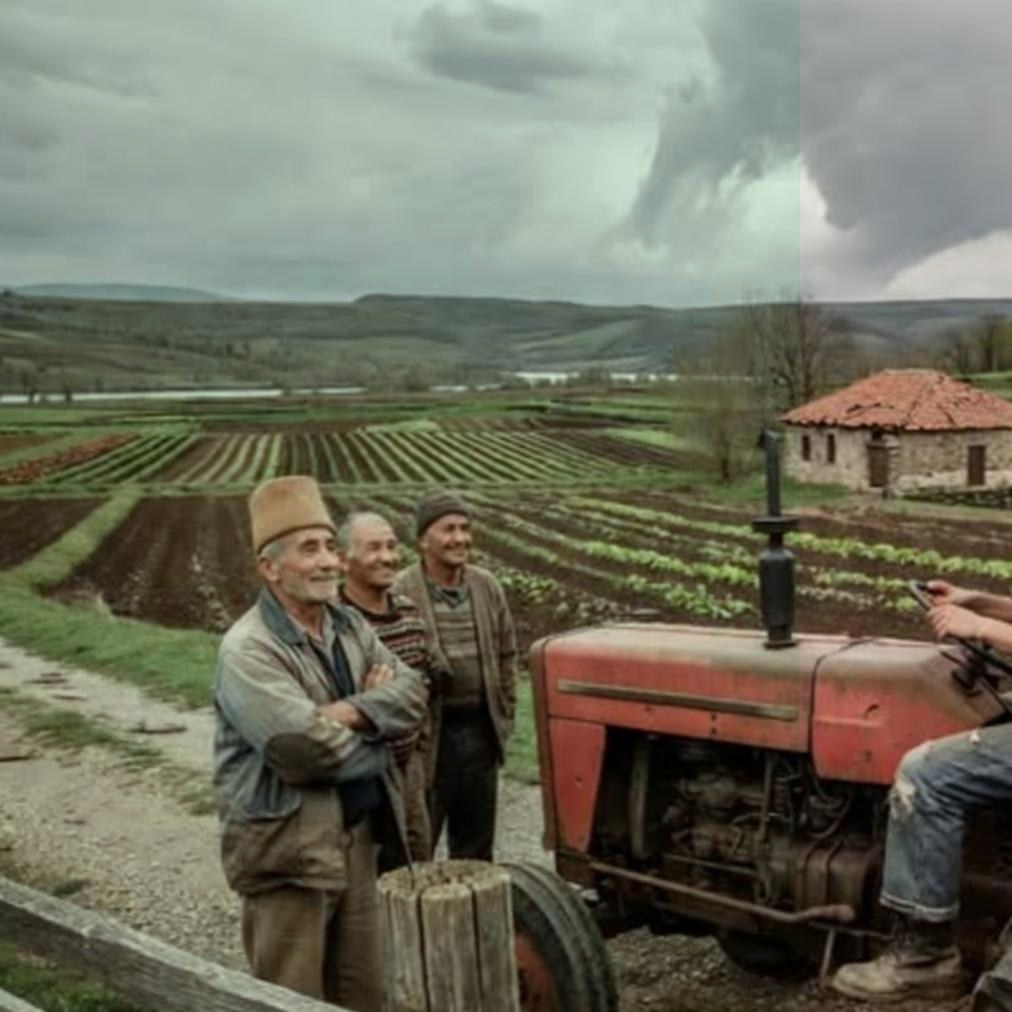
Buck’s trucks stood in the river’s path, and the water was already striking their tires.
June called emergency services once again.
“We are going to open the South Gate,” she said. “If you do not let us through, the village will flood.”
In response we heard only one phrase:
“Open the gate. Now.”
I pressed the lever with both hands.
The iron did not move at first. My hands began to tremble. My father’s jacket sleeves still covered my wrists, and the smell of peppermint came into my nose.
“One more time, Ellie,” June told me.
I pressed.
The lever roared and the gate hidden under the ground opened.
At first the water entered the channel with a whisper. Then it rushed down with all its force. The black river spread across forty-eight acres, burned the grass, shook the soil, and went around Buck’s trucks.
In ten minutes the southern field became like an enormous lake.
But the village did not flood.
The first streets of Willow Bend waited for a wall of water, but the wall never came. The water settled in the natural basin, exactly as Dad had calculated.
But Buck’s trucks got stuck in the middle of the road.
Law enforcement arrived in boats. With them were inspectors from the state environmental agency, who already knew the file sent by June.
Buck got out of the vehicle. His white hat had become heavy with water.
“This girl illegally trespassed on my land!” he shouted.
The inspector took a document in his hand.
“This land was never yours. It is a natural protected zone.”
“You do not know who you are talking to.”
“We do,” June said. “And we know what you did.”
They showed Buck my father’s video.
Buck looked at the screen. His own voice could be heard there:
“When the rain comes, this land will be worth the price of garbage.”
He shook his head.
“This is edited.”
Tucker, who was standing several meters away, had gone pale.
“Dad, I only moved the trucks.”
“Shut up,” Buck told him.
“You told me the channel was safe.”
“I said shut up!”
For the first time Tucker looked at his father as if he were a stranger.
Then the inspector took out a second document. They found Buck’s signature in the bank’s case files. The hidden clause in the contract that gave him the right to buy the land cheaply after a flood was considered part of an illegal scheme.
The bank manager called June and said that the farm seizure process had been suspended.
Buck’s lawyer said only one sentence over the phone:
“I can no longer defend you in this case.”
Buck dropped the phone from his hand.
The next day, at six in the morning, he was arrested at the district office not because he had lost the farm, but because the false documents, illegal dumping of earth, and deliberate alteration of the water flow had been proven.
I did not go to the first hearing at court. June told me that my presence there was not necessary.
“You have already done what was hardest,” she told me.
“What?”
“You did not let him turn your fear into his weapon.”
Several weeks later an official hearing was held. This time I stood in the courtroom. Buck sat two chairs away from me, but for the first time he looked small. The shiny folder no longer lay in front of him. He was not wearing his hat either.
The prosecutor played the audio recording.
Buck’s voice sounded in the courtroom again.
“When the rain comes, this land will be worth the price of garbage.”
Everyone heard it.
Including Buck.
He rubbed his hand over his face. As if he could not believe that he himself had said those words. That was the hardest thing for him—not that others had heard, but that he could no longer escape his own voice.
The judge ordered him to pay money, the costs of restoring the land, and banned him for several years from participating in district land management. Tucker was assigned community service because he had brought the trucks to the river channel, but his cooperation with the investigation was taken into account.
The farm remained with us.
The bank made a new schedule for paying the debt. The state provided a grant for restoring the southern lowland. June reduced her night shifts and, for the first time in many months, slept fully at home.
What hurt me most was the empty shed.
The red tractor no longer stood there. There was no compressor, no tools, and no workbench covered with Dad’s oil stains. But I had kept the small metal plate removed from the steering wheel—“Lot fourteen.”
Every evening I placed it on the windowsill together with my father’s copper key.
Three months later new grass grew in the southern field. The water slowly went down. The village children watched birds there, while June put up a small sign: “Hart Protective Meadow.”
One morning, when the first snow came, I received a letter from an old friend of my mother. Buck was writing to me from prison.
“I want to talk to you. I need your help. My family has fallen apart.”
I held the letter in my hand for a long time.
June did not ask me anything.
“You’re not going to answer?” she said at last.
“No.”
“Why?”
I looked at the snow through the window.
“Because I should not be the one to save him from the consequences again.”
After several seconds I folded the letter and put it in a drawer. I did not tear it up. I did not need to destroy it to prove that I was free.
Months later we began new work on the farm. We planted oats on the upper fields, placed beehives in the meadow, and never again drove heavy machinery across the southern lowland. Children returning from school helped me measure the water level.
One evening a little neighbor girl brought me a drawing. In the drawing there was a large green field, a small house behind it, and a yellow sun in the sky.
“This is you,” she told me.
“Why didn’t you draw me on a tractor?”
“Because you listen to the land.”
I smiled.
That was exactly what Dad used to tell me. Machines talk, he said. People do too. It is just that sometimes the truth brings out the voice of people only when everything is collapsing.
That winter we slowly filled the shed. The neighbor gave the compressor back to us. The builder returned the welding machine to us for half price. Some people brought tools too.
“We owed your father a debt,” one of them told me.
I nodded.
“Now we are paying it together.”
On the morning of the first spring I went alone to the southern lowland. Dew glittered on the grass. The river flowed calmly. I still held that old copper key in my hand.
I took the metal plate out of my pocket—“Lot fourteen”—and attached it to a small wooden board. Right there, on the new fence, I hung the key.
The wind moved the plate slightly.
I was no longer wearing my father’s jacket. It hung in the upstairs room, washed, but still full of the smell of peppermint and cedar.
I stood in the middle of the meadow and for the first time was not afraid that someone would come to take everything away.
The South Gate remained open.
And the land began to breathe.
Missed the beginning?
Related posts:
 They Mocked Me at the Auction of My Father’s Farm When I Left the Land Unplowed — But Buck Could Not Silence the Meadow by the River’s Roar
 Man lachte, als ich das beste Feld meines Vaters unberührt ließ – bis der Bürgermeister beim Anblick des Flusses plötzlich verstummte
 Sie verspotteten mich, weil ich das beste Feld nicht pflügte – dann verstummte die ganze Stadt, als mein Onkel zum Fluss blickte
 Seven Months After the Divorce, My Ex-Wife Called Me From the Maternity Ward, But I Froze When I Heard Her First Words
 When I Rudely Answered a Woman Who Came to Work at the Workshop, One Look from Her Turned My Life Upside Down
 I jokingly called the woman asking for a job my wife, but one question from her silenced every voice in the office





