
The line went dead, and in the kitchen it seemed that all the clocks stopped at once.
Roman held the phone in his hand. The time of the last call was blinking on the screen.
“My brother is there,” I said.
“Maybe.”
“And if it is a trap?”
“Then that is exactly where we must go.”
Niko shook his head.
“Boss, you cannot go alone.”
“I am not going alone.”
Roman looked toward me.
At that moment, for the first time I did not see the mafia boss in him. I saw a man who was afraid of losing one more beloved person.
“Sedi, you will walk behind me. You will do what I tell you.”
“If Eli is there, I will go to him.”
“This is not a request.”
“Then give me a reason to trust you for the first time.”
Niko looked awkwardly at them both. Roman looked at me for a long time.
“Because I will need your brother alive if I want to defeat Marco.”
The answer was not enough, but it was honest. I pushed my wet hair back, put on my shoes, and ran toward the small room.

Everything in my room was as I had left it: a narrow bed, a cheap wardrobe leaning against the wall, and a yellow curtain hanging on the window. Only one thing had changed.
My mattress was raised.
Where my old notebook had lain, only a straight strip of dust remained.
“They were here,” I said.
Roman stopped on the threshold. His gaze fell on a small silver-colored clasp lying on the floor.
“Marco’s people.”
“Were the records here?”
“No. Only a key was supposed to be in your room.”
“What key?”
Roman took a small copper key from his pocket. Its head was round, and three digits were written on it: 3103.
“This is the second part of the code hidden in the flower’s base.”
“Then why didn’t you tell me?”
“Because I did not know whom I could trust.”
“Do you know now?”
Roman looked into my eyes.
“Now I know whom I will lose if I remain silent again.”
The old station warehouse was in the northern part of the city. At four in the morning, the rain began again. Water ran down the car windows in thick streaks, while the streetlights looked like broken gold.
Roman sat at the wheel. I sat beside him, and Niko in the back.
“Do not tell me that everything will be all right,” I said.
“I won’t.”
“Then what will you tell me?”
“That we will bring Eli back.”
“And if Marco is waiting there?”
Roman gripped the wheel more tightly.
“Then for the first time I will demand an answer from everyone before them all.”
“You are not going to kill him?”
“No.”
His answer surprised me.
“Why?”
“Because your brother needs doctors. My father’s death does not need another corpse. It needs the truth.”

The warehouse door was half open. Inside, one lamp swung and drew a yellow arc on the ceiling.
“Stay in the car,” Roman told me.
“No.”
“Sedi.”
“My brother is there.”
Roman exhaled. Then he handed me his black coat.
“Then put this on.”
“I do not need your protection.”
“I know. But I still want you not to get cold.”
It was the strangest thing he had ever said to me.
Inside, Eli was tied to a chair. He had a scratch on his face, but his eyes were open. Marco stood behind him, holding a gun.
“At last,” he said. “My nephew has come.”
Roman stepped forward several paces.
“Let Eli go.”
“The key first.”
Roman raised the copper key.
“The records are already with me.”
Marco smiled.
“No, Roman. The records are not with you, but in court.”
The doors on the right opened at the same time. Police officers entered with their weapons raised. My breath caught.
Marco looked at Roman.
“You brought them yourself.”
“No,” I said.
Everyone looked toward me.
“I brought them.”
Roman looked at me quickly, but it was already too late. I took a small recorder from my coat pocket.
With Toby’s help it had been left for me. The call, the threats—everything had been recorded. We only needed time to reach the police.
Marco’s face changed.
“You are a little servant.”
“No,” I answered. “I simply thought for too long that keeping silent meant survival.”

The police handcuffed Marco. Roman went to Eli and untied the ropes. I hugged my brother; his breathing was warm and real.
At that same moment, an investigator passed by Roman.
“Costa, your lawyer is already waiting for you. The investigation into your father’s case has officially been reopened.”
Roman stopped.
“Will you arrest me too?”
“Not yet. The recording says you did not know about your father’s murder. But we have many other matters to clarify.”
Roman nodded.
“I will be here.”
He did not run away.
That was the first sign that everything had changed.
The following days filled with calls, interrogations, and closed doors. Roman’s lawyer refused to defend him on the very first morning.
“I will no longer hide your crimes,” he told him. “If you want the truth, you must first tell it yourself.”
Roman put down the phone and stood by the window for a long time.
Marco’s people were arrested. The accounts were frozen. The Costas’ empire collapsed in one week like a damp wall.
And every morning Roman entered the same office where the locked drawers had once stood. Now investigators worked there.
One evening he turned on my recorder.
His own voice sounded in the room:
“If you tell anyone that you took these flowers, they will kill you first and then him.”
Roman sat on the chair and listened to himself. On the recording his voice was cold, cruel, and certain, as if a human life were an ordinary thing.
I stood at the door.
“Turn it off,” I said.
“No.”
“Why?”
“Because for the first time I hear what my fear sounds like in someone else’s ears.”

He buried his head in his hands.
“I thought protection meant frightening everyone.”
“You frightened everyone.”
“I know.”
It was the first time he had not made excuses for himself.
A month later the Costas’ house was almost empty. The security boys left. The servants found other jobs. The office doors remained open.
In my old room I left only one thing: the bent yellow curtain that no longer covered the window.
On the bed I saw a small piece of paper. It was Eli’s drawing. Four people stood under the sun: me, Eli, Toby, and another tall man holding a pink flower.
“Did you draw Roman?” I asked.
Eli shrugged.
“He isn’t bad anymore.”
“Will he always be good?”
“If he tries himself.”
Several weeks later I left the city. I moved into a small apartment where trees could be seen from the kitchen window and the whole house did not wake when the door was locked.
I began working at Toby’s bakery. The smell of bread woke me in the morning, and in the evening there were fresh flowers on my windowsill. Carnations no longer frightened me.
Roman called me once a week, but mostly asked only about Eli. He really went to the police and told everything: the routes of the money, Marco’s orders, the night of his father’s murder. He no longer tried to save his empire.
Three months later he came out of the courthouse. His case was not yet finished, but he was free on the day he came to me.
In the evening he stood at the door, holding a small brown paper bag.
“Are they flowers?” I asked.
“No. Bread.”
I smiled for the first time.
“Are you checking this with jealousy too?”
“I am not checking anything anymore. I only brought it.”
He put the bag by the door.
“I want you to come back.”
“Where?”
“Home.”
I looked at him carefully.
“It is no longer your home, Roman.”
He nodded silently.
“I know.”
“And I am not going back there.”
Pain appeared in his eyes, but this time I did not force anything. He neither squeezed my hand nor gave an order.
“Maybe someday?” he asked.
“Maybe someday only if you no longer call me someone who should return. I am already here.”
Roman understood this.
“Goodbye, Sedi.”
“Goodbye.”
He left.

That night Eli sat in my kitchen doing his mathematics homework. Pink carnations still stood on the windowsill. One stem had bent slightly and left a shadow in the water.
I carefully straightened it with scissors.
Then I opened the window.
The first snow was falling outside. White flakes swirled around the streetlamps, and for the first time in my life the sound of snow did not resemble a locked door.
Eli raised his head.
“Sedi, was Roman a bad man?”
I was silent for a while.
“He did bad things.”
“Is he a good man now?”
“Now he is trying to become better. That is more difficult.”
Eli turned back to his notebook.
“Will you go back to him?”
“No.”
“Why?”
I looked at the carnation on the windowsill.
“Because love is not when you turn someone’s fear into your own life.”
In the evening Roman’s message arrived on my phone.
“Today I told everything in court. I am not asking you to return. I simply wanted you to know that, in the end, I managed to tell the truth.”
I looked at the screen for a long time.
Then I wrote only one word:
“Good.”
I did not add, “I missed you.”
I did not write, “Come.”
Sometimes a quiet refusal is the kindest thing a person can give to those whom they once constantly saved from the consequences of their own guilt.
I put the phone down. Eli was finishing his homework. Bread was baking in the oven. And by the window stood that one bent carnation that had once changed the entire dark house.
This time no one asked me who had given me the flowers.
I had bought them myself.
Missed the beginning?
Related posts:
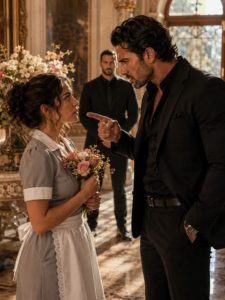 The Pink Flowers Found in My Room Made the Mafia Boss Furious, but Then I Saw Something Strange on His Face
 On Christmas Eve, my husband embraced another woman, and in the morning an attorney was left speechless by my actions
 When a Pregnant Woman at a Gala Barely Touched the Glass to Her Lips, the Strongest Man Suddenly Turned Pale
 Llegué a mi primer día con un cambio que hizo murmurar a todos, pero al verme Roman Vettery dejó de sonreír
Am fost trimisă în camera de oaspeți în luna a opta, iar când am ridicat geanta, Roman a încetat să zâmbească
Llegué a mi primer día con un cambio que hizo murmurar a todos, pero al verme Roman Vettery dejó de sonreír
Am fost trimisă în camera de oaspeți în luna a opta, iar când am ridicat geanta, Roman a încetat să zâmbească
 Karácsony este a férjem elhagyott egy másik nő miatt, de amikor visszatért, a mosolya hirtelen eltűnt